Nichols College students explore historic Black Tavern site with new ground-penetrating radar
November 16, 2026
Nichols College archaeology students are using new ground-penetrating radar (GPR) technology to search for foundations of buildings that once stood near the historic Black Tavern in Dudley.
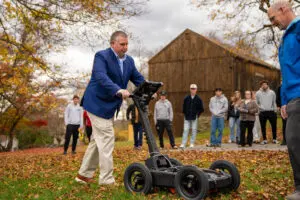
On Nov. 9, students in an introduction to archaeology course taught by Associate Professor of Environmental Science Joseph Mitchell, Ph.D., RPA, measured a survey grid and collected data with GPR equipment, which uses radar signals to detect features beneath the ground’s surface. Representatives from Webster First Federal Credit Union, including President and CEO John Thomasian ’08, a Nichols alumnus, visited campus to observe the technology demonstration.
A $10,000 contribution from Webster First helped fund the equipment purchase, alongside support from the Janet Malser Humanities Trust, a Nichols College Faculty Innovation Grant and other donors.
Mitchell and Associate Professor of Criminal Justice Boyd Brown began investigating the Black Tavern site in 2020, a site Mitchell uses in conjunction with his archeology course. An experiential course, students learn how to survey, dig and recover artifacts—and now, use GPR technology.
Mainly through “shovel tests,” or digging shallow holes, faculty and student efforts at the site have uncovered thousands of artifacts. These include prehistoric Native American stone tools dating back approximately 1,500 years, as well as historic-period (circa mid-1600s to present) pottery fragments, glass and nails associated with Dudley Hill and the community that included the Black Tavern. Other finds include a pewter whistle made in Sheffield, England; floral porcelain made in Vienna, Austria; and a knife handle/bolster. The Nov. 9 activity had students use GPR on the spot they previously surveyed via shovel tests.
In the late 1800s, Dudley Hill was home to houses, a general store, a chapel and other buildings near the Black Tavern, which itself served travelers. Since accurate maps of these former structures are limited, Mitchell hopes the GPR data will help them identify the locations and depths of buried foundations and other features, potentially guiding future excavations.
“Having this GPR is great for both our research and teaching,” said Mitchell. “It’s one thing to discuss archaeology and its methods in the classroom, but actually being able to go outside and apply them in the field gives students a much better understanding and appreciation of how things work; this is especially true with tools like GPR,” Mitchell said.
Madi Packard ’29, a communications major and psychology minor who helped measure the survey area and collect data that day, said the experience challenged her expectations about what GPR data would look like.
“In movies and TV shows, there’s often a dramatic depiction where the GPR shows this instant, perfect image of what’s there. But really, the process is more complex than that. A lot of the work comes from analyzing data afterwards, so being able to see how it works in real time and learning to kind of be patient with that data, it’s really helpful,” she said.
Webster First President and CEO John Thomasian ’08, who grew up in the area and attended Nichols, reflected on his college years while visiting students during the GPR field activity. He welcomed the opportunity for Webster First to strengthen its connection with Nichols and support students.
“I had a lot of great days on the Hill here,” Thomasian told the class during the demonstration. “It’s nice coming back.”
Beyond archaeology, Mitchell and Brown plan to use the equipment in forensic science coursework, including exercises involving mock burials. Mitchell also plans to work with Assistant Professor of Environmental Science Prajjwal Panday, Ph.D., this summer to build on their previously published environmental research and use GPR to map the bottom of Webster Lake and measure sediment thickness.
Spectrum News also visited campus to see the ground-penetrating radar in action and speak with students, faculty and Webster First representatives. You can watch the coverage here.
(Pictured in top story photo: Associate Professor of Environmental Science Joseph Mitchell, Ph.D., RPA, demonstrates the new ground-penetrating radar equipment to students near the historic Black Tavern on Nov. 9.)
About Nichols College
Nichols College has earned business accreditation from the prestigious Association to Advance Collegiate Schools of Business (AACSB International), the longest serving global accrediting body for business schools and the largest business education network connecting learners, educators, and businesses worldwide. Founded in 1815, Nichols College transforms today’s students into tomorrow’s leaders through a dynamic, career-focused business and professional education. Nichols offers real-world learning focused on professional depth – combined with vibrant living, competitive athletics, and an unmatched alumni advantage – equipping students to exceed their own expectations. To learn more about Nichols College, visit www.nichols.edu.
