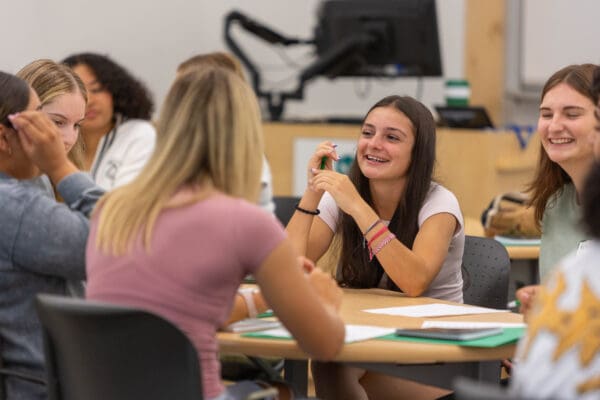
Prospective students laugh and engage in small group discussion during a LEAP Day visit on the Nichols College campus.

Political Science Minor

at Nichols College

Gain a deeper understanding of government, policy and civic institutions with a minor in political science at Nichols College.

This flexible minor complements your business education by developing critical thinking and analytical reasoning skills.

Whether you’re majoring in business, communication, economics or another field, adding this minor sharpens your understanding of how political decisions impact industries, markets and organizations.

Students with a minor in political science gain expertise applicable to careers in public administration, law, business, campaign management, diplomacy, journalism and nonprofit organizations.
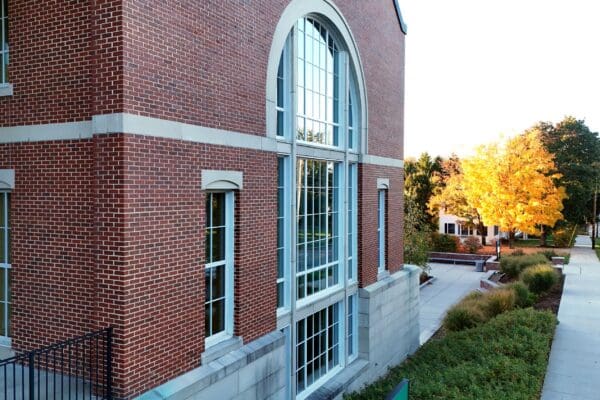
Close-up exterior of a Nichols College brick building with a large arched window, with a vibrant yellow fall foliage tree visible along the campus sidewalk

Sample courses:

Introduction to Political Science

This course provides an introduction to methods and concepts in the study of political science with special emphasis on each of the major sub-fields, including political theory, American politics, comparative politics and international relations. It will encourage empirical and critical thinking about the structure and quality of American democracy and emphasize pathways to engaged citizenship and civic leadership.

Business, Government & Regulation

Businesses do not operate in a vacuum; what they do has an impact on their shareholders, their employees, their customers, the communities in which they operate, the nation and even the world. This course examines the relationship between business and society, and the important role that government plays in mediating that relationship.

American Foreign Policy

This course will chart the ascendance of the United States from a regional power in the late-nineteenth century to a global superpower in the present. We will examine the expansion of U.S. political, economic, and cultural influence – including the ideological foundations that have been used to justify such expansion – and assess its consequences. We will begin by looking at the United States in the 1890s, a decade when it acquired overseas colonies (a key marker of “world power” status), and conclude by looking at contemporary foreign-policy concerns.

Political Science Minor Requirements

A student pursuing a minor in political science must complete Introduction to Political Science and three courses from those listed below. The student must submit a Declaration of Minor form, available online through the Registrar's page on the Nichols HUB.

Required Course

This course provides an introduction to methods and concepts in the study of political science with special emphasis on each of the major sub-fields, including political theory, American politics, comparative politics, and international relations. It will encourage empirical and critical thinking about the structure and quality of American democracy, and emphasize pathways to engaged citizenship and civic leadership.
Three additional courses to be selected from:

The United States Constitution is the operating manual of our government. This course examines how the criminal justice system is underpinned by that great document. Since the United States Constitution determines the processes and definitions of Criminal and Social Justice in our society, it is necessary to study the history and origins of applicable legal doctrines as they relate to the practices of today's criminal justice system. We will utilize court cases involving the constitutionality of the administration of justice. We will examine these topics in a layered approach incorporating legal, empirical, and policy implementations. Ethical, procedural, and political issues will also be examined and debated.

We expect a lot from our presidents. Americans look to the person in the Oval Office to have a bold vision for our country's future and effectively deal with a whole host of issues such as the economy, education, the environment, foreign affairs, and more. As one political scientist has put it, "Everybody now expects the [person] inside the White House to do something about everything." Why do we have such high expectations and are they realistic? This course investigates how the presidency has evolved, especially during the past century. We will examine its constitutional origins and the historical factors that have helped expand its power and influence. We will explore what concepts like "charisma" and "character" mean and the part they have played in choosing presidents. Through case studies, we will look at examples of "effective" and "ineffective" chief executives and see if history teaching us lessons that can be applied today.

Businesses do not operate in a vacuum; what they do has an impact on their shareholders, their employees, their customers, the communities in which they operate, the nation, and even the world. This course examines the relationship between business and society, and the important role that government plays in mediating that relationship. It examines the concept of corporate responsibility and how that idea has evolved, as well as notions of business ethics. The course looks at the constitutional foundations of the American government, how Washington has developed its powers to regulate business, especially since the early-20th century, and how the business world tries to influence the political environment. Finally, the course looks in-depth at specific topics in the business-government-society relationship: consumerism, worker rights, civil rights and diversity, corporate governance, and consumer protection.

This course will chart the ascendance of the United States from a regional power in the late-nineteenth century to a global superpower in the present. We will examine the expansion of U.S. political, economic, and cultural influence - including the ideological foundations that have been used to justify such expansion - and assess its consequences. We will begin by looking at the United States in the 1890s, a decade when it acquired overseas colonies (a key marker of "world power" status), and conclude by looking at contemporary foreign-policy concerns.

This course will examine the relationship between media and politics in U.S. history since the dawn of the 20th century. The development of media - basically, any form of mass communication from newspapers and magazines to radio, television, and the internet - has deeply affected the ways in which ideas have been expressed and manipulated over the years. Our course will assess the use and effectiveness of various media during times of strife or crisis. We also will consider the role of the press, particularly in how it has shaped political issues and to what extent its role has appreciably changed over time.

No description available.

Ready to Expand Your Impact?

The political science minor at Nichols College in Dudley, MA, offers the perfect complement to your major. Contact your academic advisor to learn more about adding this flexible minor to your academic plan. To learn more about Nichols, check out upcoming visit opportunities or contact our admissions team.