
Nichols College students engage in a small group discussion around a table with laptops during a class on campus.

Legal Studies Minor

at Nichols College

Build legal reasoning and regulatory knowledge with a minor in legal studies at Nichols College. This focused minor complements your business education by developing understanding of legal principles, contracts, compliance and the legal frameworks that govern business operations.

Whether you're majoring in business, criminal justice, accounting or another field, adding this minor enhances your ability to navigate legal issues, understand regulatory requirements and make informed decisions in legally complex environments.

Students with a legal studies minor gain expertise applicable to careers in corporate compliance, contract management, human resources, risk management, law enforcement, and as strong preparation for law school.
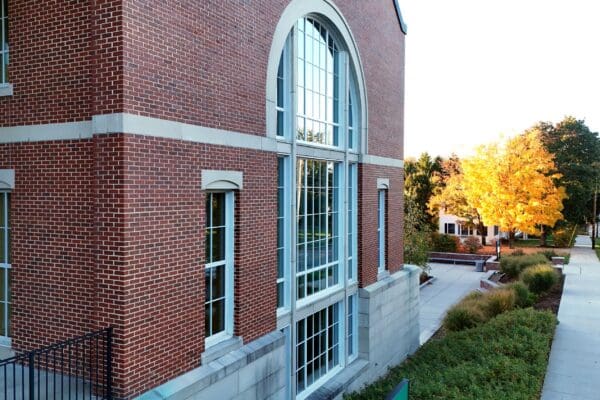
Close-up exterior of a Nichols College brick building with a large arched window, with a vibrant yellow fall foliage tree visible along the campus sidewalk

Sample courses:

Criminal Law & Procedure

This course will provide an in-depth examination of the crimes and actions most encountered by the private industry and the public law enforcement officer. We will also examine recent court decisions. Students will become acquainted with concepts of search and seizure, individual restraint, and limitations of personal freedom and expression.

Advanced Legal Studies

Modern legal practice requires both broad and nuanced understanding of the law. Effective legal professionals must be able to develop strategy, research, evaluate, interpret and incorporate critical thinking into their work. This course mixes lecture with practice and students will gain hands-on experience with drafting and developing legal arguments and honing their oral advocacy skills.

Constitutional Law

The United States Constitution is the operating manual of our government. This course examines how the criminal justice system is underpinned by that great document. Since the United States Constitution determines the processes and definitions of Criminal and Social Justice in our society, it is necessary to study the history and origins of applicable legal doctrines as they relate to the practices of today’s criminal justice system. We will utilize court cases involving the constitutionality of the administration of justice. We will examine these topics in a layered approach incorporating legal, empirical, and policy implementations. Ethical, procedural, and political issues will also be examined and debated.

Legal Studies Minor Requirements

A student pursuing a minor in legal studies must complete four courses from those listed below. The student must submit a Declaration of Minor form, available online through the Registrar's page on the Nichols HUB.

Required Courses

Businesses do not operate in a vacuum; what they do has an impact on their shareholders, their employees, their customers, the communities in which they operate, the nation, and even the world. This course examines the relationship between business and society, and the important role that government plays in mediating that relationship. It examines the concept of corporate responsibility and how that idea has evolved, as well as notions of business ethics. The course looks at the constitutional foundations of the American government, how Washington has developed its powers to regulate business, especially since the early-20th century, and how the business world tries to influence the political environment. Finally, the course looks in-depth at specific topics in the business-government-society relationship: consumerism, worker rights, civil rights and diversity, corporate governance, and consumer protection.

Modern legal practice requires both broad and nuanced understanding of the law. Effective legal professionals must be able to develop strategy, research, evaluate, interpret and incorporate critical thinking into their work. This course teaches students to be effective advocates by building on their legal foundation. It will mix lecture with practice and students will gain hands-on experience with drafting and developing legal arguments, and honing their oral advocacy skills.
Two additional courses to be selected from:

This course will provide an in-depth examination of the crimes and actions most encountered by the private industry and the public law enforcement officer. We will also examine recent court decisions. Students will become acquainted with concepts of search and seizure, individual restraint, and limitations of personal freedom and expression.

The United States Constitution is the operating manual of our government. This course examines how the criminal justice system is underpinned by that great document. Since the United States Constitution determines the processes and definitions of Criminal and Social Justice in our society, it is necessary to study the history and origins of applicable legal doctrines as they relate to the practices of today's criminal justice system. We will utilize court cases involving the constitutionality of the administration of justice. We will examine these topics in a layered approach incorporating legal, empirical, and policy implementations. Ethical, procedural, and political issues will also be examined and debated.

Specialty courts are defined as those courts that provide custom treatment to specific challenges, such as drugs, veterans, mental health, homeless, domestic abuse, etc. This course examines how specialty courts operate within the criminal justice system. Emphasis is placed on the definitions and processes of specialty courts within both the Commonwealth of MA and the United States. We will utilize court cases to explore specialty courts in depth and will provide experiential learning opportunities for students to immerse themselves within specialty courts.

Today's organizations must compete globally and their most important asset for success is a highly competent and effective workforce. This course focuses on how top businesses attract, hire, and retain the best and the brightest talent while respecting and protecting civil and employment rights.

Real estate touches all of us - it is where we begin and end each day, where we attend classes, where we work, where we spend time with friends and family - it is literally everywhere we go. A working knowledge of real estate law is important to every member of society as almost all of us will rent or own real property in our lifetimes. This course introduces students to the basics of real property law and then explores the various issues that arise in both residential and commercial real estate transactions. Emphasis is placed on the ways to acquire real property; the types of concurrent ownership; the limitations posed by encumbrances and liens; the various types of real estate contracts and how those contracts are negotiated; the importance of a title search and survey review; the various ways of financing a real estate purchase; the closing process; and the governmental regulations that affect real estate transactions.

Ready to Build Legal Skills?

The legal studies minor at Nichols College in Dudley, MA, develops regulatory understanding and legal reasoning abilities valued across professions. Contact your academic advisor to learn more about adding this strategic minor to your academic plan. To learn more about Nichols, check out upcoming visit opportunities or contact our admissions team.