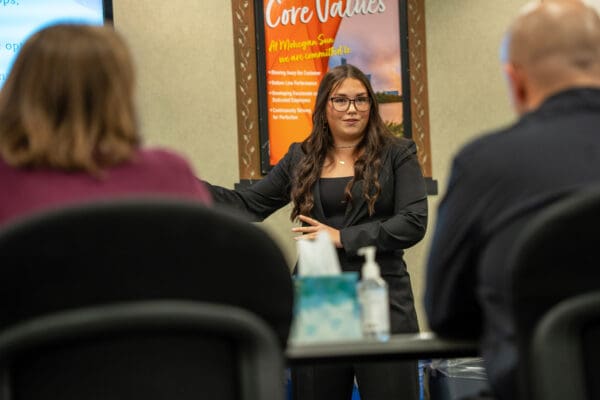
A Nichols College student gives a presentation wearing a black suit with two observers in the foreground.

Minor in Leadership

at Nichols College

Develop the skills to lead teams, manage projects and inspire organizational change with a minor in leadership at Nichols College.

This focused minor complements your business education by building practical leadership competencies that employers seek across industries.

Whether you’re majoring in business, sport management, criminal justice or another field, adding this minor improves your ability to motivate others, make strategic decisions and navigate workplace challenges.

Students with a minor in leadership gain expertise applicable to careers in management, entrepreneurship, human resources, nonprofit administration and any role requiring team coordination and strategic thinking.

Close-up exterior of a Nichols College brick building with a large arched window, with a vibrant yellow fall foliage tree visible along the campus sidewalk

Sample courses:

Learning to Lead

Through intensive, experiential learning and practice, students will be immersed in the study of leadership, and will directly apply themselves in leadership opportunities. This course takes a cross-curriculum approach to exposing students to the many facets of leadership and, in a motivational setting, encourages them to find their own personal leadership style, ultimately identifying the emerging leader within.

Leading Ethically Through Complexity

This course explores ethical constructs of leadership focusing on values and decision-making for leaders. Leaders’ decisions affect not only those within the organization and those it services but can also shape the social context in which we all live. In an increasingly complex world, leaders who are grounded in values and purpose are better prepared for ethical decision-making.

Developing and Motivating Human Potential

Hiring qualified talent is no guarantee that these employees will achieve their potential. Without nurturing, much of this talent will remain untapped and wasted. High performing workforces are the result of continuous development and effective motivational strategy. Based on sound motivational theory, this course examines why people work and what organizations should know and do to create winning teams.

Leadership Minor Requirements

A student pursuing a minor in leadership must complete Leading Ethically Through Complexity and three courses from those listed below. The student must submit a Declaration of Minor form, available online through the Registrar's page on the Nichols HUB.

Required Course

This course explores ethical constructs of leadership focusing on values and decision-making for leaders. Leaders' decision affect not only those within the organization and those it services but can also shape the social context in which we all live. In an increasingly complex world, leaders who are grounded in values and purpose are better prepared for ethical decision-making.
Three additional courses (maximum of two from the same subject) to be selected from:

This course is an introduction to issues in interpersonal communication, examined from the perspective of communication competence, with an emphasis on improving interpersonal skills and increasing communication competence in everyday social and professional exchanges. The course covers an array of concepts and theories including developmental and cultural influences, the power of words, non-verbal communication, mindful listening, conflict management, friendship, and intimate romantic relationships.

This course will delve into the unique characteristics of and challenges facing women in the workplace today. The biological and sociological theories of gender differences will be explored, as will gender-based communication and leadership styles. The current state of women in leadership around the world will be examined, with students completing a statistical research project. Students will examine and reflect on their own leadership and work styles, as well as practice professional skills of particular interest to women.

This course explores how we address the ethics of communication, particularly within the workplace, how to adjust and adapt communication styles to be effective in a diverse workplace, and how to recognize, interpret, and respond to different communication needs, including neurodiversity. We must consider justice, ethics, fairness, and care to work well with others professionally and personally. In this course, you will learn how to identify the foundation of your personal ethics, how your ethics are applied in various practical scenarios, and how to best communicate by addressing others' communication needs.

This course examines leadership, behavior, and style, and its potential for contributing to change in business, governmental, and nonprofit organizations. How leaders interact with the climate of the organization and its situational context, both political and environmental, will be examined through case studies of important figures in political, business, and social history.

Hiring qualified talent is no guarantee that these employees will achieve their potential. Without nurturing, much of this talent will remain untapped and wasted. High performing workforces are the result of continuous development and effective motivational strategy. Based on sound motivational theory, this course examines why people work and what organizations should know and do to create winning teams.

In preparation for collaborative and team-based workplaces, this course offers the opportunity for students to gain knowledge and skills that lead to successful team outcomes. The components of the course include team building, project management, and conflict management, covering topics such as group dynamics, emotional intelligence, diversity, project scheduling, and more. Students will have the opportunity to work in and lead multiple team-based projects, and learn how to maximize team productivity and potential.

This course explores the critical link between a leader's well-being and their leadership effectiveness, emphasizing the importance of both personal and team health. Students will enhance their research literacy in key wellness areas such as sleep, nutrition, and mindfulness, and investigate best practices for employee wellness plans (Previously LEAD 210)

This course is designed to present topics of special interest in leadership not covered in the existing course listings.

This course is designed to present topics of special interest in leadership not covered in the existing course listings.

This course is designed to present topics of special interest in leadership not covered in the existing course listings.

No description available.

No description available.

No description available.

We expect a lot from our presidents. Americans look to the person in the Oval Office to have a bold vision for our country's future and effectively deal with a whole host of issues such as the economy, education, the environment, foreign affairs, and more. As one political scientist has put it, "Everybody now expects the [person] inside the White House to do something about everything." Why do we have such high expectations and are they realistic? This course investigates how the presidency has evolved, especially during the past century. We will examine its constitutional origins and the historical factors that have helped expand its power and influence. We will explore what concepts like "charisma" and "character" mean and the part they have played in choosing presidents. Through case studies, we will look at examples of "effective" and "ineffective" chief executives and see if history teaching us lessons that can be applied today.

Why wait to learn leadership in the workplace? Research in leadership indicates that anyone can be a leader, regardless of age or experience. This course challenges students to examine their own leadership potential through an on-campus experiential internship. Throughout the semester students will apply Kouzes and Posner's five practices of exemplary leadership (Model the Way, Inspire a Shared Vision, Challenge the Process, Enable Others to Act, and Encourage the Heart) to enhance their own leadership experience. Students will also engage in activities, both in and outside of the classroom, that challenge them to ultimately discover the psychology behind leadership by practicing it.

This course examines the formation of groups, group processes, followership, and leadership processes within groups and group behaviors. Emphasis is placed on the experience of applying group theory.

As business practices evolve to meet the changing demands of the marketplace, leaders must constantly evaluate and make adjustments to stay on top of the field. This course is designed to help students identify, evaluate, and analyze current trends and then to make judgments on the viability and wisdom of those trends.

Ready to Lead With Confidence?

The leadership minor at Nichols College in Dudley, MA, offers practical training that complements any major. Contact your academic advisor to learn more about adding this minor to your academic plan. To learn more about Nichols, check out upcoming visit opportunities or contact our admissions team.