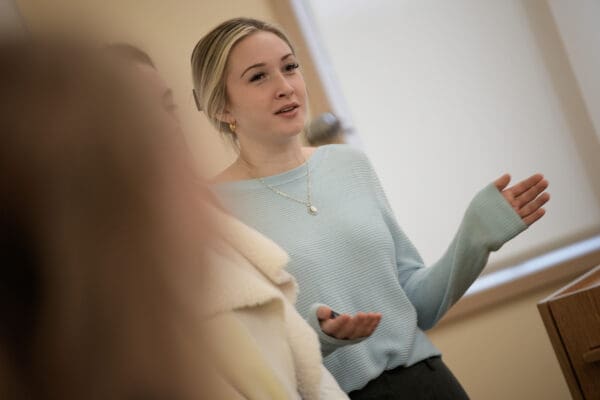
A Nichols College student presents to classmates in a small classroom setting, gesturing with her hands

History Minor

at Nichols College

Develop strategic thinking and analytical reasoning with a minor in history at Nichols College. This flexible minor complements your business education by building skills in research, analysis, and understanding how past events shape present decisions and future trends.

Whether you're majoring in business, economics, political science, or another field, adding this minor sharpens your ability to recognize patterns, evaluate evidence, and think critically about complex problems.

Students with a history minor gain expertise applicable to careers in business strategy, consulting, law, education, government, journalism, and any role requiring analytical thinking and contextual understanding.
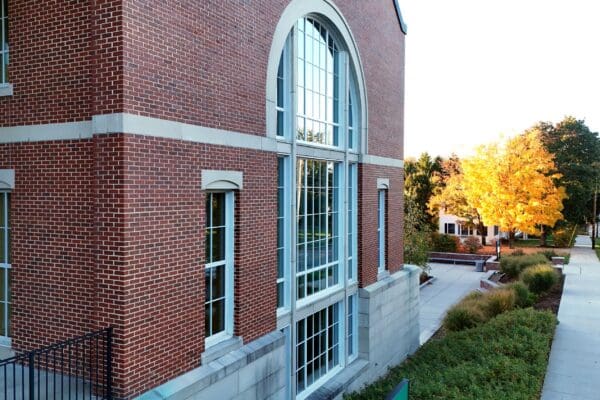
Close-up exterior of a Nichols College brick building with a large arched window, with a vibrant yellow fall foliage tree visible along the campus sidewalk

Sample courses:

The Making of Modern America

This survey course primarily focuses on the United States in the nineteenth century, an era in which the country emerged into the modern state that we recognize today. During the nineteenth century, the United States grew territorially at an astounding rate, reaching the shores of the Pacific Ocean and beyond. Meanwhile, the country enjoyed rapid growth in its economy as it transitioned from an agriculturally based system (highly dependent on slavery) to an industrially centered one. This period also marked broadening popular participation in the body politic, albeit with significant limitations based on race and gender. The effects of expansion on the nation’s various peoples will be examined.

Political & Historical Leaders

This course examines leadership, behavior, and style, and its potential for contributing to change in business, governmental, and nonprofit organizations. How leaders interact with the climate of the organization and its situational context, both political and environmental, will be examined through case studies of important figures in political, business and social history.

Media and Politics in America

This course will examine the relationship between media and politics in U.S. history since the dawn of the 20th century. The development of media – basically, any form of mass communication from newspapers and magazines to radio, television, and the internet – has deeply affected the ways in which ideas have been expressed and manipulated over the years. Our course will assess the use and effectiveness of various media during times of strife or crisis. We also will consider the role of the press, particularly in how it has shaped political issues and to what extent its role has appreciably changed over time.

History Minor Requirements

A student pursuing a minor in history must complete four courses having a HIST prefix, listed below. The student must submit a Declaration of Minor form, available online through the Registrar's page on the Nichols HUB.

Required Courses

Choose one:

Designed to introduce students to the practice of historical study, this course is a survey of the origins of the United States - from Europeans' arrival in North America to the founding of the republic. It is designed to offer students a broader understanding about how and why the United States developed into a nation-state, including the political, economic, social, and cultural factors that led to U.S. independence. The course is organized chronologically and will emphasize the theme of identity. Much as it is today, what became the United States of America was a tremendously diverse place in terms of race, class, gender, religion, and place of origin. These differences bred both conflict and accommodation among peoples who became "Americans," the results of which greatly shaped the early republic.

This survey course primarily focuses on the United States in the nineteenth century, an era in which the country emerged into the modern state that we recognize today. The course is organized chronologically and emphasizes the theme of expansion. During the nineteenth century, the United States grew territorially at an astounding rate, reaching the shores of the Pacific Ocean and beyond. Meanwhile, the country enjoyed rapid growth in its economy as it transitioned from an agriculturally based system (highly dependent on slavery) to an industrially centered one. This period also marked broadening popular participation in the body politic, albeit with significant limitations based on race and gender. This expansion in its various forms was marked by both conflict and accommodation among the nation's diverse population. We will examine the effects of expansion on these various peoples.

For the better part of the 20th century, the United States was widely recognized as the most powerful country on earth. Borrowing from famed publisher Henry Luce, this era has been called the "American Century." This course will survey the political, economic, social, and cultural factors that contributed to this development, assess how such influence was sustained, and consider the extent to which the term still applies in the present. Through close readings of primary and secondary sources, we will examine how domestic affairs - including race relations, income inequality, and national security - affected foreign policy and vice versa.

This survey course will examine the emergence of the earliest human civilizations, from pre-historic beginnings through the 6th century. We will explore how these societies began and developed over time; examine their political institutions, religious beliefs, and social structures; and investigate how economic and technological development, as well as evolving religious and intellectual ideas, helped promote new commercial and cultural ties among these civilizations. This course will focus on the earliest societies in the ancient Near East and the Nile Valley, India, East Asia, the Mediterranean world, and early Europe.

This survey course will examine the evolution of civilizations from 600 until 1600. We will explore the development of the Islamic world, the African kingdoms, and the Americas in the age of the Incas, the Maya, and the Aztecs. We will examine the impact that trade, religious and intellectual ideas, war, and disease played in promoting remarkable changes in Indian, East Asian, and European societies during this time period. The worldwide impact, both positive and negative, made by the European Renaissance and Age of Discovery will be analyzed.

This survey course will examine the evolution of civilizations from 1600 until the present, when the world becomes increasing integrated because of advances in technology and increasing trade and cultural exchange among societies. We will explore the political, religious, intellectual, and economic developments that lay behind the expansion of Western influence into other parts of the world. We will assess the political revolutions that occurred in the Atlantic world in the 18th and 19th centuries and the ideological and social movements that brought reforms to Europe but European imperialism to Africa and Asia. We will examine the causes and effects of the Industrial Revolution as well as the impact of the world wars, which led to the decline of Western imperialism and the resurgence of civilizations in India, China, and Africa.
Choose three from the following (no more than two at the 200-level):

This course provides students an historical grounding to the contemporary Global War on Terror. Guided by the process and method of historical inquiry, we will consider the policies and precedents that have informed the GWOT's undertaking from well before the attacks of September 11, 2001. By studying these antecedents, we will develop a deeper, more sophisticated understanding of this present-day conflict. Using both primary and secondary sources, we will focus principally on threats and activities abroad, including engagements against al Qaeda and ISIS as well as the 21st-century wars in Afghanistan and Iraq.

This course is intended to expose students to a variety of topics in the history of medicine and public health. Although most of the topics covered fall under the heading of "social history," students will examine how health and disease often impact political and economic history. The United States will be the focus of the course; however, events in Europe will also be discussed since many medical breakthroughs occurred outside of America. Topics to be discussed include epidemics, the development of anesthesia, mental health reform, the birth of urban sanitation, the impact of the Civil War on medicine, and the federal government's role in ensuring the safety of food and medicines.

This course will examine the history of the Civil Rights Movement in America, from its origins in the years after the Civil War to the current Black Lives Matter movement. Students will learn how the development of the NAACP, the Great Migration and World War II helped ignite the protests of the 1950s and 1960s. Students will study numerous events related to the struggle for civil rights, including the murder of Emmett Till, school integration, student sit-ins, Martin Luther King, Jr. and Malcolm X. Students will complete a research project on a person or event related to the Civil Rights Movement.

This course will focus on the American experience at home and abroad during World War II. It will cover military, political, economic, social, cultural, and diplomatic aspects of the war. Discussions of the methods of historical inquiry - particularly through primary and secondary sources - will be used to illustrate interpretations of the major events of World War II. Controversial aspects of the war and its conduct will be examined, especially pertaining to the role of the United States. Among the topics to be examined include the attack at Pearl Harbor, the issue of the timing of the second front in Europe, whether the Holocaust could have been prevented, the role of women on the home front, the brutality of the Pacific war, and whether it was necessary to drop the atomic bomb.

Through readings, lectures, discussion, guest speakers, field trips, independent research and presentations, students will explore the history of Nichols since its founding in 1815 to the 2000s. Although our focus will be on Nichols, we will also consider larger connections with local, regional, and national history.

Everyone loves a good ghost story. Millions of American believe in the paranormal - and even skeptics have heard a bump in the night and suspected it might be something supernatural. The course will start in 1848 upstate New York, where the spiritualist craze first began. Students will learn about the development of spiritualism in the United States, its popularity during the Civil War and its downfall in the early-20th century. We will also discuss hoaxes, tricksters, and the psychology behind the belief in ghosts. The course will conclude with an examination of the current popularity of ghost hunting shows. Students will conduct a group research project on a haunted site in New England and present their research at the end of the semester.

This course explores the trauma and catastrophe of World War I, a war that was unlike any other war in the history of human conflict up to that point. In addition to exploring the timeline of the war, we will reflect upon the experience of the soldiers and their families, technology used on the battlefield and the realization of what total war entailed. Although it has been a hundred years since the end of the war, we will look at how the wounds from this war are still visible today.

This course is designed to present topics not covered in the usual program yet considered of value to the student of history.

This course considers the role that women have played in American life from the colonial period to modern day. Special consideration will be given to such topics as the perceived role of women, their actual status and contributions in the Lowell mills, the Abolitionist movement, suffrage, and the 20th century civil rights movement.

This course will chart the ascendance of the United States from a regional power in the late-nineteenth century to a global superpower in the present. We will examine the expansion of U.S. political, economic, and cultural influence - including the ideological foundations that have been used to justify such expansion - and assess its consequences. We will begin by looking at the United States in the 1890s, a decade when it acquired overseas colonies (a key marker of "world power" status), and conclude by looking at contemporary foreign-policy concerns.

This course considers the evolution of modern Europe, including the social, political and economic developments of major European nations from the fall of Napoleon's Empire in 1815 to the present. Special emphasis will be placed on the Industrial Revolution, European nationalism and imperialism, the causes and effects of the world wars and the Cold War, the fall of Communism, and the drive toward European Union.

This course examines leadership, behavior, and style, and its potential for contributing to change in business, governmental, and nonprofit organizations. How leaders interact with the climate of the organization and its situational context, both political and environmental, will be examined through case studies of important figures in political, business, and social history.

This course is a survey of Latin American history from the early-nineteenth century to the present. It is designed to introduce students to significant issues and trends in the region, broadly defined as lands in the western hemisphere south of the Rio Grande, including the Caribbean islands. The course is roughly organized chronologically and will emphasize three major themes. We will begin with the end of the colonial period by examining the process of state formation as the region emerged from three centuries of European colonialism. We also will examine the impact of U.S. influence on Latin America, particularly since the late-nineteenth century. The third major theme is the phenomenon of revolution during the twentieth century as peoples across the region sought to redress longstanding inequalities.

This course will examine the relationship between media and politics in U.S. history since the dawn of the 20th century. The development of media - basically, any form of mass communication from newspapers and magazines to radio, television, and the internet - has deeply affected the ways in which ideas have been expressed and manipulated over the years. Our course will assess the use and effectiveness of various media during times of strife or crisis. We also will consider the role of the press, particularly in how it has shaped political issues and to what extent its role has appreciably changed over time.

This course examines the Civil War and the process of rebuilding the nation at the end of America's bloodiest war. It will cover the causes for the war, the principal battles, the political and military personalities involved, the war's consequences, and explore why the Union emerged victorious.

This course is designed to present certain topics not covered in the usual program yet considered of value to the student of history.

This course is designed to present certain topics not covered in the usual program yet considered of value to the student of history.

Qualified students who have departmental approval may apply for internships to gain experience in the field of public history at area museums, historic sites, archives, and libraries. Students will work to develop skills relevant to history-related careers outside the classroom. They will demonstrate their progress in weekly writing assignments and regular meetings with the supervising professor, along with a final project and presentation.

No description available.

No description available.

No description available.

Ready to Learn From the Past and Lead Into the Future?

The history minor at Nichols College in Dudley, MA, builds critical reasoning skills that enhance decision-making in any career. Contact your academic advisor to learn more about adding this intellectually enriching minor to your academic plan. To learn more about Nichols, check out upcoming visit opportunities or contact our admissions team.