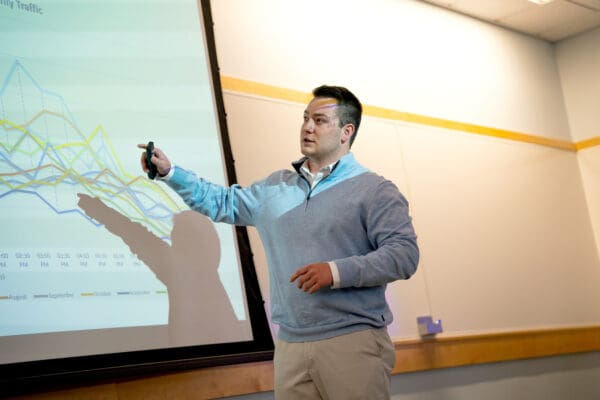
A Nichols College student presents a data analysis during the annual REAL Symposium

Certificate in Analytics

at Nichols College

Transform data into actionable insights with a certificate in analytics from Nichols College.

Our undergraduate certificate in business analytics is designed for students who want to pursue their chosen major while simultaneously earning a specialized credential with cross-industry applications.

As a student earning an undergraduate certificate in data analytics, you’ll learn to collect, analyze and transform data into something actionable through coursework and projects with industry veterans. This certificate can be completed alongside any major at Nichols College, allowing you to graduate on time at no extra cost with a unique credential that elevates your resume and expands your competitive advantage.

Close-up exterior of a Nichols College brick building with a large arched window, with a vibrant yellow fall foliage tree visible along the campus sidewalk

Benefits of a Certificate in Analytics from Nichols College

Adding an undergraduate certificate in business analytics provides specialized skills that set you apart in the competitive job market:

Industry-Connected Learning

Complete projects and coursework with industry veterans, including Google Analytics Academy professionals

Career-Ready Data Skills

Learn to collect, analyze and transform data into actionable insights valued across industries

Competitive Advantage

Adding a specialized, in-demand credential is a strong addition to any resume

Plus, our program is AACSB-accredited—only six percent of institutions worldwide are accredited by the prestigious Association to Advance Collegiate Schools of Business.

Sample Courses

Introduction to Intelligent Automation

Intelligent Automation is changing the nature of work. This course will explore the emergence and adoption of intelligent automation throughout various sectors. Fundamental concepts, vocabulary, automation tools and frameworks needed to identify, evaluate and measure opportunities will be introduced. Students will build simple automations using an automation tool.

Data Visualization

This hands-on course covers the art and science of data visualization. It explores various visualization techniques and the way that shape, size, color, orientation and motion influence the way information is comprehended.

Data Mining

This course covers “D2D”, or Data to Decisions. Specifically, this means we will learn what to collect, how to collect it and how to transform it into actionable information to solve real business problems.

Data Analytics Certificate Requirements

To enter the program, you'll need to complete MATH 150 or MATH 253 with a grade of B or better. The certificate in analytics requires four courses (12 credits). Two of those courses can count towards both the certificate and your major.

Required Courses

Choose Three Courses From:

Intelligent Automation is changing the nature of work. Technology is enabling workforce automation and employee augmentation, aiming to automate repetitive tasks and reduce the number of lower value processes being performed manually. The goal for these technologies is to empower companies and their employees to invest their time in higher-yield, higher complexity tasks that can result in greater value for business, their customers and clients, and improve profits and efficiencies. Introduction to Intelligent Automation will explore the emergence and adoption of intelligent automation throughout various sectors. Fundamental concepts, vocabulary, automation tools and frameworks needed to identify, evaluate and measure opportunities will be introduced. Students will build simple automations using an automation tool.

This course will cover the basics of how to write computer programs in Python. Topics will include data types, loops, strings, lists, methods, graphics and GUI interfaces. Time permitting, we will discuss tools for data analysis. In class instruction will focus on case studies tackling business applications.

Industry's appetite for intelligent automation solutions grows as stakeholders recognize the power and value to these impressive tools. However, solution identification and deployment is not a simple matter. The appropriate analysis must be performed to identify the opportunity, document the process and data environment, craft the business solution and build a plan that minimizes risks. Historically, 50% of technology projects fail because this critical step is rushed, skipped or done badly. Students will learn the fundamentals of business analysis in the course from an industry best practice framework. By the end of class, students will have used key aspects of the framework and completed foundational business analysis templates.

In this course students will build upon their knowledge of automation development and business analysis. Students will learn more advanced automation skills, including effective development practices, preparing them to identify and build automations without instruction. How these automations are built matters, though, as building bunches of bad bots creates more problems for an organization than the automations may have solved. The concepts of Center of Excellence and governance practices will be introduced so students learn how business analysis and development practices contribute (positively or otherwise) to the overall transformation initiative of an organization.

Analytics is the process of getting value out of data. It explains how seemingly mundane data points, when combined, can provide insights into habits, processes, and patterns. We live in a world overflowing with data, and only recently has technology reached the point where anyone can conduct this type of analysis without the aid of supercomputers or consulting firms. This course covers "D2D", or Data to Decisions. Specifically, this means we will learn what to collect, how to collect it, and how to transform it into actionable information. It is also focused on solving real business problems, which is the most practical application for Nichols business students.

This hands-on course covers the art and science of data visualization. It explores various visualization techniques and the way that shape, size, color, orientation, and motion influence the way information is comprehended. The class will use world-class visualization platforms such as Tableau and PowerBI. Students will understand the difference between exploratory versus explanatory visualization as well as gain an appreciation for the appropriate use of visualization techniques. We'll discuss how visualizations can be manipulated to mislead or misinform others and discuss the ethics around data visualization. Students will work through a series of interactive dashboards culminating with the final project in which the student will create a story with their data.

The primary goal of this class is to learn principles and practices of database management and database design. We will discuss the database relational database design, normalization, SQL queries, reports and other interfaces to database data, and documentation. We will also treat ethical and privacy issues associated with database systems. In-class instruction and exercises will focus on the fundamentals for creating sophisticated, interactive, and secure database applications.

This course provides an introduction to regression including: simple linear regression, multiple regression, model building, and variable screening methods.

This course will introduce modern techniques of computational statistics for practical analysis of data utilizing the R programming language. Data analysis and interpretation will be emphasized, rather than statistical theory. Real world data sets will be used to illustrate statistical principles.

Choose One Courses From

Within the field of criminal justice, it is necessary to understand why some people commit crimes and others do not. Crime rates throughout the world are continuously monitored and everyone wants to know the profile of the typical offender; yet it is relevant that we explore the principles and theories that correlate with crime rates and its offenders. This course will explore historical and contemporary theories of the causes of crime; including theories derived from biological, psychological, sociological, geographic, economic, and political perspectives.

Intelligent Automation is changing the nature of work. Technology is enabling workforce automation and employee augmentation, aiming to automate repetitive tasks and reduce the number of lower value processes being performed manually. The goal for these technologies is to empower companies and their employees to invest their time in higher-yield, higher complexity tasks that can result in greater value for business, their customers and clients, and improve profits and efficiencies. Introduction to Intelligent Automation will explore the emergence and adoption of intelligent automation throughout various sectors. Fundamental concepts, vocabulary, automation tools and frameworks needed to identify, evaluate and measure opportunities will be introduced. Students will build simple automations using an automation tool.

This course will cover the basics of how to write computer programs in Python. Topics will include data types, loops, strings, lists, methods, graphics and GUI interfaces. Time permitting, we will discuss tools for data analysis. In class instruction will focus on case studies tackling business applications.

Industry's appetite for intelligent automation solutions grows as stakeholders recognize the power and value to these impressive tools. However, solution identification and deployment is not a simple matter. The appropriate analysis must be performed to identify the opportunity, document the process and data environment, craft the business solution and build a plan that minimizes risks. Historically, 50% of technology projects fail because this critical step is rushed, skipped or done badly. Students will learn the fundamentals of business analysis in the course from an industry best practice framework. By the end of class, students will have used key aspects of the framework and completed foundational business analysis templates.

In this course students will build upon their knowledge of automation development and business analysis. Students will learn more advanced automation skills, including effective development practices, preparing them to identify and build automations without instruction. How these automations are built matters, though, as building bunches of bad bots creates more problems for an organization than the automations may have solved. The concepts of Center of Excellence and governance practices will be introduced so students learn how business analysis and development practices contribute (positively or otherwise) to the overall transformation initiative of an organization.

Analytics is the process of getting value out of data. It explains how seemingly mundane data points, when combined, can provide insights into habits, processes, and patterns. We live in a world overflowing with data, and only recently has technology reached the point where anyone can conduct this type of analysis without the aid of supercomputers or consulting firms. This course covers "D2D", or Data to Decisions. Specifically, this means we will learn what to collect, how to collect it, and how to transform it into actionable information. It is also focused on solving real business problems, which is the most practical application for Nichols business students.

This hands-on course covers the art and science of data visualization. It explores various visualization techniques and the way that shape, size, color, orientation, and motion influence the way information is comprehended. The class will use world-class visualization platforms such as Tableau and PowerBI. Students will understand the difference between exploratory versus explanatory visualization as well as gain an appreciation for the appropriate use of visualization techniques. We'll discuss how visualizations can be manipulated to mislead or misinform others and discuss the ethics around data visualization. Students will work through a series of interactive dashboards culminating with the final project in which the student will create a story with their data.

Analysis of long-term corporate financial decisions, including capital budgeting, cost of capital, leverage, dividend policy, debt and equity financing, working capital management, business combinations, and international finance.

This course provides an introduction to regression including: simple linear regression, multiple regression, model building, and variable screening methods.

This course will introduce modern techniques of computational statistics for practical analysis of data utilizing the R programming language. Data analysis and interpretation will be emphasized, rather than statistical theory. Real world data sets will be used to illustrate statistical principles.

A study of the application of research techniques in market analysis. Student teams design, conduct, and present a research project, including problem definition, questionnaire design, data collection, data analysis, documentation, and recommendation.

This course's purpose is to develop knowledge of when to apply the correct statistical techniques. Emphasis is placed on the "real world" applications of statistical methods through projects. Topics include descriptive and inferential statistics, multivariate, parametric, and nonparametric techniques. This course makes extensive use of statistical analysis software. This course is a core requirement for all psychology majors, is the prerequisite for Applied Research Methods II, and is offered in the fall semester.

This course will discuss the theory, development, and application of analytics in sport. Topics covered include player performance, player management, sports data strategies, team management, and game day operations and strategies. Extensive use of statistical software will be expected.

Ready to Add Data Analytics Expertise to Your Degree?

A certificate in analytics from Nichols College provides the specialized training employers seek, completed alongside your major at no additional cost. Contact your academic advisor to learn more about adding this certificate to your undergraduate degree. To learn more about Nichols, check out upcoming visit opportunities or contact our admission team.