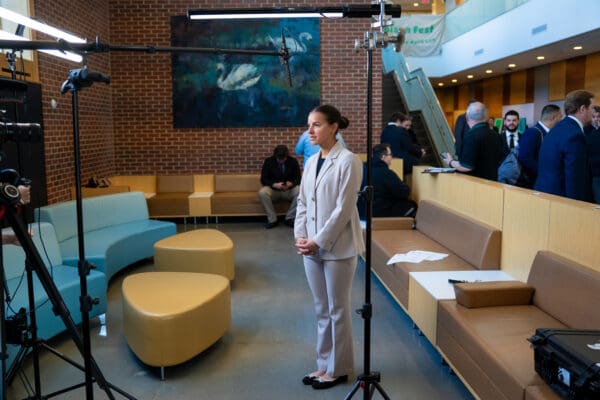
A smartly dressed International Business student stands in front of a broadcasting set up at a Nichols College event.

BSBA in International Business

at Nichols College

Business doesn’t stop at national borders, and understanding how companies operate across countries and cultures is essential in today’s global economy.

You can learn how to conduct business with industry leaders worldwide with an international business degree (BSBA) from Nichols College.

This interdisciplinary program is built on three pillars—international business; international management; and international affairs, governance and policy. Case studies, international travel opportunities and strategic internships combined with this foundation prepare you with the cultural competency and business acumen needed to navigate global markets, manage cross-border business activity and succeed in multicultural environments.
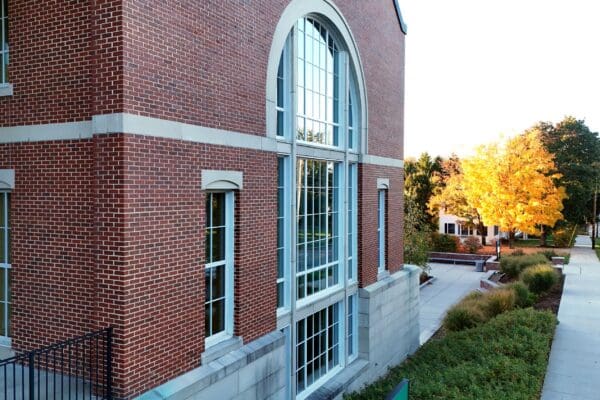
Close-up exterior of a Nichols College brick building with a large arched window, with a vibrant yellow fall foliage tree visible along the campus sidewalk

Why Study International Business at Nichols College?

Pursuing an international business degree at Nichols College means joining a program designed to prepare business leaders for the pace and magnitude of the global economy. Here's what sets our program apart:

Three-Pillar Foundation

Study within a comprehensive curriculum covering international business; international management; and international affairs, governance and policy

Hands-On Global Experience

Gain exposure to real-world global business challenges through international travel opportunities and Harvard Business Publishing case studies

Cultural Competency Development

Learn to navigate cultural differences in business practices across management, marketing, finance and economics disciplines

Professional Connections

Engage with professionals and secure meaningful internships through our career contacts, hands-on employer experiences and alumni network that's 16,000+ members strong

Worcester County Location

Benefit from strategic access to New England's global business corridor and international trade networks while getting the personal attention of a close-knit campus community

Plus, our program is AACSB-accredited—only six percent of institutions worldwide are accredited by the prestigious Association to Advance Collegiate Schools of Business.

Experiential Learning at Nichols College

Hands-on, experiential learning is a key component of a Nichols education. Every business student completes an internship, a professional certification and a research, experiential or consulting project before they graduate. Add holistic professional development to that hands-on foundation, and you get real results—95% of recent graduates secured jobs or entered graduate school within six months. All from a college ranked top 10 nationally among undergraduate business schools for mid-career salary potential and best value.

A Nichols College student intern assists with an event at historic Fenway Park in Boston.

Student-Faculty Projects

From assisting with faculty research and teaching to working on an advanced project with your professor, there are many ways to extend your learning beyond the classroom at Nichols.

Student-Run Opportunities

Whether you’re managing the Thunder Fund, working with Bison Consulting clients, helping run the Nichols Dudley Hill Golf Course Club and Bison Den or pitching ideas to companies, you’ll build career-ready skills.

Holistic Professional Development

Build confidence and vital soft skills through experiences that take you into the community, paired with public speaking practice, networking etiquette and signature leadership development.

Study Abroad

Take your education global through faculty-led trips, international internships, semester abroad programs and short-term travel that let you earn Nichols credits while expanding your worldview.

Careers in International Business

A degree in international business builds expertise in global markets, cross-border trade and cultural dynamics, along with transferable skills in communication, analysis and strategic thinking. Graduates can pursue roles across multinational corporations, finance, consulting, government agencies and global nonprofit organizations.

Career possibilities include:

  • International management analyst
  • International marketing manager
  • Global financial analyst
  • International media planner
  • International loan officer
And More
Two Nichols College students in professional attire laughing together at a career and internship fair booth

Meet Your Faculty

Julio Elias

Chair, International Business 508-213-2112

Karol Gil-Vasquez

Keith T. Anderson Associate Professor of Economics  508-213-2105

Marcus Goncalves

Adjunct Professor 508-213-2429
FAQ

Frequently Asked Questions About Our International Business Program

What makes Nichols College's international business program unique compared to other programs?

Our international business degree at Nichols College stands out through its interdisciplinary three-pillar foundation combining international business; international management; and international affairs, governance and policy. We encourage international travel opportunities and utilize Harvard Business Publishing case studies for real-world learning. Our campus location in Central Massachusetts offers access to diverse multinational corporations while maintaining the personalized attention that allows faculty to customize learning experiences based on students’ specific career interests.

What international travel opportunities are available to International Business students?

International business students have multiple options to gain global experience through travel and immersive learning. Opportunities include semester-long study abroad programs, short-term faculty-led travel and international internships that allow students to earn Nichols credit while working or studying overseas. Through the IBUS 490 internship, students may be placed with organizations in the U.S. or abroad, applying classroom learning in real-world settings. These experiences help students build cultural competency, global business insight and professional experience across diverse international environments.

How does the international business program prepare students for specific career paths?

Students in our international business program are prepared to navigate the fast-paced world of global commerce through the program’s focus on examining business and cultural differences and interdisciplinary foundation. Combined with experiential learning and travel opportunities, students develop competencies relevant to managerial problems in international context, preparing them for careers with multinational corporations, financial institutions with foreign operations, and government agencies involved in international trade and finance.

International Business Courses

Required Courses

Examines management theory and practice as applied to business activities that cross national boundaries. Emphasis is placed on an understanding of strategic, cultural, behavioral, functional, legal, and socio-ethnical aspects of international management in a global economy with multinational business enterprises.

This course provides an introduction to the field of comparative politics, the study of places other than the United States. We will analyze in-depth studies of political processes from nations all around the world to investigate debates at the heart of political science, economics, history and other fields within the Liberal Arts and Business core: Why are politicians responsive to the needs of citizens in some countries but not in others? Why do people vote on ethnic lines in some places but not others? Why do some states guarantee social protection for their citizens whereas others leave it in the hands of the market? How do political institutions and social factors shape the provision of public goods? What role do property rights play in transitions to democracy and to market economies? Discussions include topics on governance and accountability, political economy, political culture, identity politics, social cleavages, citizenship, and democratic institutions.

This course provides an overview of the unique problems faced by enterprises engaging in international activities, and the importance of understanding the international economic, social, political, cultural, and legal environment. This course also provides practical information on the mechanics of importing and exporting, joint venture, franchising, and subsidiaries, international dimensions of management, marketing and accounting, international financial management. Other subjects covered in this course includes special problems faced by multinational enterprises, recent problems of the international economic system, country-risk analysis, and the increasing use of counter trade.

This seminar is a senior-level capstone course for international business students. A case study approach will be used to explore the major current issues in international business and bring together the general concepts and ethical dimensions studied in earlier coursework in the program. A capstone project requires students to examine current issues and develop critical information literacy skills.

and one from:

This internship enables students to apply the knowledge acquired throughout the program to the real world. The International Business internship program will work closely with the Office for International Engagement, the Career and Professional Development Center, and a growing list of international companies, as well as independently placing students in several locations, in the U.S. and abroad. A cumulative grade point average of 2.7 as well as 60 credits completed is required; the internship consists of 120 hours of work.

No description available.

No description available.

No description available.

Elective Courses

This course explores the impact on project management of culture, language variations, religious, regulatory and legal practices, technology penetration, temporal orientation, gender issues, corruption, ethics, personal liberty and political contexts. Students learn how to meet global projects challenges through efficient use of practices and technology. The course provides hands-n application of project management, in line with the Project Management Institute (PMI) body of knowledge (PMBOK), and utilizes available case studies and examples from companies to help students sharpen the skills needed to recognize and foster a successful international project environment.

This is an in-depth study of a selected topic, issue, problem or trend in international business. The specific subject matter is not offered as an existing regular course or deserves more time-emphasis than is possible in a regular course. This course may be repeated once for a total of six credits.

An economic analysis of the foundations of international trade and the impact of trade on domestic and global economies. The course includes a study of the balance of payments, world debt, exchange rates, and the international monetary system. Current issues and problems are emphasized. (Previously ECON 412)

An analysis of the international business and consumer environments and the development and implementation of marketing programs across business alternatives (e.g., direct investment, joint ventures, licensing). Topics include the roles of cultural, political, technological, economic, and legal aspects of marketing in an international environment, as well as how these affect the marketing mixes likely to be successful in various international markets. (Previously MKCM 434)

This course provides students with strategies to improve international business problem solving and managerial decision making through the use of analytics by using quantitative and qualitative decision-making tools and techniques. This course also provides students with an overview of how decisions are made to solve management problems in the international business environment. It introduces the fundamental concepts and methodologies of decision-making process, problem solving, decision analysis, data collection, and probability distribution, evaluation, and prediction methods.

Virtually every US company now faces competition from abroad, and the fortunes of most US firms, large and small, are inextricably bound to the global economy. Company HR Departments must have a global perspective to remain competitive. And all managers, especially HR professionals, must develop a sensitivity to global issues and practices. This course will focus on several aspects of human resources in a global context: labor practices in developing countries; multinational companies' strategies in complying with international ethical principles; and how companies can manage global operations in a manner that results in a successful experience for both the employee and the firm. (Previously HRM 481)

Free Electives

12 credit-hours of electives

Interested in Learning More?

Join us at one of our upcoming campus events in Dudley, MA, or schedule a campus visit. You can also contact our Admissions team to discuss your academic goals and how Nichols can help you reach them.