
A smiling Nichols Students amongst his peers engages in the classroom while three other students work on laptops beside him.

BSBA in Finance

at Nichols College

From startups to global banks, every organization needs people who understand how to manage money, assess risk and plan for the future.

You can prepare to become a leader in money management with a bachelor’s degree in finance from Nichols College.

You’ll study the major areas of financial analysis and planning with the help of faculty who have real-world financial experience working anywhere from the Big Apple to local banks. You’ll build hands-on experience with Bloomberg terminals, the same technology used by major banks and corporations. With our applied curriculum and our program’s strong industry ties, you’ll graduate ready to step confidently into your career.
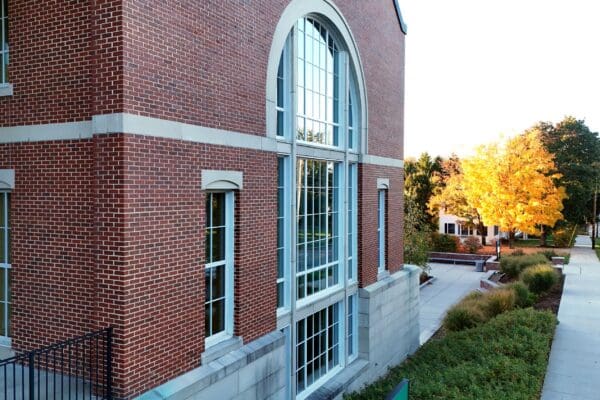
Close-up exterior of a Nichols College brick building with a large arched window, with a vibrant yellow fall foliage tree visible along the campus sidewalk

Why Study Finance at Nichols College?

Pursuing a bachelor’s degree in finance at Nichols College gives you the experience and connections to hit the ground running. Here’s what sets our program apart:

Comprehensive Curriculum

Study core areas of financial analysis and planning, from corporate finance to personal finance, guided by faculty with real-world industry experience

Industry Skills and Credentials

Use the same financial tools used by Wall Street professionals to obtain Bloomberg Finance Fundamentals and ESG certifications, and you can gain portfolio management experience

High-Reward Field

Gain an edge in a field known for exceptional return-on-investment and impressive post-graduation earning potential

Professional Connections

Engage with professionals and secure meaningful internships through our career contacts, hands-on employer experiences and alumni network that's 16,000+ members strong

Worcester County Location

Benefit from strategic access to New England's financial corridor while getting the personal attention of a close-knit campus community

Plus, our program is AACSB-accredited—only six percent of institutions worldwide are accredited by the prestigious Association to Advance Collegiate Schools of Business.

Becoming an Accounting and Finance Major at Nichols College

Accounting and finance are majors that many of our students choose to pair up, with the complementary nature of the fields. They’re also some of the most involved programs, so we’ve created this special track that supports an efficient double-major pathway in accounting and finance. Current students should speak with their academic advisor to learn more about this program.

Experiential Learning at Nichols College

Hands-on, experiential learning is a key component of a Nichols education. Every business student completes an internship, a professional certification and a research, experiential or consulting project before they graduate. Add holistic professional development to that hands-on foundation, and you get real results—95% of recent graduates secured jobs or entered graduate school within six months. All from a college ranked top 10 nationally among undergraduate business schools for mid-career salary potential and best value.

A Nichols College student intern assists with an event at historic Fenway Park in Boston.

Student-Faculty Projects

From assisting with faculty research and teaching to working on an advanced project with your professor, there are many ways to extend your learning beyond the classroom at Nichols.

Student-Run Opportunities

Whether you’re managing the Thunder Fund, working with Bison Consulting clients, helping run the Nichols Dudley Hill Golf Course Club and Bison Den or pitching ideas to companies, you’ll build career-ready skills.

Holistic Professional Development

Build confidence and vital soft skills through experiences that take you into the community, paired with public speaking practice, networking etiquette and signature leadership development.

Study Abroad

Take your education global through faculty-led trips, international internships, semester abroad programs and short-term travel that let you earn Nichols credits while expanding your worldview.

Program Highlights for Finance Majors

Our finance degree program bridges classroom theory with real-world application. Students spend a semester, or optionally up to one year, managing actual investments through our Thunder Fund, gaining invaluable portfolio management experience that sets them apart in the competitive finance job market.

Bloomberg Terminals

Students build analytical skills by using Bloomberg Terminals, the same financial tools and software used by professional traders on Wall Street. Through Bloomberg tools, students monitor and analyze real-time financial market data and even earn Bloomberg certification, a professional credential they’ll need as a trader for the Nichols student-managed investment fund.

Bloomberg Finance Lab

Located in the Fels Student Center, the Bloomberg Finance Lab is equipped with 12 Bloomberg Terminals, 23 double-monitor workstations and a stock market LED display (“ticker tape”) to allow students to monitor and make moves in the equities market.

Student-Managed Investment Fund

Students manage real investment portfolios with real money through our student-managed investment fund, called the Thunder Fund. This is a course-related, two-semester opportunity where students use the Bloomberg Finance Lab to manage the Thunder Fund and gain real-world experience in making financial markets decisions. Students monitor industry sectors, research companies, detail an investment thesis and ultimately make buy/sell recommendations. The fund’s investment philosophy focuses on macro trends, fundamental analysis, equity evaluation, corporate strategy and risk management. The equity-only fund was originally seeded with $150,000 thanks to successful alumni in the field.

Careers in Finance

A BSBA in finance builds skills in financial analysis, markets and money management. Graduates pursue roles in corporate finance, banking, insurance, investment counseling, portfolio management, trading and real estate.

Career possibilities include:

  • Account analyst
  • Broker/dealer
  • Budget analyst
  • Commercial lender
  • Credit analyst
And More
Two Nichols College students in professional attire laughing together at a career and internship fair booth

Meet Your Faculty

Christine Beaudin

Chair, Finance 508-213-2445

Brendan Williams

Assistant Professor of Accounting 508-213-2166

Karin Curran

Chair, General Business 508-213-2170

Michael Forte

Chair, Accounting 508-213-2260
FAQ

Frequently Asked Questions About Our Finance Program

How does the finance degree program at Nichols College prepare students for careers?

Our program combines theoretical knowledge with practical application. Students study the major areas of financial analysis and planning, including corporate financial analysis, capital markets and securities, investing, banking operations, and personal finance. They also apply what they learn through using our Bloomberg terminals, participation in our student managed investment fund called the Thunder Fund, industry certifications and internships at top firms like BlackRock, Fidelity and IBM.

What technology and certifications can students earn in the finance degree program?

Students gain access to professional Bloomberg terminals and can earn Bloomberg Finance Fundamentals Certification and ESG (Environmental, Social and Governance) Certification. These industry-recognized credentials give graduates a competitive advantage.

What is the student managed investment fund?

Our student managed investment fund, called the Thunder Fund, is a hands-on learning experience where students manage real investment portfolios, making actual buy and sell decisions while learning portfolio theory, risk management and investment analysis under faculty supervision.

Finance Courses

Required Courses

Analysis of long-term corporate financial decisions, including capital budgeting, cost of capital, leverage, dividend policy, debt and equity financing, working capital management, business combinations, and international finance.

A study of investment principles and techniques including the investment environment, evaluation of securities, current practices in the securities/investments industry, and the formulation of investment objectives.

An introduction to the financial issues that impact the lives of average people every day. The course covers money management, the rudiments of investing, personal tax, the fundamentals of life, health and property insurance, the tradeoffs between risk and return in investing, home ownership and mortgages, the pitfalls of consumer debt, retirement planning, and estate planning.

A capstone course which expands upon corporate finance and investment concepts. Includes exposure to advanced financial theory. The case method of instruction challenges student teams to understand, evaluate, and solve real world business problems.

and one from:

This course will provide students the knowledge to build a DCF model to aid them in evaluating potential investment opportunities. Students will be in charge of rebalancing the existing portfolio, assessing risk, and ensuring that the portfolio is in compliance with the IPS. Students will engage in real world and hands-on experience in security analysis and portfolio construction and management through the management of the Nichols College Student Managed Investment Fund.

This course provides students with real world and hands-on experience in security analysis and portfolio construction and management through the management of the Nichols College Student Managed Investment Fund. Students will be jointly in charge of the investment decisions of the fund and the overall composition of the portfolio. Each student will perform various quantitative and qualitative analysis of individual securities, industries, and the overall portfolio.

Elective Courses

choose one from the following options, only one experiential learning opportunity may be selected as an elective.:

An intermediate macroeconomic course analyzing the determination of national income, employment, the price level, interest rates, and exchanges in the economy. Piece-by-piece, a theoretical model will be constructed that is capable of describing how each of these variables is determined. After the model is completed, the course investigates issues of business cycle theory, foreign trade, and macroeconomic policy. Special attention will be given to theoretical and policy debates.

This course focuses on the essential features and functions of money and credit in a capitalist economy operating with a fiat currency in a flexible exchange rate regime such as the U.S. economy. We study the role of the U.S. Federal Reserve Bank (The Fed), the U.S. Treasurer and the commercial banking sector in the U.S. economy, the banking and financial systems. The fundamental elements of financial markets, instruments and investments, and their links to the monetary and banking systems are examined. Special attention is given to the institutional structure and the accounting procedures through which the Fed and the Treasurer coordinate monetary policy. We examine the endogenous nature of crises and financial instability in capitalist economies. Here, we study the theories provided by prominent 20th century economists - Hyman Minsky and J.M. Keynes - whose names and theoretical contributions have been widely evoked during the 2008 Financial Crisis. We identify the causes and implications of financial crises, and understand possible policy solutions. Such policies emphasize the need to understand the recent evolution of the regulatory framework in the financial and banking industry.

This course introduces students to the fundamental concepts and analytical methods used for making residential and commercial real estate finance and investment decisions. Students will gain a fundamental, real-world understanding of returns on capital with a focus on expected growth along with market and project-specific risks. Students will develop hands-on experience building financial Pro Forma Statements using a multi-year discounted cash flow analysis which will include tax implications, depreciation, capital gains and losses.

This course is offered on an occasional basis and addresses topics and themes of special interest not covered in the standard course offerings in finance.

This course introduces students to portfolio management based on theory and best practice techniques of investments. Students will gain a comprehensive knowledge of portfolios and a set of tools designed to assist them in the investment decision-making process. Students will be exposed to the basic theories of managing a portfolio of financial assets within the risk-return framework.

This course introduces basic concepts of futures, swaps and options that are frequently used by institutional investors and experienced individual investors for investment and speculation. Students will learn how these products work, how they are used, how they are priced, and how financial institutions hedge their risks then they trade the products.

This course will provide students the knowledge to build a DCF model to aid them in evaluating potential investment opportunities. Students will be in charge of rebalancing the existing portfolio, assessing risk, and ensuring that the portfolio is in compliance with the IPS. Students will engage in real world and hands-on experience in security analysis and portfolio construction and management through the management of the Nichols College Student Managed Investment Fund.

This course provides students with real world and hands-on experience in security analysis and portfolio construction and management through the management of the Nichols College Student Managed Investment Fund. Students will be jointly in charge of the investment decisions of the fund and the overall composition of the portfolio. Each student will perform various quantitative and qualitative analysis of individual securities, industries, and the overall portfolio.

Global interconnectedness is an extremely important reality today. Global interconnectedness influences our individual lives every day. Very few enterprises can today insulate themselves from the influences of global developments. A main goal of this course is to develop an understanding of the international dimensions of our economy. Students will become acquainted with the economic analysis of the foundations of international trade and the impacts of trade on domestic and global economies. Impediments to trade are analyzed, such as tariffs, quotas, and market power of megacorporations. The course includes a study of global finance, the balance of payments, world debt, exchange rates, and the international monetary system. Contemporary real world issues and problems are emphasized.

Experiential Learning Electives

An intensive program of work experience with a business or corporation. Combines both experiential learning with traditional academic work through required term essay and presentation of internship results to an appropriate class. Internship course specifications and "learning contract" forms are available through the Office of Career Services. Students interested must be of junior or senior standing and have a 2.5 grade point average.

The Research Associate is an option for select, motivated students to work under the close supervision of a faculty member, assisting in the faculty's current research project, or conducting their own study. Students are provided training in research, and develop new communication and critical thinking skills, and are introduced to the possible future opportunities in the research-related aspects of their field. The experience will enhance students' graduate and employment qualifications. To be eligible, students must have completed at least 60 hours of classroom instruction. Research Associates and other experiential learning opportunities require approval of the Program Chair.

A Teaching Associate Intern works with students in a specific course to provide support for the faculty member in charge. His/ her duties may include teaching; preparing instructional materials; critiquing student papers; tutoring students; aiding in online or classroom discussions; sample assignment preparation; and performing other duties as assigned. Major responsibility for a class shall not be given to a teaching associate intern. The associate works under the supervision of an experienced faculty member. In consultation with the supervisor, the teaching associate works to gain instructional skills and to enhance his/her grasp of the essentials of the academic discipline and the role and responsibilities of a faculty member. To be eligible, students must have completed at least 60 hours of classroom instruction (or receive approval by the appropriate faculty member or program chair), have earned a "B+" or better in the course they wish to assist, and have earned a cumulative GPA of 3.0. Teaching Associates and other experiential learning opportunities require approval of the Program Chair.

*For those who choose to take both Thunder Fund I and II, it is recommended that students enroll in FIN 472 Thunder Fund I prior to FIN 473 Thunder Fund II. However, it is not required.

Free Electives

15 credit-hours of electives

Interested in Learning More?

Join us at one of our upcoming campus events in Dudley, MA, or schedule a campus visit. You can also contact our Admissions team to discuss your academic goals and how Nichols can help you reach them.