A smartly dressed Nichols College student speaks to a faculty member at a networking event for the Economics department.

BSBA in Economics

at Nichols College

Ever wondered how experts analyze markets, forecast trends or help companies navigate uncertainty? Economics is the path that unlocks those answers, and related careers.

Our economics degree will help you enter the global marketplace with the advanced problem-solving and data skills needed to drive results. Our program combines business core courses with specialized economic analysis, preparing analytical thinkers to assess complex economic issues.

Through a curriculum that connects economic theory with practical application, you’ll graduate with the preparation you need to make educated decisions in finance, consulting, research and business leadership roles.
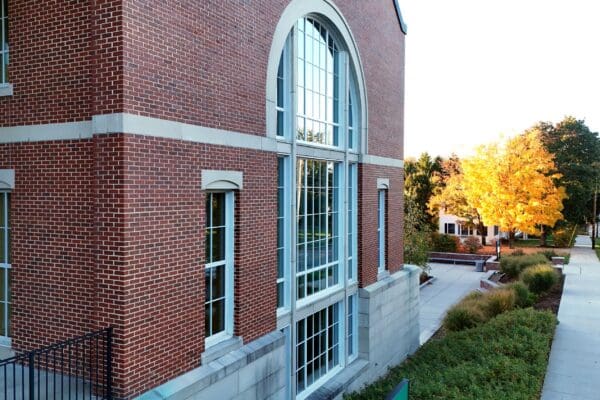
Close-up exterior of a Nichols College brick building with a large arched window, with a vibrant yellow fall foliage tree visible along the campus sidewalk

Why Study Economics at Nichols College?

Pursuing a BSBA in economics at Nichols College in Dudley, MA, means joining a program that applies rigorous economic inquiry to modern business questions to develop career-ready graduates. Here's what sets our program apart:

Advanced Analytical Skills

Develop the quantitative reasoning, independent thinking and problem-solving abilities needed to address global economic challenges

Globally Experienced Faculty

Learn from professors who bring expertise from the Central Bank of Mozambique and the World Bank or from publishing award-winning international scholarly research

Diverse Career Preparation

Open doors to roles as economist, financial planner, market research analyst and economic consultant with the program’s business foundation

Professional Connections

Engage with professionals and secure meaningful internships through our career contacts, hands-on employer experiences and alumni network that's 16,000+ members strong

Worcester County Location

Benefit from strategic access to New England's financial corridor while getting the personal attention of a close-knit campus community

Plus, our program is AACSB-accredited—only six percent of institutions worldwide are accredited by the prestigious Association to Advance Collegiate Schools of Business.

Experiential Learning at Nichols College

Hands-on, experiential learning is a key component of a Nichols education. Every business student completes an internship, a professional certification and a research, experiential or consulting project before they graduate. Add holistic professional development to that hands-on foundation, and you get real results—95% of recent graduates secured jobs or entered graduate school within six months. All from a college ranked top 10 nationally among undergraduate business schools for mid-career salary potential and best value.

A Nichols College student intern assists with an event at historic Fenway Park in Boston.

Student-Faculty Projects

From assisting with faculty research and teaching to working on an advanced project with your professor, there are many ways to extend your learning beyond the classroom at Nichols.

Student-Run Opportunities

Whether you’re managing the Thunder Fund, working with Bison Consulting clients, helping run the Nichols Dudley Hill Golf Course Club and Bison Den or pitching ideas to companies, you’ll build career-ready skills.

Holistic Professional Development

Build confidence and vital soft skills through experiences that take you into the community, paired with public speaking practice, networking etiquette and signature leadership development.

Study Abroad

Take your education global through faculty-led trips, international internships, semester abroad programs and short-term travel that let you earn Nichols credits while expanding your worldview. Learn more about study abroad. [link to Global Education page]

Careers in Economics

A BSBA in economics allows graduates to enter the business world with advanced analytical skills and economics expertise that make them valuable across industries. A business foundation combined with economic specialization prepares students for leadership roles requiring data-driven decision-making and strategic thinking.

Career possibilities include:

  • Economist
  • Data Analytst
  • Market Research Analyst
  • Actuary
  • Compensation Manager
  • Economic Researcher
And More
Two Nichols College students in professional attire laughing together at a career and internship fair booth

Meet Your Faculty

Julio Elias

Chair, International Business 508-213-2112

Karol Gil-Vasquez

Keith T. Anderson Associate Professor of Economics  508-213-2105
FAQ

Frequently Asked Questions About Our Economics Program

What is the difference between a BA degree in economics and a BSBA degree in economics at Nichols College?

The BA in economics degree program at Nichols College in Dudley, MA, provides a liberal arts foundation with economics specialization, preparing students for diverse careers in government, business, law and education. Students complete liberal arts core curricula with five additional economics electives and 27 free elective credit hours. The BSBA in economics degree program focuses on business applications of economic principles, combining business core curricula with economics specialization for careers in finance, consulting and business analysis. BSBA students complete three additional economics electives with 21 free elective hours, emphasizing business-ready skills and data analysis capabilities.

How does the BSBA in Economics program prepare students for business careers?

Our BSBA in economics degree program combines a rigorous business core curriculum—including accounting, finance and management—with specialized economic analysis training. Students develop advanced data analysis skills through courses in business statistics and econometrics while learning to apply economic theory to real business challenges. With 100% of recent alumni working in professional business positions and comprehensive internship experience, graduates enter careers as financial analysts, economic consultants and market researchers with the analytical tools and business acumen employers demand.

What career paths are available to graduates with a BSBA in Economics?

BSBA in economics graduates pursue diverse business careers including economist, data analyst, market research analyst, financial planner, actuary, economic consultant and compensation manager. The business foundation opens doors to roles in financial institutions, consulting firms, corporations and government agencies where economic analysis drives strategic decision-making. Many graduates also pursue advanced degrees including MBA programs or a master’s in applied economics, leveraging their strong business and economic education foundations for leadership roles. The combination of business knowledge and economic expertise makes our graduates valuable in any industry requiring data-driven strategy.

BSBA Economics Degree Courses

Required Courses

From competitive market environments to bargaining power to monopoly and too-big-to-fail, this course in intermediate microeconomics is part of the core of the economics discipline. This course focuses on strategy, institutions, and evolution in game theoretic environments. Students develop competence in applying microeconomic models to explain economic decision-making by individuals and firms, how markets allocate resources, how the structure of markets affects choices and social welfare, and the ways that government intervention can improve or impair the functioning of markets. Real world examples and current issues are used to illustrate concepts and to strengthen understanding of the modern economic landscape.

An intermediate macroeconomic course analyzing the determination of national income, employment, the price level, interest rates, and exchanges in the economy. Piece-by-piece, a theoretical model will be constructed that is capable of describing how each of these variables is determined. After the model is completed, the course investigates issues of business cycle theory, foreign trade, and macroeconomic policy. Special attention will be given to theoretical and policy debates.

This course focuses on the essential features and functions of money and credit in a capitalist economy operating with a fiat currency in a flexible exchange rate regime such as the U.S. economy. We study the role of the U.S. Federal Reserve Bank (The Fed), the U.S. Treasurer and the commercial banking sector in the U.S. economy, the banking and financial systems. The fundamental elements of financial markets, instruments and investments, and their links to the monetary and banking systems are examined. Special attention is given to the institutional structure and the accounting procedures through which the Fed and the Treasurer coordinate monetary policy. We examine the endogenous nature of crises and financial instability in capitalist economies. Here, we study the theories provided by prominent 20th century economists - Hyman Minsky and J.M. Keynes - whose names and theoretical contributions have been widely evoked during the 2008 Financial Crisis. We identify the causes and implications of financial crises, and understand possible policy solutions. Such policies emphasize the need to understand the recent evolution of the regulatory framework in the financial and banking industry.

and one from

An intensive program of work experience with a business or corporation. Combines both experiential learning with traditional academic work through required term essay and presentation of internship results to an appropriate class. Internship course specifications and "learning contract" forms are available through the Office of Career Services. Students interested must be of junior or senior standing and have a 2.5 grade point average.

No description available.

No description available.

No description available.

Electives

Three additional courses in ECON from those listed below:

This course is a senior level seminar concerning the historical role of labor in the American Economy. One of the major themes of the course will be the relationship between labor markets and political issues. We will be interested in the relatively stagnate wage growth of the last three (plus) decades and the rise of income inequality. Other topics of interest will be: (1) the role of Women in the US economy; (2) the issue of Race in shaping the historical development of capitalism in the US; and (3) the changing structure of labor in the Twentieth Century US American economy, and the rise of the "predator state." We will seek to better understand these trends and to explain them through history, modeling, and theoretical and political analysis.

This course focuses on the connections between physical, cultural, and political geography and our economies. Case studies are used to explore both natural and global economic issues. (Can also be offered as IBUS 309)

These courses consider a variety of topics related to the practice and science of economics. A broad array of economic issues will be studied, including the history of economic thought, behavioral economics, social issues in economics, and other courses offered on a rotating basis.

Today many cities in the United States, such as Detroit, are in Great Depression-like circumstances while others such as Atlanta are flourishing. More locally the towns of Southbridge and Webster seem to struggle economically, while Sturbridge and Cambridge thrive. This course attempts to understand these phenomena. This course will focus on several topical issues, including: urban flight, suburban sprawl, urban work and labor markets, poverty, urban education, crime, urban sociology and psychology, and issues of race (e.g., discrimination and segregation). The course is intended to familiarize students with the basic issues and policies of urban and city life. The course integrates a political economic and sociological approach to urban issues, based upon reading contemporary books and texts.

These courses consider a variety of topics related to the practice and science of economics. A broad array of economic issues will be studied, including the history of economic thought, behavioral economics, social issues in economics, and other courses offered on a rotating basis.

This seminar or independent study course is designed to prepare advanced students for graduate study covering theoretical and contemporary economic issues in depth.

Global interconnectedness is an extremely important reality today. Global interconnectedness influences our individual lives every day. Very few enterprises can today insulate themselves from the influences of global developments. A main goal of this course is to develop an understanding of the international dimensions of our economy. Students will become acquainted with the economic analysis of the foundations of international trade and the impacts of trade on domestic and global economies. Impediments to trade are analyzed, such as tariffs, quotas, and market power of megacorporations. The course includes a study of global finance, the balance of payments, world debt, exchange rates, and the international monetary system. Contemporary real world issues and problems are emphasized.

Free Electives

15 credit-hours of electives

Interested in Learning More?

Join us at one of our upcoming campus events in Dudley, MA, or schedule a campus visit. You can also contact our Admissions team to discuss your academic goals and how Nichols can help you reach them.