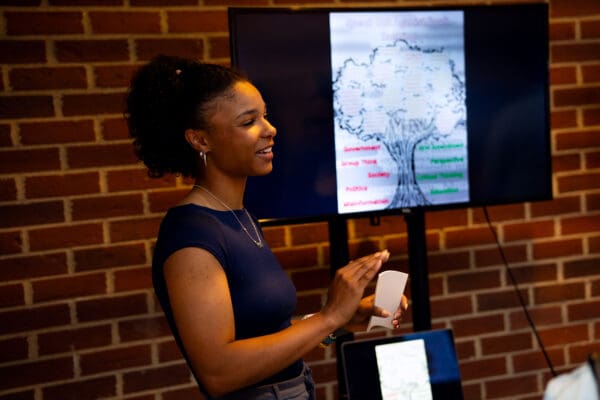
A smartly dressed Nichols College Pyschology degree student presents to a classroom in front of a projector holding index cards.

BA in Psychology

at Nichols College

Curious about how people make decisions, build relationships or respond to stress? You can gain the tools you need to explore these questions and more with a degree in psychology from Nichols College.

Through foundational courses as well as electives in areas like forensic psychology, sport psychology and group dynamics, you’ll investigate the fascinating complexity of human behavior.

In our program, you’ll work closely with an advisor to focus your studies in an area of interest that’s both personally and professionally meaningful, and you’ll find additional opportunities to enhance your growth through experiential learning. You’ll be prepared for success, whether your goal is to start your career or pursue graduate school after college.
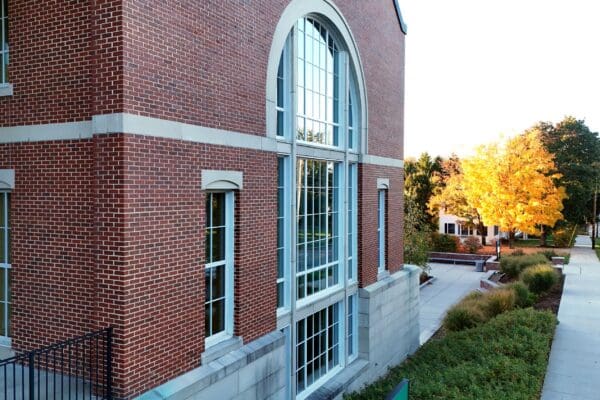
Close-up exterior of a Nichols College brick building with a large arched window, with a vibrant yellow fall foliage tree visible along the campus sidewalk

Why Study Psychology at Nichols College?

Students in our psychology program analyze challenging questions about why people think, feel and act the way they do, and they benefit from learning that bridges the gap between theory and real-life application. Here's what sets our program apart:

Flexible Concentration Options

Combine electives to form thematic concentrations that align with your career goals, from clinical to organizational psychology

Faculty With Field Experience

Learn from professors who bring experience as researchers, clinical psychologists and mental health counselors

Hands-On Learning

Put concepts into practice and earn credit by helping faculty with research or teaching or by pursuing an advanced project

Graduate School Pathways

Benefit from strong advanced study readiness—many of our recent psychology grads were successfully accepted into graduate school

Professional Connections

Engage with professionals and secure meaningful internships through our career contacts, hands-on employer experiences and alumni network that's 16,000+ members strong

Worcester County Location

Benefit from strategic access to New England's psychology and counseling landscape while getting the personal attention of a close-knit campus community

Plus, our program is AACSB-accredited—only six percent of institutions worldwide are accredited by the prestigious Association to Advance Collegiate Schools of Business.

Experiential Learning at Nichols College

Hands-on, experiential learning is a key component of a Nichols education. Every liberal arts student completes an internship or engages in an experiential learning opportunity guided by a faculty member as an alternative to a traditional internship—and many do both, as well as complete industry certifications. Add holistic professional development to that hands-on foundation, and you get real results—95% of recent graduates secured jobs or entered graduate school within six months. All from a college ranked top 10 nationally among undergraduate business schools for mid-career salary potential and best value.

A Nichols College student intern assists with an event at historic Fenway Park in Boston.

Student-Faculty Projects

From assisting with faculty research and teaching to working on an advanced project with your professor, there are many ways to extend your learning beyond the classroom at Nichols.

Student-Run Opportunities

Whether you’re managing the Thunder Fund, working with Bison Consulting clients, helping run the Nichols Dudley Hill Golf Course Club and Bison Den or pitching ideas to companies, you’ll build career-ready skills.

Holistic Professional Development

Build confidence and vital soft skills through experiences that take you into the community, paired with public speaking practice, networking etiquette and signature leadership development.

Study Abroad

Take your education global through faculty-led trips, international internships, semester abroad programs and short-term travel that let you earn Nichols credits while expanding your worldview.

Careers in Psychology

A degree in psychology develops expertise in human behavior as well as skills that are transferable across industries: effective communication, problem-solving and research. Graduates can go on to work in healthcare, business, education and social services, among other sectors.

Career possibilities include:

  • Case manager
  • Child care worker
  • Laboratory assistant
  • Market researcher
  • Research assistant
  • Probation and parole officer
And More
Two Nichols College students in professional attire laughing together at a career and internship fair booth

Meet Your Faculty

Thomas Davis

Professor of Psychology 508-213-2126

Brian McCoy

Professor of Psychology 508-213-2242

Arthur McGovern

Professor of Psychology 508-213-2123

Arden Bowser

Adjunct Professor
FAQ

Frequently Asked Questions About Our Psychology Program

What makes the Nichols College psychology degree program different from other psychology programs in New England?

Our program stands out through our commitment to experiential learning. We emphasize research projects, teaching assistant opportunities and internships that prepare students for both immediate careers and graduate school. Our flexible curriculum allows students to combine electives into personalized concentrations aligned with career goals.

How does the psychology program prepare students for graduate school?

Students gain research experience through faculty-led projects, develop strong writing and analytical skills through coursework and build professional relationships through mentorship with committed faculty. The bachelor’s degree in psychology program covers essential graduate school prerequisites including research methods, statistics and diverse psychology foundations from abnormal to cognitive psychology. Faculty advisors guide students through graduate school selection and preparation for entrance exams, while experiential learning provides the practical experience that strengthens graduate applications.

What career opportunities are available with a bachelor's degree in psychology?

Graduates work as case managers, market researchers, human resources specialists, probation officers, research assistants, social service specialists and more. Many students combine psychology with business, criminal justice or communication for specialized career preparation. While some graduates pursue immediate careers, others use their bachelor’s degree in psychology as a foundation for graduate programs in clinical psychology, counseling, social work or organizational behavior.

Psychology Degree Courses

Required Courses

In this overview course, students will learn the principles and applications of psychology for practical purposes and across disciplines. The practical applications of psychological research to issues and problems facing the world will be addressed. Students will learn and be actively engaged in how psychological findings can be used in a large variety of contexts. This course is a core requirement for all psychology majors.

This course's purpose is to develop knowledge of when to apply the correct statistical techniques. Emphasis is placed on the "real world" applications of statistical methods through projects. Topics include descriptive and inferential statistics, multivariate, parametric, and nonparametric techniques. This course makes extensive use of statistical analysis software. This course is a core requirement for all psychology majors, is the prerequisite for Applied Research Methods II, and is offered in the fall semester.

Students will integrate the knowledge they have accumulated in their first three years as psychology majors through the development and investigation of their own applied psychology hypotheses. In collaboration with the instructor and classmates, students will proceed through the stages of research from hypothesis development to literature review, to proposing their research methods, to data collection, with their semester-long project culminating in a written APA (American Psychological Association) format research paper and presentation of findings via a faculty-judged poster session. This course is offered in the spring semester and is a core requirement for all psychology majors and satisfies that program writing intensive and information literacy and experiential learning requirements.

Psychology Foundations

Four required from courses listed below:

The course reviews human development from pregnancy and prenatal development through old age with a unique balance and depth of coverage across all age groups. We will examine the physical and intellectual changes humans undergo from conception through death. With an emphasis on modern cultural and societal issues ranging from homophobia to family violence, this course builds on the basic themes of life-span development.

In this course, students will examine various theories underlying the development of human temperament. We will start with modern theories and then explore earlier and more esoteric approaches to the topic. We will also look at the profound effect temperament has on perception, communication, and relationships. Knowledge of human temperament is fundamentally pragmatic, and this project-based course will help students relate to themselves and the social world around them.

This course will provide a basic introduction to the biological processes underlying human behavior. A basic principle of this course is that everything the "mind" does will eventually be explained in terms of the interplay among various brain components. In the context of the brain-behavior interaction, we will study the biological mechanisms that are the most relevant to essential issues in psychology.

This course reviews the major contemporary theories and techniques of counseling. Students have opportunities to observe counseling situations and to practice counseling techniques. Ethical and professional issues are also addressed.

An introduction to the basic concepts and theories of human cognition. Topics include attention, memory, knowledge organization, language, reasoning, artificial intelligence, and artificial life.

This course examines the factors impacting human relationships. Emphasis is placed on interpersonal attraction, attitude formation, social perception and cognition, altruism, aggression, small group behavior, and social identity and influence.

The major forms of abnormal behavior are described. They are discussed in light of an integrative bio-social model. Disorders include anxiety disorders, personality disorders, sexual deviance, and dysfunction, dissociate and somatoform disorders, mood disorders, childhood disorders, substance use disorders, schizophrenia, and cognitive disorders. Treatment approaches are discussed as well.

Electives

Three required from courses listed below, or additional selection from Psychology Foundations courses

Why do they do it? The psychology of individuals who engage in extreme political violence such as terrorist acts has become the subject of intense controversy in step with the rise of "homegrown" terrorism. Are terrorists insane or suicidal? Are they merely angry and alienated? Or are they motivated by perverse altruism? How is terrorism really different from mass shootings? These are just some of the questions that we will focus on in this class.

Why is coaching one of the most rewarding professions? Are you driven to help others perform at their best? What is the "magic" to motivation and confidence? Is there a coach that you admire? Empowering your athletes for peak performance is key to coaching. Exploring effective coaching behaviors and techniques are only the starting point to developing a personal coaching style. Observation, application, and practice in all forms will be at the core of this course.

Humor is serious business. Sure, there's simple comedy, like a pie in the face or a Tyler Perry movie, but a lot of humor displays real intellect, and despite much reflection and experimentation-both in labs and on stages-no one has yet discovered a unified theory of hilarity. This course examines the mechanisms and models of humor, interpersonal humor, and the linkages of humor to personality, the practical use of humor in multiple settings, the biological and psychological connections humor has to one's health and well-being, and how-to bring humor to everyday life. Disclaimer: In this course you will be viewing and reading material that contains profane language and, in some cases, sexual content, racist stereotypes, and references to drug abuse/use. Should there be things you feel uncomfortable with reading or viewing - then this course may not be suitable for you.

Why do I wake up happy one day and sad the next? Why is it I cannot describe why I am feeling a certain way? This course introduces students to a range of issues related to our study of emotions. We will review theories, functions, mechanisms, and meanings of emotions - in other words the "what" and the "why" of feeling states. Students will then examine the nature and implications of emotions such as happiness and sadness, joy, and pain, hope and fear, as well as shame, guilt and remorse, through the readings of memoirs and articles, listening to podcasts, viewing films, and class discussions. Finally, we consider how people regulate moods and deal with overwhelming emotions. After completing the course, students will be able to describe why people feel the way they do when dealing with various aspects of life.

What is happiness? We know it when we feel it, and certainly, when we do not. We want it for ourselves and for those we care about. Happiness can be our ultimate goal in life that motivates everything we do and gives life meaning. Yet despite our familiarity with the concept, happiness is misunderstood. This course applies scientific methods, models, and evidence to investigate happiness. The class is not meant as a recipe for happiness, but as an analytical study of how scholars struggle to define and study it.

The Psychology of Sleep and Dreaming explores the mysterious and uncharted world of sleep and dreams. Our journey will make you question your beliefs about the role of sleep in your life while discovering the importance of sleep for improving your physical and mental health. Our exploration examines normal sleep behavior, the neuroscience of sleep, dreaming and consciousness, circadian and biological rhythms, and the diagnosis and treatment of sleep disorders such as narcolepsy, insomnia, and hypersomnia. Not only will you learn about sleep in general, but you will also gain insight into your own sleeping patterns using dream analysis software. Through lectures, podcasts, exercises and film discussion, students will learn about the importance of sleep for mental and physical wellbeing and how to best establish a healthy sleep routine.

Most courses on addiction focus on demographics, epistemology, clinical diagnosis, and treatment. This course will examine these matters, but also the life and experiences of addiction through the lens of those that have experienced addiction, firsthand. Through autobiographies (books & film) and use of a phenomenological methodology of inquiry, students will explore the behaviors and consequences of drug and alcohol addiction, hoarding, gambling, and sex addiction. Disclaimer: In this course you will be viewing and reading material that contains profane language and, in some cases, sexual content, racist stereotypes, and references to drug abuse/use. Should there be things you feel uncomfortable with reading or viewing - then this course may not be suitable for you.

Why wait to learn leadership in the workplace? Research in leadership indicates that anyone can be a leader, regardless of age or experience. This course challenges students to examine their own leadership potential through an on-campus experiential internship. Throughout the semester students will apply Kouzes and Posner's five practices of exemplary leadership (Model the Way, Inspire a Shared Vision, Challenge the Process, Enable Others to Act, and Encourage the Heart) to enhance their own leadership experience. Students will also engage in activities, both in and outside of the classroom, that challenge them to ultimately discover the psychology behind leadership by practicing it.

This course explores, from psychological and sociological perspectives, the characteristics of men and women who commit multiple murders. Through the in-depth examination of known serial killers, students will learn what is serial killing; how a serial killer is different from a mass murderer; what factors explain serial killing; how prevalent it is; and what are the recent trends in understanding their behavior. Disclaimer: In this course you will be viewing and reading material that contains profane language and, in some cases, sexual content, racist stereotypes, and references to drug abuse/use. Should there be things you feel uncomfortable with reading or viewing - then this course may not be suitable for you.

This course examines in depth a major issue, problem, or theme in the area of psychology. It includes a specialized research paper or project, involves discussion and oral and written reports, and may include guest speakers and field trips.

Study of the physical, intellectual, emotional, and social development of the adolescent. The focus is on contemporary concerns of youth.

Forensic psychology offers fascinating insights into the origins and motives of criminal behaviors and the practical applications of psychological principles. Perhaps you want to be a forensic psychologist, or maybe you are just curious about how people behave in criminal and legal settings, and why they behave in these ways. Either way this course is designed to meet your need for information. It provides a comprehensive overview of forensic psychology, bridges the gap between research and application, and explores the 'mystique' that surrounds the topics of the field. Through a focus on global research, examples, and real-life cases studies, you will learn about fascinating topics such as the reliability of eyewitness testimony, indicators of deception and methods of lie detection, the willingness of innocent people to confess to crimes, and our ability to profile and capture offenders. Disclaimer: In this course you will be viewing and reading material that contains profane language and, in some cases, sexual content, racist stereotypes, and references to drug abuse/use. Should there be things you feel uncomfortable with reading or viewing - then this course may not be suitable for you.

This class will explore and discuss different portrayals and corresponding intellectual and emotional narratives of human suffering or psychopathology using the medium of film. The primary goals of the course are to refine student's critical thinking skills applicable to the study of abnormal behavior, raise awareness of the social stigma associated with mental illness, and to understand these issues in a broad cultural context. Disclaimer: In this course you will be viewing and reading material that contains profane language and, in some cases, sexual content, racist stereotypes, and references to drug abuse/use. Should there be things you feel uncomfortable with reading or viewing - then this course may not be suitable for you.

Many psychological disorders are common during childhood affecting children, their families, and society. Using a case study format, this course explores abnormal psychology as it relates to children. We will examine the causes, maintenance, and treatment of children's behavioral, social-emotional, and cognitive disorders from a developmental perspective.

This course examines the formation of groups, group processes, followership, and leadership processes within groups and group behaviors. Emphasis is placed on the experience of applying group theory.

A study of the psychological process of adapting to, coping with, and managing the problems, challenges, and demands of everyday life. This course is about adjusting to challenges as one gets on with the business of living: building relationships, becoming educated, establishing careers, and getting older. Topics include coping with stress, the self, forming impressions of others, prejudice, conformity, interpersonal communication, relationships, gender, sexuality, and career issues.

This course examines in depth a major issue, problem, or theme in the area of psychology. It includes a specialized research paper or project, involves discussion and oral and written reports, and may include guest speakers and field trips.

An exploration of what it means to be "human" and a "sexual" being. This class is an opportunity to discuss and debate attitudes, research, and one's own perceptions of sexuality in order to understand those of others. This course will not only ensure that you acquire basic factual information about human sexuality, but also will give you opportunity to think about your own sexual values and behaviors. Topics such as the sexual response cycle, birth control, abortion, sexual morality, love and intimacy, sexual orientation, developmental changes in sexuality, sexual dysfunctions and disabilities, prostitution, pornography, and sexual violence will be discussed.

This course examines in depth a major issue, problem, or theme in the area of psychology. It includes a specialized research paper or project, involves discussion and oral and written reports, and may include guest speakers and field trips.

Students engage in individually supervised work-study arrangements and learn to apply psychological theory and principles in a work environment (e.g., day care center or mental health clinic). Students must work at least 10 hours per week on the job, meet periodically with a supervising faculty member, research literature related to the field of the internship, and prepare a substantive report on their internship experiences and the studies involved.

No description available.

No description available.

Free Electives

21 credit-hours of electives

Interested in Learning More?

Join us at one of our upcoming campus events in Dudley, MA, or schedule a campus visit. You can also contact our Admissions team to discuss your academic goals and how Nichols can help you reach them.