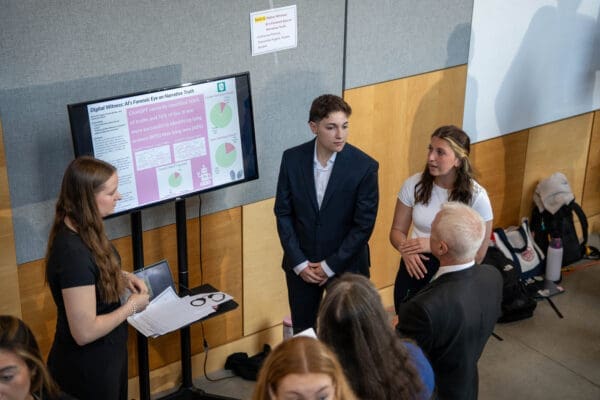
Three Nichols College students present their research project on AI and narrative truth to a faculty member at an academic research symposium

BA in Criminal Psychology

at Nichols College

Understanding why people act the way they do—especially in high-stakes situations—is at the heart of a Bachelor of Arts in criminal psychology from Nichols College.

In a unique undergraduate program that blends psychological theory with criminal justice coursework, students examine the minds behind crime, explore investigative techniques and learn about community safety initiatives.

Whether you aim to pursue a career in forensic services, mental health support or criminal investigation or advanced study after graduation, our curriculum provides the academic depth and applied learning you need to thrive in the field.

Located in Central Massachusetts, Nichols offers access to a wide range of internship opportunities and partnerships with local agencies including the Massachusetts State Police and the Worcester County District Attorney’s Office. If you’re drawn to both psychology and criminal justice, our criminal psychology program offers a versatile and practical path forward.
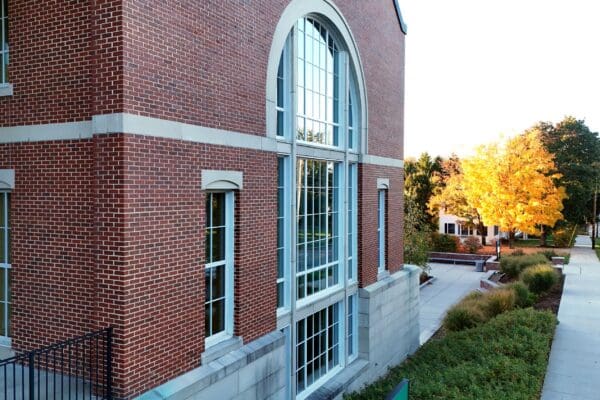
Close-up exterior of a Nichols College brick building with a large arched window, with a vibrant yellow fall foliage tree visible along the campus sidewalk

Why Study Criminal Psychology at Nichols College?

Our criminal psychology program combines classroom theory with experiential learning opportunities while developing critical thinking and analytical skills that employers value. Here’s what sets our program apart:

Faculty With Field Experience

Learn from professors who've worked in law enforcement, counterterrorism, victim services and corrections and have relationships with the FBI, Massachusetts State Police, Worcester District Attorney’s office and Massachusetts Trial Court

Worcester County Location

Benefit from access to law enforcement, criminal justice and psychological counseling networks across Central Massachusetts and beyond, all while getting the personal attention of a close-knit campus community

Professional Connections

Engage with professionals and secure meaningful internships through our career contacts, hands-on employer experiences and alumni network that's 16,000+ members strong

Individualized Mentorship

Get individualized attention and career guidance tailored to your specific interests in criminal justice or psychology

Hands-On Learning

Gain real-world perspectives with our program’s applied approach that includes hands-on activities, from mock crime scene investigations to psychological assessments to research projects

Plus, our program is AACSB-accredited—only six percent of institutions worldwide are accredited by the prestigious Association to Advance Collegiate Schools of Business.

Experiential Learning at Nichols College

Hands-on, experiential learning is a key component of a Nichols education. Every business student completes an internship, a professional certification and a research, experiential or consulting project before they graduate. Add holistic professional development to that hands-on foundation, and you get real results—95% of recent graduates secured jobs or entered graduate school within six months. All from a college ranked top 10 nationally among undergraduate business schools for mid-career salary potential and best value.

A Nichols College student intern assists with an event at historic Fenway Park in Boston.

Student-Faculty Projects

From assisting with faculty research and teaching to working on an advanced project with your professor, there are many ways to extend your learning beyond the classroom at Nichols.

Student-Run Opportunities

Whether you’re managing the Thunder Fund, working with Bison Consulting clients, helping run the Nichols Dudley Hill Golf Course Club and Bison Den or pitching ideas to companies, you’ll build career-ready skills.

Holistic Professional Development

Build confidence and vital soft skills through experiences that take you into the community, paired with public speaking practice, networking etiquette and signature leadership development.

Study Abroad

Take your education global through faculty-led trips, international internships, semester abroad programs and short-term travel that let you earn Nichols credits while expanding your worldview.

Careers in Criminal Psychology

Criminal psychology degrees open doors to roles in both public service and the private sector. Graduates may pursue advanced degrees in forensic psychology, social work or law while others choose to begin meaningful careers right away in mental health, community outreach or law enforcement.

Career possibilities include:

  • Forensic psychologist
  • Victim advocate
  • Criminal investigator
  • Behavioral analyst
  • Case manager
And More
Two Nichols College students in professional attire laughing together at a career and internship fair booth

Meet Your Faculty

Allison McDowell-Smith

Associate Professor of Criminal Justice & Counterterrorism 508-213-2273

Brian McCoy

Professor of Psychology 508-213-2242

Thomas Davis

Professor of Psychology 508-213-2126

Nathaniel Lawshe

Assistant Professor of Criminal Justice 508-213-2194
FAQ

Frequently Asked Questions About Our Criminal Psychology Program

What makes the Nichols criminal psychology program different?

Unlike broader psychology programs, ours is focused specifically on criminal behavior, investigation and legal applications, providing both academic rigor and experiential learning opportunities.

Are internships required for this major?

While not mandatory, internships are highly encouraged and supported. Most students complete at least one internship with a law enforcement agency or nonprofit organization before graduating.

Can I double major or minor with this program?

Yes! Many students pair criminal psychology with a minor to broaden their career options. Note: Students may only major in criminal justice, psychology or criminal psychology. There is NOT an option to major in more than one of these three majors.

Criminal Psychology Degree Courses

Students complete a combination of core and elective courses such as:

Required Courses

This course provides an Introduction to the Criminal Justice System, including its basic components: policing, the courts, and corrections. The primary goal is for students to develop a basic understanding of the justice system and its response to crime at the State and Federal levels. This class explores historical and emerging issues involved with the nature and measurement of crimes, patterns of offenders, and victimization.

This course will provide an in-depth examination of the crimes and actions most encountered by the private industry and the public law enforcement officer. We will also examine recent court decisions. Students will become acquainted with concepts of search and seizure, individual restraint, and limitations of personal freedom and expression.

This course will focus on the development of the skills necessary to elicit information from victims, potential witnesses and/or offenders. Topics include the art of interviewing, deception detection, and the use of legal and ethical interrogation techniques to obtain factual information regarding a crime. You will learn critical listening and questioning skills and sharpen their application through practical exercises in class and field assignments.

Within the field of criminal justice, it is necessary to understand why some people commit crimes and others do not. Crime rates throughout the world are continuously monitored and everyone wants to know the profile of the typical offender; yet it is relevant that we explore the principles and theories that correlate with crime rates and its offenders. This course will explore historical and contemporary theories of the causes of crime; including theories derived from biological, psychological, sociological, geographic, economic, and political perspectives.

Forensic psychology offers fascinating insights into the origins and motives of criminal behaviors and the practical applications of psychological principles. Perhaps you want to be a forensic psychologist, or maybe you are just curious about how people behave in criminal and legal settings, and why they behave in these ways. Either way this course is designed to meet your need for information. It provides a comprehensive overview of forensic psychology, bridges the gap between research and application, and explores the 'mystique' that surrounds the topics of the field. Through a focus on global research, examples, and real-life cases studies, you will learn about fascinating topics such as the reliability of eyewitness testimony, indicators of deception and methods of lie detection, the willingness of innocent people to confess to crimes, and our ability to profile and capture offenders. Disclaimer: In this course you will be viewing and reading material that contains profane language and, in some cases, sexual content, racist stereotypes, and references to drug abuse/use. Should there be things you feel uncomfortable with reading or viewing - then this course may not be suitable for you.

This course's purpose is to develop knowledge of when to apply the correct statistical techniques. Emphasis is placed on the "real world" applications of statistical methods through projects. Topics include descriptive and inferential statistics, multivariate, parametric, and nonparametric techniques. This course makes extensive use of statistical analysis software. This course is a core requirement for all psychology majors, is the prerequisite for Applied Research Methods II, and is offered in the fall semester.

The major forms of abnormal behavior are described. They are discussed in light of an integrative bio-social model. Disorders include anxiety disorders, personality disorders, sexual deviance, and dysfunction, dissociate and somatoform disorders, mood disorders, childhood disorders, substance use disorders, schizophrenia, and cognitive disorders. Treatment approaches are discussed as well.

Students will integrate the knowledge they have accumulated in their first three years as psychology majors through the development and investigation of their own applied psychology hypotheses. In collaboration with the instructor and classmates, students will proceed through the stages of research from hypothesis development to literature review, to proposing their research methods, to data collection, with their semester-long project culminating in a written APA (American Psychological Association) format research paper and presentation of findings via a faculty-judged poster session. This course is offered in the spring semester and is a core requirement for all psychology majors and satisfies that program writing intensive and information literacy and experiential learning requirements.

Students engage in individually supervised work-study arrangements and learn to apply criminal psychological theory and principles in a work environment. Students must work at least 10 hours per week on the job, meet periodically with a supervising faculty member, research literature related to the field of the internship, and prepare a substantive report on their internship experiences and the studies involved.

and one from

The United States Constitution is the operating manual of our government. This course examines how the criminal justice system is underpinned by that great document. Since the United States Constitution determines the processes and definitions of Criminal and Social Justice in our society, it is necessary to study the history and origins of applicable legal doctrines as they relate to the practices of today's criminal justice system. We will utilize court cases involving the constitutionality of the administration of justice. We will examine these topics in a layered approach incorporating legal, empirical, and policy implementations. Ethical, procedural, and political issues will also be examined and debated.

Specialty courts are defined as those courts that provide custom treatment to specific challenges, such as drugs, veterans, mental health, homeless, domestic abuse, etc. This course examines how specialty courts operate within the criminal justice system. Emphasis is placed on the definitions and processes of specialty courts within both the Commonwealth of MA and the United States. We will utilize court cases to explore specialty courts in depth and will provide experiential learning opportunities for students to immerse themselves within specialty courts.

Electives

Choose three of any CJ/PSY/CPSY course at a 200-level or higher. Must include at least one CJ course and one PSY course.

Free Electives

12 credit-hours of electives

Interested in Learning More?

Join us at one of our upcoming campus events in Dudley, MA, or schedule a campus visit. You can also contact our Admissions team to discuss your academic goals and how Nichols can help you reach them.