
A Criminal Justice student at Nichols College points at her presentation on a projector about the US prison system.

BA in Criminal Justice

at Nichols at College

The criminal justice field is built on people who make communities safer. You can learn how to make that kind of impact and launch a rewarding career in law enforcement, corrections or legal services with a Bachelor of Arts in criminal justice from Nichols College.

Our undergraduate program covers essential topics like criminal law, police procedures and court systems within a curriculum focused on ethical security practices and real-world learning.

With five core tracks, our program is designed to prepare you for success in this dynamic field, whether your goal is to pursue a career or advanced study after graduation.

Located in Central Massachusetts, Nichols offers students with exceptional internship access throughout New England thanks to our strong partnerships, including with local agencies such as the Worcester County Sheriff’s Department and Massachusetts State Police, which will help you satisfy the program’s internship requirement. Our graduates are well-positioned to launch successful careers in criminal justice throughout the region or anywhere their ambitions take them.
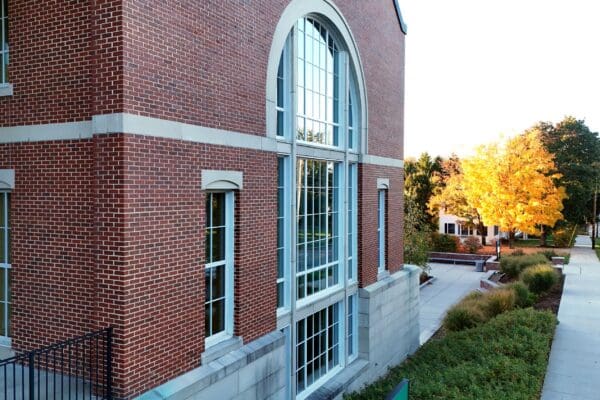
Close-up exterior of a Nichols College brick building with a large arched window, with a vibrant yellow fall foliage tree visible along the campus sidewalk

Why Study Criminal Justice at Nichols College?

Our criminal justice program combines theoretical knowledge with practical skills and internship opportunities to develop career-ready graduates. Here’s what sets our program apart:

Adaptable Pathways

Focus your studies in an area that interests you most by choosing between our five core tracks, which include counterterrorism, courts, law enforcement, policy and social work, all within a liberal arts curriculum

Faculty With Field Experience

Learn from professors who’ve worked in the areas you’re learning about and who bring their industry insights into the classroom

Agency Partnerships

Jump-start your career with unparalleled access to internship opportunities, with faculty leveraging their industry contacts in departments and precincts across New England and our career and alumni networks standing ready to assist you

Hands-On Learning

Put your learning into practice with our program’s applied approach that includes hands-on activities, from mock crime scene investigations to interrogations training to research projects and certifications

Professional Connections

Engage with professionals and secure meaningful internships through our career contacts, hands-on employer experiences and alumni network that's 16,000+ members strong

Worcester County Location

Benefit from access to active criminal justice organizations across Central Massachusetts while getting the personal attention of a close-knit campus community

Plus, our program is AACSB-accredited—only six percent of institutions worldwide are accredited by the prestigious Association to Advance Collegiate Schools of Business.

Experiential Learning at Nichols College

Hands-on, experiential learning is a key component of a Nichols education. Every liberal arts student completes an internship or engages in an experiential learning opportunity guided by a faculty member as an alternative to a traditional internship—and many do both, as well as complete industry certifications. Add holistic professional development to that hands-on foundation, and you get real results—95% of recent graduates secured jobs or entered graduate school within six months. All from a college ranked top 10 nationally among undergraduate business schools for mid-career salary potential and best value.

A Nichols College student intern assists with an event at historic Fenway Park in Boston.

Student-Faculty Projects

From assisting with faculty research and teaching to working on an advanced project with your professor, there are many ways to extend your learning beyond the classroom at Nichols.

Student-Run Opportunities

Whether you’re managing the Thunder Fund, working with Bison Consulting clients, helping run the Nichols Dudley Hill Golf Course Club and Bison Den or pitching ideas to companies, you’ll build career-ready skills.

Holistic Professional Development

Build confidence and vital soft skills through experiences that take you into the community, paired with public speaking practice, networking etiquette and signature leadership development.

Study Abroad

Take your education global through faculty-led trips, international internships, semester abroad programs and short-term travel that let you earn Nichols credits while expanding your worldview.

Careers in Criminal Justice

Criminal justice is a flexible major for anyone who wants to make a difference in their community, with careers spanning from emergency response officers to analysts who study crime trends.

Career possibilities include:

  • Police officer
  • Forensic technician
  • Parole or probation officer
  • Court reporter
  • Private investigator
  • Social worker
And More
Two Nichols College students in professional attire laughing together at a career and internship fair booth

Meet Your Faculty

Allison McDowell-Smith

Associate Professor of Criminal Justice & Counterterrorism 508-213-2273

Boyd Brown

Associate Professor of Criminal Justice 508-213-2247

Nathaniel Lawshe

Assistant Professor of Criminal Justice 508-213-2194

Steve Wojnar

Director of Public Safety

William Keefe

Adjunct Professor 508-213-2236

Edward Romano

Adjunct Professor

Christopher Weagle

Adjunct Faculty of Criminal Justice

Timothy

Undergraduate Faculty
FAQ

Frequently Asked Questions

Can I double major or add a minor with the criminal justice program at Nichols College?

Yes, you can double major in criminal justice and another field, or add a minor to complement your degree. Popular combinations include business, psychology or communications. This flexibility allows you to customize your education to match your career goals, whether you’re interested in corporate security, legal studies or specialized law enforcement roles. Your academic advisor will help you create a plan that fits your interests and timeline.

How does a degree in criminal justice prepare me for a career in law enforcement?

Our criminal justice program gives you the practical skills and theoretical knowledge law enforcement agencies seek. You’ll study criminal law, investigative techniques, ethics and the justice system while gaining hands-on experience through internships.

Are there honor societies or special recognition opportunities for high-achieving criminal justice students?

Yes, exceptional criminal justice students at Nichols College can be inducted into Alpha Phi Sigma, the prestigious national honor society for criminal justice students. Additionally, qualifying students may be eligible to receive the James L. Dunbar Scholarship in Criminal Justice. This scholarship is awarded to rising juniors or seniors specializing in criminal justice based on their academic achievement and service to the Nichols College community.

Criminal Justice Courses

Economics majors must complete 121 credit hours (approximately 40 courses), including courses from the liberal arts core curricula, focused electives and these required specialization courses:

Required Courses

This course provides an Introduction to the Criminal Justice System, including its basic components: policing, the courts, and corrections. The primary goal is for students to develop a basic understanding of the justice system and its response to crime at the State and Federal levels. This class explores historical and emerging issues involved with the nature and measurement of crimes, patterns of offenders, and victimization.

This course will provide an in-depth examination of the crimes and actions most encountered by the private industry and the public law enforcement officer. We will also examine recent court decisions. Students will become acquainted with concepts of search and seizure, individual restraint, and limitations of personal freedom and expression.

Within the field of criminal justice, it is necessary to understand why some people commit crimes and others do not. Crime rates throughout the world are continuously monitored and everyone wants to know the profile of the typical offender; yet it is relevant that we explore the principles and theories that correlate with crime rates and its offenders. This course will explore historical and contemporary theories of the causes of crime; including theories derived from biological, psychological, sociological, geographic, economic, and political perspectives.

Internships are among the most critical components of a student's education. This closely supervised on-the-job training is designed to provide students with opportunities to apply their criminal justice course work in a professional setting. Internships are completed under the guidance of an on-site supervisor and a faculty sponsor. Students will enroll in a three-credit course which requires 120 hours of work at the internship site as well as additional academic requirements. Internships may be in both the public or private sector, and at state, local or federal levels. International internships will also be considered.

Terrorism has become one of the defining security concerns of the 21st century. However, the definition of terrorism and how it should be confronted, is a complex, and often divisive topic. In this course we will conduct an in-depth examination of the historical foundations of terrorism and its modern form. Students will learn about terrorist ideology, organizational structure, and methods of operation. Students will discuss and understand the concepts of domestic terrorism and its implications within both public and private sectors, as well as political and social ramifications.

This capstone course will examine state-of-the-art (best practice) methodologies, strategies and approaches relevant to the acquisition of skills, competencies and conceptual (big picture) expertise necessary for successful and effective security management, as well as research emerging in the field of criminal justice. This course will emphasize qualitative and quantitative (analytical) approaches relevant to the accurate forecasting, identification and assessment of security-related issues, and concerns in multi-national environments using problem-based learning as the primary instructional strategy.

and one of the following:

The United States Constitution is the operating manual of our government. This course examines how the criminal justice system is underpinned by that great document. Since the United States Constitution determines the processes and definitions of Criminal and Social Justice in our society, it is necessary to study the history and origins of applicable legal doctrines as they relate to the practices of today's criminal justice system. We will utilize court cases involving the constitutionality of the administration of justice. We will examine these topics in a layered approach incorporating legal, empirical, and policy implementations. Ethical, procedural, and political issues will also be examined and debated.

Specialty courts are defined as those courts that provide custom treatment to specific challenges, such as drugs, veterans, mental health, homeless, domestic abuse, etc. This course examines how specialty courts operate within the criminal justice system. Emphasis is placed on the definitions and processes of specialty courts within both the Commonwealth of MA and the United States. We will utilize court cases to explore specialty courts in depth and will provide experiential learning opportunities for students to immerse themselves within specialty courts.

Elective Courses

Choose four additional courses:

This course examines the fundamentals of cybersecurity and various measures to avoid becoming a victim of cybercrime. Students will look at the current challenges of combating cybercrime and ways to avoid becoming a victim through real-world case studies and discussions of cybersecurity best practices. Students will learn key terms, concepts, and techniques to apply cybersecurity both at home and in work environments. Finally, the course delves into understanding the current cybercrime trends and threats posed to individuals and organizations in and through cyberspace.

The United States Constitution is the operating manual of our government. This course examines how the criminal justice system is underpinned by that great document. Since the United States Constitution determines the processes and definitions of Criminal and Social Justice in our society, it is necessary to study the history and origins of applicable legal doctrines as they relate to the practices of today's criminal justice system. We will utilize court cases involving the constitutionality of the administration of justice. We will examine these topics in a layered approach incorporating legal, empirical, and policy implementations. Ethical, procedural, and political issues will also be examined and debated.

Specialty courts are defined as those courts that provide custom treatment to specific challenges, such as drugs, veterans, mental health, homeless, domestic abuse, etc. This course examines how specialty courts operate within the criminal justice system. Emphasis is placed on the definitions and processes of specialty courts within both the Commonwealth of MA and the United States. We will utilize court cases to explore specialty courts in depth and will provide experiential learning opportunities for students to immerse themselves within specialty courts.

American Corrections provides students with a fundamental understanding of corrections through historical development, modern engagement, and future implications. This course focuses on philosophies and theories of punishment, operational structure of the American Correctional Model, and experiences of incarcerated individuals and correctional staff. It further explores challenges facing corrections today, to include sentencing, offender management, legal concerns, special populations, and reentry.

In this course, students will be introduced to the dynamic process of security investigations. We will explore the characteristics that investigators rely upon to be successful, the process that is followed during an investigation, and the legal requirements that guide how investigations must be conducted. Students will develop interview and interrogation skills and examine unsolved cases as part of their exploration of how investigations, both for law enforcement and in the private sector.

This course will explore a gendered approach to violence, including violent extremism and terrorism. Preconceived notions will be challenged. Focus will be placed on the motivations for participation in violent crimes, including the relationship between conflict and violence both locally and globally. Exploration of the radicalization process of females and methods to combat this radicalization process will be analyzed.

The forensic sciences have become a vital part of our criminal justice system over the past several decades. A rise in more sophisticated technology and several high-profile cases have helped to move forensic science out of the laboratory and into popular culture. This class will present the forensic sciences in a straightforward fashion. Basic scientific principles will be explained, and case examples used to understand how those principles are applied. An emphasis will be placed on the role of the crime scene investigator and how they preserve, record, and collect evidence at the crime scene. Specific areas of study will include how a crime scene is recorded and evidence collected, death investigations, crime scene reconstruction, fingerprints, blood spatter analysis, ballistics, fire and explosion investigations, trace evidence, and the use of DNA.

This course is offered on an occasional basis and addresses topics and themes of special interest not covered in the standard course offering in criminal justice.

This course introduces students to scientific methodology as it relates to criminal justice in order for students to become researchers and understand the field of research as it relates to criminal justice. This course provides students with an understanding of the methods of research available to criminologists and the police. It also connects theory to data and emphasizes the ability to comprehend the logic behind statistical tests of significance. Understanding the development and testing of hypotheses, data collection, data analysis, and presentation of findings is the underlying theme of the course.

This course is offered on an occasional basis and addresses topics and themes of special interest not covered in the standard course offering in criminal justice.

Physical security refers to the complex steps that are taken by security professionals to ensure the safety of facilities, resources, and personnel. This class will have two components. In the first, students will learn core concepts of physical security. In addition, they will learn methods to conduct risk and security assessments. For the second half of the class, students will work in teams and select a local business or organization. They will then consult with that business or organization to conduct a detailed risk and security assessment. Their findings will be concluded in a detailed report that will be sent to the manager of their organization and presented to the rest of the class.

Students will acquire an awareness regarding the concepts of juvenile delinquency, the sociological and developmental views of delinquency as well as environmental influences. Selected theories on delinquency and causes of juvenile delinquency will be presented. The role of the different components of the juvenile justice system including the police, courts, and correctional facilities will be discussed; their impact on prevention and rehabilitation will be emphasized. Juvenile justice advocacy, intervention, preventions and the future of juvenile delinquency and juvenile justice will also be presented.

Key leadership theories and perspectives will be discussed in the public sector context. Students will be challenged to evaluate leadership theories and perspectives aspects from a practical and ethical lens and understand the link between leadership ideas and concepts of public sector leadership, political stakeholders, and constituents. The leadership perspective focuses on how public organization and their leaders cope with change in a complex environment placing multiple and contradicting demands on the organization. Topics include the distinctiveness of leadership in public organization, different types of leadership authority, leadership as institution-building, and public leadership in times of crisis.

This course examines the definition of homegrown (domestic) violent extremism and examines the radical individuals that are involved. The following groups will be evaluated in-depth: Antifa, Earth Liberation Front, Animal Liberation Front, KKK, and ISIS lone-wolf attacks. Students will gain an understanding of how these various homegrown violent extremist groups and individuals have altered our current society. This course will stress that approximately one-third of terrorist attacks within the United States include individuals with no known affiliation to extremist groups, yet they have extreme ideologies. (Previously MSC 705)

Elective Courses

18 credit-hours of electives

Interested in learning more?

Join us at one of our upcoming campus events in Dudley, MA, or schedule a personal visit. You can also contact our Admissions team to discuss your academic goals and how Nichols can help you reach them.