|
NORTH CASCADE GLACIER CLIMATE
PROJECT
Mauri S. Pelto, Director
NCGCP
Nichols College, Dudley, MA 01571 Peltoms@nichols.edu
| Introduction
The impact of the Little Ice Age warming and the current global warming on alpine glaciers provides an analog for the magnitude and rate at which small alpine glaciers adjust to climate change. The 1.0o to 1.5oC post LIA warming resulted in extensive long term glacier retreat (Porter, 1986; Burbank, 1981). An examination of the terminus behavior of fifteen glaciers surrounding Glacier Peak, North Cascades Washington during the last century provides a synopsis of the varying impact of climate change on glaciers and the rate at which small alpine glaciers respond to climate warming. It is a unique opportunity to view the long term behavior of many glaciers on the same mountain massif. This ensures that a representative picture of glacier response is obtained. TERMINUS OBSERVATIONS
GLACIER PEAK SURVEY
Whitechuck Glacier retreated slowly from the LIA maximum until
1930. However, the glacier was rapidly thinning, preparing itself
for rapid retreat. From 1940-1967 the glacier retreated rapidly across the flat lower basin that had been covered by thin ice at the
beginning of the period.
It was still a large glacier in 1967 with a northern and a southern branch.
White River Glacier This glacier has experienced a smaller loss in area from
its Little Ice Age maximum than any of the other Kololo Peak glaciers because
most of the ice volume loss has been in thinning instead of terminus retreat.
Post LIA retreat up to 1955 was 780 m.
Honeycomb Glacier Honeycomb Glacier is one of the longest and largest glaciers
in the North Cascades. It is currently 4 kilometers long and has
an area of 3.4 km2. It has retreated 1.75 kilometers since its Little
Ice Age Maximum. The glacier was an imposing site to Rusk (1924).
GLACIER PEAK
Scimitar Glacier Scimitar Glacier had the same history as Kennedy Glacier, retreating 1600 m from its LIA maximum by 1946. The first ascent of this glacier in 1956 occurred after Scimitar Glacier had begun advancing into a young alder thicket. The advance of 530 m ended in 1975 with the narrow, steep terminus at 1715 m. In 1994 the glacier had a steep, convex uncrevassed terminus. In 1997 this terminus is stagnant. Without any motion the retreat has been 98 m since 1979. The retreat has been slow because of the thickness of ice at the terminus. Milk Lake Glacier This former glacier was on a ridge extending north from Glacier Peak and had a maximum area of 1.0 km2 at the LIA maximum. Retreat from the maximum was slow, as the glacier mainly thinned. In 1955 and again in 1967 Milk Lake Glacier filled the lake bed at 1840 m. By 1984 the glacier was clearly thinner, and a lake was in evidence around the eastern and southern edge of the glacier. By 1988 this lake had expanded greatly and the glacier had lost half of its area from the 1967 position. By 1997 the glacier had collapsed into the lake, leaving a narrow 50 m wide strip of thin fringing ice. The glacier is gone except for a few remanant ice patches. The area of the new Milk Lake is 0.175 km2. Ptarmigan Glacier Is a north facing glacier below Kennedy Peak. The glacier is a wide slope glacier. Retreat from the Little Ice Age maximum of 1050 m had occurred by 1940. The glacier continued to retreat slowly an additional 50 m by 1967. Between 1967 and 1975 the glacier advanced 75 m. Retreat since 1979 has been 190 m, with most of the retreat since 1997. Vista Glacier This is the northernmost of the large valley glaciers on the east side of Glacier Peak. The glacier begins at 2475 feet beneath Kennedy Peak. The glacier during the LIA joined the Ermine Glacier and extended down to 1345 m. By 1900 when Asahel Curtis photographed this glacier it had retreated 1300 m. By 1946 the glacier had retreated an additional 600 m to its 20th century minimum at 1900 m. In 1955 the glacier had begun a slow advance that had ended by 1975 with a total advance of 105 m. By 1997 the glacier had retreated back to the 1946 position. The lower section of the glacier is thin and uncrevassed, and a rapid retreat is ongoing. Ermine Glacier Beginning at 2690 m this glacier extended down the Vista Creek Valley to 1345 m. The Vista and Ermine Glacier remained connected until the early 20th century. By 1940 the glacier had retreated to the top of a steep bedrock bench that marks the northern edge of the glacier, the bench is at 1960 m. In 1955 the glacier had begun to advance down this bench, but also push further northeast along the top of the bench. A spectacular icefall had formed by 1975 ,just above the terminus, caused by the descent of this steep bench. In 1987 the terminus had thinned but not retreated more than a few meters from the advance position. In 1992 the retreat became rapid, 108 m by 1997. Another 200 m of retreat had occurred by 2005 Dusty Glacier This glacier has the widest most fearsome crevasses of any glacier in the North Cascades. The glacier descends from 2750 m to 2560 m before plunging over an icefall. The glacier levels out in a basin at 2325 m, before descending a second icefall to its current terminus at 1960 m. Dusty Glacier joined with the North Guardian Glacier during the LIA, separating during the 1930’s. During the LIA the glacier advanced to 1465 m. The retreat of this glacier by 1906 when Rusk observed it had been only 400 m. The glacier ended in a basin that was filled with ice, though much of the ice was stagnant. This basin became known as Recession Basin, for the ensuing rapid retreat up until 1946 when the glacier had retreated out of the basin and ended just north of Point 7523 feet at 2020 m. By 1955 advance was underway, an advance of 130 m had already occurred (Hubley, 1956). The advance ceased until 1967 when it began again, the glacier reaching another 150 m down into the upper part of Recession Basin at 1865 m. The terminus today is very active with extensive crevassing. In fact it is a true icefall. If avalanching off of the terminus down the steep slope did not occur, this glacier might maintain its current position. The glacier has retreated 400 m by 2005. North Guardian Glacier The North Guardian Glacier begins at 2630 m. The glacier is steep and extensively crevassed to 2200 m, but then has a gently sloped, uncrevassed nature to its terminus at 1960 m. The LIA retreat of 1500 m had ended by 1946 with the glacier terminating at 2020 m. The ensuing advance greatly increased crevassing. The net advance of 160 m was less than expected, probably because of the low slope basin at the terminus. Retreat has been mainly thinning, versus terminus meltbacke 1979. In 1997 the lower several hundred meters of the glacier had no crevassing. On the north side a separate tongue of the glacier had retreated to its 1946 position. The main terminus continues a slow retreat. Chocolate Glacier This is the largest of the east side valley glaciers. Beginning at 3050 m it descends to 1800 m today. When Rusk (1924) first saw this glacier he noted that it presented a dramatic sediment covered front. Immediately above the terminus it was heavily crevassed and quite active, indicating a slow retreat. This glacier which he named Cool Glacier had retreated little from the alpine meadows fringing the south side of the glacier. The terminus had already retreated 400 m up the narrow valley by 1906 from its LIA. A retreat of 1380 m occurred between 1906 and 1946. The retreat was noted to be particularly rapid during the 1920-1940 period by Austin Post. Glacier advance had begun by 1950. An advance from 1946-1955 of more than 200 m had occurred (Hubley, 1956). The advance continued up until 1975 totalling 450 m. This was the largest advance of the Glacier Peak glaciers, probably due to the nature of the steep, narrow valley down which the glacier flows from 1960 m to the terminus. The retreat since 1975 has been 350 m. The current terminus at 1800 m is still the lowest of the east side glacier. Chocolate Glacier remains heavily crevassed and active to 1900 m. The lowest 300 m of the glacier are stagnant. Cool Glacier This steep glacier is heavily controlled by the steep slope
below the current terminus at 2100 m. The glacier cannot easily advance
down this steep slope, as a result the advance during the 1955-1975 period
was limited to 180 m. The LIA maximum was 1500 m beyond the current
terminus. The LIA maximum at 1530 m was adjacent to the Suiattle
LIA terminus. The retreat up the steep slope from 1600-1850 m was
rapid and had been completed by the time of Rusk’s observations (Rusk,
1924). The retreat was then slow from 1910-1946 before a rapid advance
occurred (Hubley, 1956). The advance reached its maximum by 1967,
earlier than most becuase terminus avalanching precluded further advance.
Since 1979 retreat has returned the south side of the glacier to its 1946
position, while north side is still 40 m in advance of the 1946 location.
The most important single
variable observed for future behavior is the equlibrium line altitude (ELA:
line above which snows remains year around). The ELA rose about 200
m at the end of the LIA generating the retreat of all of the glaciers averaging
1500 m around Glacier Peak. The adjustment to the post LIA
warming took approximately 100 years on the Glacier Peak glaciers that
have high slopes and comparatively rapid glacier flow, these glaciers
drain Glacier Peak itself. The glaciers on the peak itself
were near to equilibrium in 1946. The ELA then dropped nearly 100
m during the 1950-1975 period causing a small advance of 100-400 m on glaciers
directly on Glacier Peak. This lowering was not enough to stop the
retreat of four of the five Kololo Peak glaciers that are still adjusting
to the post LIA warming. The ELA has since risen to 100-120 m again
causing retreat of all glaciers. The glaciers around Kololo Peak
and Milk Lake Glacier just north of Glacier Peak have all taken at least
150 years to adjust to the post LIA warming and except for Suiattle Glacier
and Milk Lake Glacier have not reached a steady state even yet. Thus,
a pronounced warming of more than 10C will take at least a century to fully
respond to by these small alpine glacier.
|
![]() Glacier Peak in 2005 indicating the terminus positions in Black of the glaciers on east side at their Little Ice Age Maximu, in white showing the maximum advance of the 1970's.
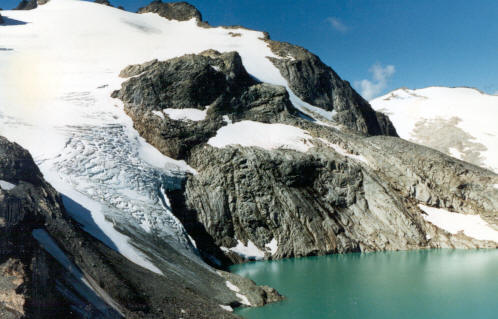
Former valley filled by north Branch Whitechuck Glacier. (Leor
Pantilat)
View to the terminus of Honeycomb Glacier in 2002 from the Nunatak. The new
lake is evident. |