What is Mass Balance?
Mass balance is the difference between the amount of snow and ice accumulation on the glacier and the amount of snow and ice ablation (melting and sublimation) lost from the glacier. Climate change causes variations in temperature and snowfall, changing mass balance. This is considered the most best measure of glacier response to climate change. Changes in mass balance control a glacier’s long term behavior. This is just like your bank account with accumulation being deposits and ablation being withdraws. A glacier with a sustained negative balance is out of equilibrium and will retreat. A glacier with a sustained positive balance is out of equilibrium and will advance. If a glacier still has a sustained negative balance after a period of significant retreat the glacier is likely in disequilibrium and will not survive, as it has no significant annual accumulation area. The North Cascade Glacier Climate Project monitors the mass balance of more glaciers than any other in North America. The World Glacier Monitoring Service annually compiles the mass balance measurements from around the world. There are 42 reference glaciers each with at least 30 years of continuous observation that are used to generate regional averages. Global values are calculated using a single value (averaged) for each of 19 mountain regions in order to avoid a bias to well observed regions.
In 2022 glaciers experienced the 35th consecutive year with a global alpine mass balance loss, and the 14th consecutive year with a mean global mass balance below -500 mm w.e. The mean annual mass balance loss has been -0.5 m of glacier thickness lost from 1970-2022, making a cumulative loss of 26 m.
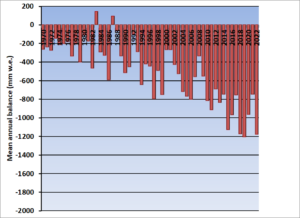
Annual mass balance of glaciers from WGMS reference glacier network.
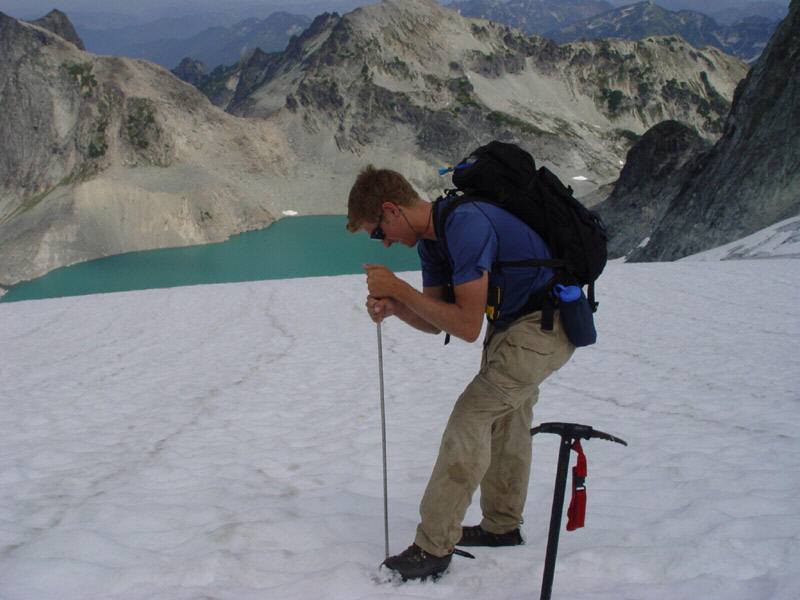
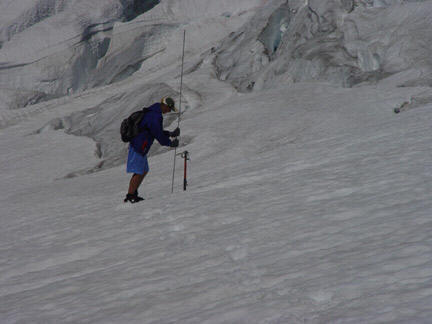
Tim Bartholomaus probing snowpack depth on Lynch Glacier in 2004.
How is it measured?
Mass balance is measured by determining the amount of snow accumulated during winter, and that is remaining at the end of the melt season, and measuring the amount of snow and ice removed by melting in the summer. The difference between these two parameters is the mass balance. If the amount of snow accumulated during the winter is larger than the amount of melted snow and ice during the summer, the mass balance is positive and the glacier has increased in volume. On the other hand, if the melting of snow and ice during the summer is larger than the supply of snow in the winter, the mass balance is negative and the glacier volume decreases. Mass balance is reported in meters of water equivalent. This represents the average thickness gained (positive balance) or lost (negative balance) from the glacier during that particular year. A typical glacier that is not calving must have 60-70% of its area snowcovered at the end of the summer to be in balance.
Ablation is most often measured by emplacing stakes in the glacier at the end of the previous melt season or the beginning of the melt season. As the glacier surface melts the amount of the stake emerging from the glacier is measured. The total melt at each stake by the end of the melt season is the net ablation. Most of the stakes must be re-emplaced during the summer.
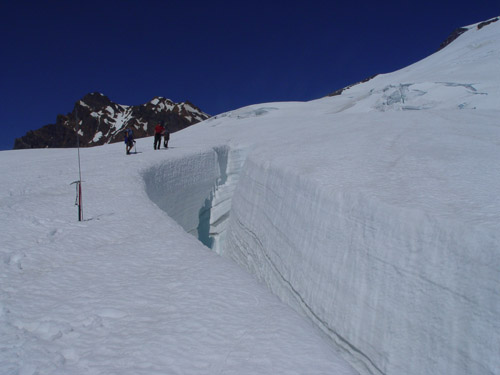
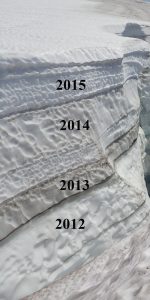
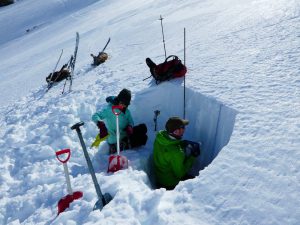
Accumulation is measured by either probing or crevasse stratigraphy to determine the annual snowpack thickness at many locations. Crevasse layering is evident in the picture at right. It is similar to reading tree ring width for climate analysis. These measurements are completed both in August and again in late September, the end of the hydrologic year, each summer on 10 glaciers in the North Cascades by NCGCP. Measurements of ablation are made at 3-6 locations and accumulation at 60-200 locations. The impact of the number of measurements is examined in The Impact of Sampling Density on Mass Balance. The changes in accumulation and ablation with location and during recent years indicates the importance of monitoring multiple glaciers as they are unique. Crevasse stratigraphy is used to determine annual snow layer thickness. In the slide at right you can see four annual layers. A thin surface layer, and than two approximately one meter thick layers, and then a partially shown lowest layer that is much dirtier. The continuity of the layer thickness provides a better measure than a point measure in a snowpit or with probing. We utilize probing where crevasses do not exist, above right. Snowpits such as seen at lower left are not used in the North Cascades since the density of the snowpack by August has been found to be constant. Snowpits provide a point measurement and are time consuming. They are crucial for determining snowpack early in the melt season when the density does vary, not Zillmer Glacier, BC below. A map is generated from this network of mass balance. Below is an example from Columbia Glacier in the North Cascade Range, WA, a WGMS reference glacier.
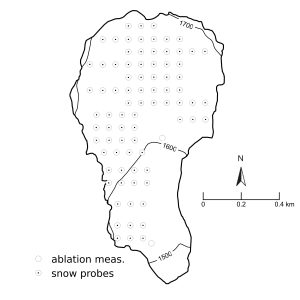
Map of the measurement network on Columbia Glacier.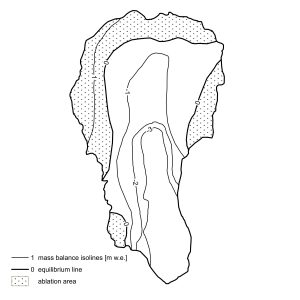
Map of the mass balance of Columbia Glacier in 2016.