![]() ![]() |
ABSTRACT
|

Mt.
Baker is a stratovolcano and is the highest summit in the North Cascades at 3285
m. This volcano is host to 11 substantial glaciers with an area of 37.4 km2.
The Mt. Baker ski area is the site of a snow measurement station, which is
located 11 km to the east of Mt. Baker. This snow measurement station has an
average annual snowfall of 13.7 m. This station typically loses its snow cover
in July.
From
1984 to 1999 annual snowpack measurements have been completed on Mt. Baker. From
1984 to 1990 snowpack measurements were completed only in mid-August and late
September from 1500 to 2100 m on Rainbow Glacier. From 1990 to 1999 snowpack
measurements have been completed in early June, in mid-August, and late
September between 1500 m and 2100 m on Rainbow Glacier, and between 1500 m and
2800 m on Easton Glacier. The observed snowpack at the higher elevation glacier
locations always exceeds the depth reached at the 1300 m snow measurement
station. These measurements are part of the North Cascade Glacier Climate
Project’s annual glacier mass balance program.
Measurement
of accumulation in the accumulation area has been accomplished using probing and
crevasse stratigraphy (Pelto, 1996). Probing has proved both successful and easy
to use in most temperate and subpolar climate settings (Ostrem and Bruggman,
1991). LaChapelle (1954) noted that a maritime snow cover surface develops after
its first year a marked increase in ram resistance caused by repeated
refreezing. It is this hardness discontinuity that allows programs to utilize
probing for accumulation layer thickness determination. In the North Cascades,
all summers are notably warm resulting in a 2–5 cm thick band of continuous
readily identifiable dirty-firn that resists penetration.
It
has been noted by several investigators that superimposed ice is not found on
North Cascade glaciers and that ice lenses within the annual snowpack are rare (Pelto,
1996). Since North Cascade glaciers rarely have ice lenses, an indicator of
little internal accumulation, probing is an accurate method of measuring
accumulation layer thickness. The probe is driven through the snowpack until the
previous ablation surface is reached. The probing instrument is a 1/2 inch
diameter solid stainless steel rod with 0.1 foot depth increments inscribed.
Probing, though rapid in snow depths of less than 2.5 m in mid and late summer
has proved difficult at greater depths than 3.5 m (Pelto, 1996). Fortunately
depths of more than 3.5 m late in the summer typically occur in areas of
significant crevassing on the glaciers that NCGCP observes, possibly due to the
more rapid motion that the thick accumulation promotes.
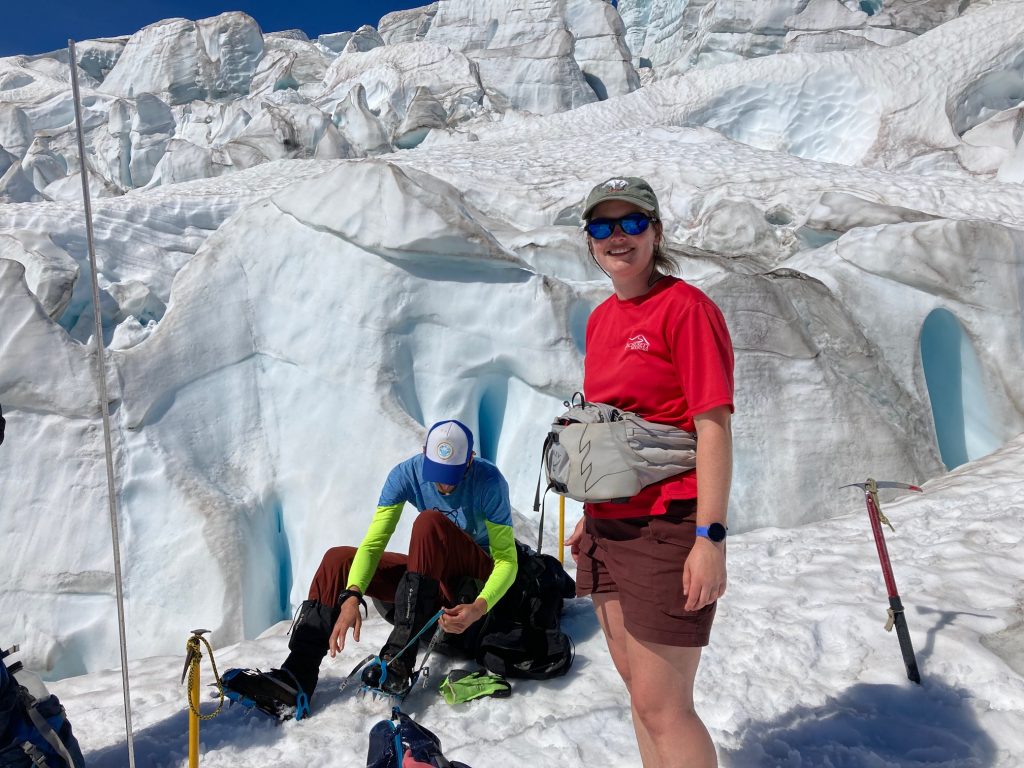
Crevasse
stratigraphic measurements are conducted only in vertically walled crevasses
with distinguishable annual layer dirt bands. Most of the vertically walled
crevasses also tend to be narrow less than 1 m across. In the North Cascades the
ablation surface of the previous year is always marked by a 2- to 5-cm-thick
band of dirty-firn or glacier ice.
The
accuracy of crevasse stratigraphy and probing measurements are cross-checked on
at least 25% of the accumulation area of each glacier where probing is used
between crevasses. This cross-checking identifies measurement points that either
represent an ice lens and not the previous summer surface in the case of
probing, or areas where crevasses do not yield representative accumulation depth
in the case of crevasse stratigraphy. In 1998, 1100 probing measurements were
completed in the North Cascades, 380 were within 20 m of a crevasse, 368 of
these yielded a depth within 5 cm of the nearest crevasse stratigraphic measure.
If a disparity is noted further point measurements are made in the immediate
vicinity to determine the, which method is yielding a false reading or if the
depth is simply quite variable.
The
standard deviation in snow depth obtained in cross checking and duplicate
measurements are smallest for crevasse stratigraphy, +0.02 m, and +0.03
m for probing. The narrow range of deviation in vertically walled crevasses
indicates that they do yield consistent and representative accumulation depths
late in the summer.
Crevasses
have long been avoided in mass balance measurements because of the dangers they
present, despite the ease with which the annual layer can be measured. Meier and
others (1997) questioned the accuracy of crevasse stratigraphic measurements..
Probing, coring and snowpits are artificial incisions into the glacier to
identify the annual layer. There is no reason that a natural incision provided
by a vertically walled crevasse, which intersects the same annual layer would be
any less reliable (Pelto, 1997). In fact, in extensive NCGCP tests (Pelto,
1996), crevasse measurements had a lower standard measurement error in duplicate
measurements. This is expected given the two dimensional view of crevasse
stratigraphy versus a single dimension in snowpits and probing. In ice sheet
areas distant from a dust source this maybe difficult, but on alpine glaciers
mountaineers and glaciologists have long noticed the ubiquitous nature of these
layers (Post and LaChapelle, 1962).
It
is possible that the annual layer is difficult to distinguish in a crevasse,
because of a poorly developed summer icy-dirty layer. This difficulty is even
more apparent in snowpits and cores, where the view of the previous summer
surface is much more limited. The lack of dirt layers in crevasses is rare in
the North Cascades and many other regions. Only vertically walled crevasses that
yield readily identifiable annual layers where the annual layer is not distorted
by a slump into the crevasse can be utilized.
In
June a total of six to 10 accumulation measurements are completed on the Easton
and Rainbow Glacier. The density of accumulation measurements is greatest for
the August measurement period when 150–200 measurements are made on the Easton
Glacier and Rainbow Glacier, generating the most detailed map of accumulation
variations across the glacier. The difficulty is assessing the maximum snow
water equivalent that typically occurs in mid to late May above 1500 m on North
Cascade glaciers (Pelto, 1996; 1998). Because of the exceptional snow depths
typically greater than 12 m, and the high avalanche danger it is not judicious
to make extensive snowpack measurements in May. Our measurements made in early
June are used as a minimum of measurement of winter accumulation. To determine
the change in snowpack water equivalent from the spring maximum to mid-August
and hence, calculate winter snowfall, wooden stakes are emplaced into the
snowpack to record ablation.
Ablation
measurements are made at a minimum of six stakes on each glacier. The stakes are
reset at each observation. The stakes are emplaced in early June and
measurements are made in late July and early August, recording the ablation
during the first three months of the ablation season, for water resource
assessment purposes and resetting of the stakes when necessary. Ablation
measurements are repeated in late September at the designated conclusion of the
hydrologic year.
The
combination of the ablation measurements and a comparison of the early June and
mid-August accumulation measurements provides two measures of the snowpack depth
changes prior to the extensive mid-August measurements. The one factor remaining
to be considered is the compaction of the snowpack and the consequent increase
in density. The density of North Cascade glacier snowpack has been found to be
essentially to within the range of accuracy of the measurement instruments
(0.58–0.60 g/cm3) constant by August and density measurements are
only completed during June measurements (Pelto, 1996; Krimmel, 1999). Density
has varied from 0.50 to 0.55 g/cm3 in June on Easton and Rainbow
Glacier. This fits well the observations of density of South Cascade Glacier,
which for early June of 1993 –1998 yielded a density range of 0.51–0.55 g/cm3 (Krimmel,
1998). For both the June and August measurements we then calculate snow water
equivalent.
Snow
water equivalent is the important value for water resource and glacier mass
balance purposes; however, in this instance we are also interested in total
winter snowfall. The average density of new snowfall at Paradise, Mt. Rainier is
Washington at 1650 m is 0.13–0.15 g/cm3. The snowpack depth
measured in June and August when the density exceeds 0.5 g/cm3 then
represents a minimum snowfall of three times the observed snowpack depth. The
dividend, of the sum of observed snow water equivalent (AC) and observed snow
water equivalent ablation (AB), and the mean winter snowfall density of 0.15
g/cm3 (p) yields the actual total winter snowfall (S).

Figure
1. Snowpack depth at 2300 m on Easton Glacier each August.
Table
1 indicates the specific observed accumulation at various altitudes on Easton
Glacier from 1990–1999. At each altitude the 1998/99 snowpack depth was more
than 28% greater than any of the previous years. Snowpack depth was inconsistent
and did not appreciably increase from the 2450 m value at altitudes between 2500
and 2800 m.
Table 1. Snow depth remaining from the previous winter’s snowfall on
Easton Glacier at specific elevations in mid-August.
|
Elevation (m) |
1990 |
1991 |
1992 |
1993 |
1994 |
1995 |
1996 |
1997 |
1998 |
1999 |
|
1680 |
0 |
0.45 |
0 |
0 |
0 |
0 |
0 |
0 |
0 |
1.55 |
|
1830 |
0 |
1.60 |
0 |
0 |
0 |
0 |
0.2 |
1.2 |
0 |
4.10 |
|
1985 |
2.25 |
4.25 |
0 |
1.45 |
2.10 |
2.60 |
3.05 |
3.75 |
1.4 |
5.8 |
|
2140 |
3.35 |
5.20 |
1.55 |
2.65 |
3.00 |
3.55 |
3.85 |
5.15 |
1.85 |
8.1 |
|
2300 |
3.90 |
6.15 |
2.70 |
3.25 |
3.30 |
4.05 |
5.0 |
6.05 |
2.85 |
9.45 |
|
2450 |
4.35 |
7.35 |
3.20 |
3.80 |
3.75 |
4.55 |
5.45 |
6.75 |
3.25 |
10.65 |
On
Rainbow Glacier maximum snowpack depths are typically observed at 1900 m. Figure
2 indicates the observed mid-August snowpack depths at this elevation for the
1984–1999 period. Again 1999 stands out as exceptional with a depth of 8.2 m
(Fig. 2). Avalanche danger onto this glacier, which occupies Avalanche Gorge
prevented any June snowpack measurements in 1999. Ablation stakes were emplaced
on the north margin of the glacier in early June. The observed ablation from
June–August was 3.80 m in 1999.

Figure
2. Snowpack depth at 1900 m on Rainbow Glacier each August.

Figure 3. Total winter snowfall on
Rainbow (upper)
and Easton Glacier (lower).
How
much initial snowfall does this remaining summer snow on Easton and Rainbow
Glacier represent? The snowpack in late August had a density of 0.60 g/cm3,
this is four times the normal new fallen snow density. Thus, at a minimum at
2450 m the 10.65 m of snow remaining represented 42–43 m of snow compressed by
time, melting and refreezing (Fig. 3). Ablation from early June to late August
3.95 m of dense snowpack indicates an additional 15–16 m of snowfall,
depending on the degree of compaction of snowfall that had melted prior to our
late August measurement. The minimum total snowfall for 1998/99 was then 57–59
m at 2450 m on Easton Glacier, Mt. Baker. The sum of the observed August
snowpack SWE (8.2 m) and June–August (3.8 m) ablation indicates that 1998/99
total winter snowfall at 1900 m on Rainbow Glacier was 47–49 m.
How localized was this
high snowfall season? Paradise on Mt. Rainier exceeded 1000 inches for the
winter season for the fifth time since 1920, but fell 72 inches short of the
record snowfall of 1972/73. Snowpack measurements at USDA snotel stations at
Lyman Lake and Stevens Pass did not reach record depths in 1999. However, in
both cases the snowpack endured longer then any other season since these
measurements began in 1981. Thus, we have a combination of record snowfall and
slow spring melt yielding record summer snowpack, even more exceptional than the
actual winter snowpack.
Krimmel, R.M. 1995. Water, Ice and Meteorological Measurements at South
Cascade Glacier, Washington, 1994 Balance Year. USGS WRI-95-4162.
Krimmel, R.M. 1998. Water, ice and meteorological measurements at South
Cascade Glacier, Washington, 1997 Balance Year. USGS WRI-98-4090.
LaChapelle, E. 1954. Snow Studies on the Juneau Icefield. Am. Geogr.
Soc., Juneau Icefield Research Project Report no. 9.
Meier, M.F., Armstrong, R.A., and Dyugerov, M.B. 1997: Comments on
“Annual net balance of North Cascade glaciers 1984–1994” by Mauri S. Pelto.
J of Glaciol., 43 (143): 192–193.
Ostrem, G. and Bruggman, M. 1991: Glacier Mass-Balance Measurements.
Canadian NHRI Science Rep. no. 4.
Pelto, M.S. 1993. Current behavior of glaciers in the North
Cascades and its effect on regional water supply. Washington
Geology, 21(2): 3–10.
Pelto,
M.S. 1996. Annual balance of North Cascade glaciers 1984–1994. J. Glaciol., 41, 3–9.
Pelto, M.S. 1997: Reply to comments of Meier and others on “Annual net
balance of North Cascade glaciers 1984–1994” by M. S. Pelto. J
of Glaciol., 43(143): 193–196.
Post, A.S., and LaChapelle, E.R., 1962: Glacier Ice. The Mountaineers and
University of Washington Press, Seattle, Washington.