|
NORTH CASCADE GLACIER CLIMATE PROJECT
Mauri S. Pelto, Director
Founded
1983
|
The North Cascades of Washington extend from Snoqualmie Pass to the Canadian Border and in 1980 contained 700 glaciers. Today this number is dwindling. North Cascade glaciers attract our attention because of their beauty, power, and inaccessibility. But more importantly these glaciers store water. Lots of water, as much water as all of the states' lakes, rivers and reservoirs combined. They are natural reservoirs and provide 25% of the North Cascade regions total summer water supply. During the dry months of June-September North Cascade glaciers release approximately 230 billion gallons of water each year. Today this water is fully utilized for irrigation, salmon fisheries, and power generation.
All too often we take our natural resources for granted. We plan on 230 billion gallons of glacier runoff each summer. From 1944 to 1976 this was a good bet. Today, after several decades of stability North Cascade glacier's are in rapid retreat. Annual runoff is determined by annual precipitation for the most part. However, the timing is altered by the existence of glaciers. A glacier retains snowpack in the spring and early summer when streamflow is high and releases meltwater later in the summer when others sources of water are diminishing. Thus, glacier retreat raises spring snowmelt season flows and reduces low late summer flows. This is important for fall salmon runs and for later summer irrigation and hydropower demands.
Three lines of evidence indicate
that most North Cascade glaciers are currently in a state of disequilibrium. The
mean cumulative annual balance for the 1984-2008 period is -12.4 m w.e, which
represents a net loss of ice thickness exceeding 14 m. This is a significant
loss for glaciers that average 30-50 m in thickness, representing 20-40% of
their entire volume lost in two decades.
Annual longitudinal profiles on nine glaciers North Cascade glaciers confirm this volume change indicating a loss of -8.7 to -12.3 m in thickness (5.0-5.6 m w.e) between 1984 and 2005, agreeing well with the cumulative mean annual balance of -11.5 m w.e for that period. The change in glacier thickness on several glaciers has been equally substantial in the accumulation zone and the ablation zone, indicating no point to which the glacier can retreat to achieve equilibrium.
North Cascade glacier retreat is rapid and ubiquitous. All 47 monitored glaciers are currently undergoing a significant retreat or have disappeared in the case of three of them. Two of the glacier where mass balance observations were begun, Spider Glacier and Lewis Glacier, have disappeared. This retreat on eight Mount Baker glaciers from 1984-2005, that were advancing in 1975 averages, 340 m.
The retreat is due to
25% less April 1 winter snowfall from 1946-2007and warmer
summer temperatures (1.5 F rise beginning in 1985).
In 1987, 1992,1993, 1994, 1998, 2001, 2003, 2004 and 2005 water shortages in the North
Cascade region were due to drier winters, rapid spring snowmelt and smaller
glacier area available to melt. A
smaller ice cube when melting provides less water.
Between 1978 and 1987 Lewis Glacier shrank from 90 to 17 acres in size.
The summer of 1987 proved to be too much for the Lewis Glacier near Rainy
Pass. By 1989 the Lewis Glacier was
non-existent. To understand how
climate warming is affecting our glaciers and how a potential greenhouse warming
would impact North Cascade glaciers, we first must understand how glaciers work.
As director of the North Cascade Glacier Climate Project, since 1984, I
have had the opportunity to visit 150 North Cascade glaciers.
This website focuses on providing you with an understanding of how and why
North Cascade glaciers behave as they do; and, how climate warming is affecting
the glaciers and consequently our water supply.

By late April, the accumulated snow of the past winter on Columbia
Glacier averages 25 feet in depth. The
snow that does not melt is transformed, during the summer months, by partial
melting and refreezing into small kernels of ice called firn.
The firn is then buried by the next years snow, and during the following
summer, if not exposed at the surface to melting, is altered by more passing
meltwater.
After surviving three
or four summers the firn has been transformed into glacier ice. Meltwater melts part of the firn grains as it travels
downward and sometimes add to the grains by refreezing.
A glacier is divided into two sections the ablation zone and
accumulation zone by the annual snowline. The
snowline indicates areas where snowfall equals snowmelt.
Ablation (melting) exceeds snowfall in the ablation zone, whereas
snowfall exceeds ablation in the accumulation zone.
The snowline is easily identifiable by the change from white snow to blue
glacier ice or gray firn. A glacier
generally increases in thickness in the accumulation zone, the
snows accumulating more and more. Below
the snowline ablation dominates and thinning begins.
Finally at the terminus the rate of glacier flow is equaled by the rate
of melting and the glacier ends. In recent years some glaciers have not had a consistent accumulation zone. Without an accumulatiion zone the glacier cannot survive as event thea accumulation zone becomes an area of thinning.
GLACIER
MOVEMENT
As the snow and ice thickens movement begins, because the force of
gravity overcomes the resisting friction of the rough bed at the base of the
ice. The greater the weight of
snow, firn and ice the greater the force of gravity acting upon the glacier.
In the North Cascades a thickness of 50 feet on steep slopes, and 100
feet on shallow slopes is necessary to initiate movement.
There are many small, thin and permanent snow patches in the North
Cascades that are too thin to move and do not achieve glacial status.
To identify a glacier look for crevasses and blue glacier
ice.
Another test is to examine the color of the meltwater issuing from the
questionable glacier, if the meltwater is relatively clear, then erosion is not
occuring below the snowpatch, indicating no movement and it is not a glacier.
If the meltwater is a milky blue, green or gray, this is due to the
presence of glacial flour caused by glacier erosion and you are probably looking
at a glacier. If possible you
can peer under the edge of the snowpatch at the bottom of the ice and if the ice
is grooved, then movement is occurring and you have a glacier.
Glaciers move at different speeds depending on ice thickness, slope and
bed roughness. Thick ice, steep slopes and a smooth bed lead to rapid
movement. Glacier speed is not
constant over the entire area of glacier; hence, crevasses occur.
Crevasses are usually the focus of our attention on glaciers, because of
the danger they pose. In the North
Cascades these dark fractures in the surface of a
glacier are typically 30 to 60
feet deep, seldom exceeding 100 feet in depth.
A crevasse occurs because of an increase in glacier speed.
The acceleration literally pulls the surface apart, the downhill side of
the crevasse is moving faster than the uphill side of the crevasse.
The most common cause for an increase in glacier speed is an increase in
slope. On the Lower Curtis Glacier
there is a dramatic increase in glacier speed and hence crevassing as the
glacier slopes suddenly steepens a short distance above the terminus.
Crevassses are formed by differential glacier speed, usually due to a
change in glacier slope; hence they tend to occur in the same place on a
glacier. When a glacier flattens
out crevasses are often compressed shut. Thus,
a specific crevasse does not usually remain open as it is carried down glacier.
Icefalls are regions of intense crevassing caused by a sharp increase in
slope. The resulting glacier
acceleration causes heavy crevassing.
Because of the comparatively rapid acceleration of the glacier, icefalls
are unstable areas, having frequent avalanches.
A prominent feature of icefalls are seracs.
Seracs are towers of ice left standing between crevasses.
The seracs often collapse causing numerous unpredictable avalanches
during all seasons of the year. Icefalls
on the Coleman and Lower Curtis Glacier are the most easily observed icefalls on
North Cascade glaciers, each displays prominent seracs.
On slopes exceeding 55 degrees, glacier ice can no longer cling to the
rock and will avalanche. Many North
Cascade glaciers end on a steep slope releasing avalanches from the glacier
front, examples are LeConte Glacier, Dana Glacier, Upper Curtis Glacier and
Lower Curtis Glacier. These
glaciers are spectacular to view from a distance, particularly during early
spring when avalanching is heaviest, but are dangerous to set foot below. The
avalanches end on gentler slopes, in some cases reforming into a glacier.
This type of glacier is a reconstituted glacier, Lower Park Glacier on
Mt. Baker, Johannesburg Glacier near Cascade Pass, and Lower Price Glacier on
Mt. Shuksan are reconstituted glaciers.
That glaciers move makes them almost alive in our eyes.
That this movement is unstoppable makes them daunting.
There is no way to stop the inexorable motion of a glacier, in the Pamir
Mountains of the Soviet Union an attempt was made to stop an advancing glacier
by bombing it. This failed, it was
like bombing a sand dune, yes a large explosion occurred, but afterwards there
was only slighlty less snow and ice.
Because glacier movement increases with increasing thickness a glacier
tends to moves fastest near the snowline where it is thickest, and slowest at
the terminus where it is thin. Movement
has been measured on only a handful of glaciers in the North Cascades.
The average movement is 20-100 feet/year. The Columbia Glacier in
the Monte Cristo area is more moves 20 feet per year.
In the mid 1930's an avalanche of rock from Chiwawa Peak slid down onto
the upper Lyman Glacier. In 1987
this debris reached the terminus. In
50 years this debris moved 2600 feet or 50-55 feet/year. As climate warms a
glacier will thin and move slower. In
some cases velocities do exceed 100 or even 200 feet per year.
In the icefall region above the terminus on the Lower Curtis Glacier the
glacier is 110 feet thick and is on an 18 degree slope.
The result is a compartively rapid flow of 110 feet per year.
The fastest moving glaciers in the North Cascades are the large glaciers
on the flanks of Mt. Baker: Park Glacier, Deming Glacier and Coleman
Glacier all
reach velocities of 200 feet per year in certain areas. This high speed is due to the high thickness and consistently
steep slopes on Mt. Baker glaciers. William
Harrison observed the velocity of the Coleman Glacier in 1954,in the icefall
region one half mile from the terminus glacier velocity was 11 inches per day
(330 feet/year), closer to the terminus velocity had dropped to 7 inches per day
(255 feet/year). At the slow
end of the scale is Colonial Glacier and Whitechuck Glacier each moving less
than 5 feet per year.
Almost all alpine lakes in the North Cascades occupy cirque baisns
excavated by glaciers. A cirque
is a deep basin surrounded by high ridges in a horseshoe shape.
These basins are created only by glacier erosion.
The lip of the cirque, is the point from which stream emptying the cirque
drains. The lip is near the former
terminus position and has experienced little erosion; hence, the lip is higher
in elevation than the area behind it where glacier erosion was high.
Glacier erosion being highest at the snowline, results in the basin being
deepest approximately halfway from the cirque lip to the headwall.
Glacier erosion is also rapid at the headwall of the cirque, hence a
cirque eats away at the mountain that is at its head.
The result of cirques eroding opposites sides of the same ridge is a
narrow, jagged ridge called an arrete. Ripsaw Ridge above Boston Glacier and
Nooksack Ridge on the east side of Mt. Shuksan are two inhospitable examples.

The
Lower Curtis Glacier is eroding into the southwest face of Mt. Shuksan.
Today the Columbia Glacier occupies a cirque at 4900 feet, while Blanca
Lake at 3800 feet fills a cirque occupied by ice during the last ice age.
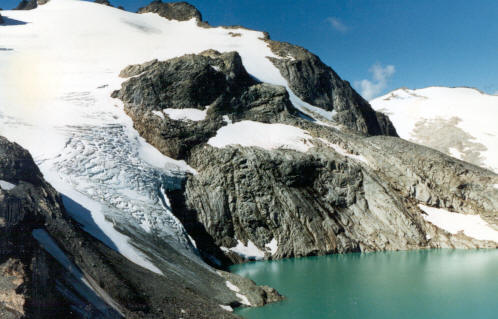
The unusual jade green color of Blanca Lake and many alpine lakes comes
from glacier flour suspended in the water altering the color from its normal
blue.
At the base of a glacier you can see the erosion occurring.
Glacier ice in contact with the bedrock has innumerable small and large
rocks frozen into the ice, these rocks act as cutting tools scraping away
bedrock as the glacier slides over its base, creating vast quantities of glacier
flour. This gigantic coarse
grained "sandpaper" is the world's most proficient eroder.
During the summer, meltwater at the glacier base carries away most of the
sediment generated. During the rest of the year much of the sediment is frozen
into the glacier base. Larger
blocks of rock are often plucked out of the bedrock by a glacier. Imagine a 400 foot of ice scraping along its rock base, then
it catches a small prominence, the downslope force applied to the prominence is
sufficient to lift a section of rock out of its place. These blocks are carried
in the basal ice of the glacier slowly being broken into smaller pieces as the
boulder encounters other bedrock prominences.
Near the terminus of a glacier you can usually see a small portion of the
bottom of the glacier by looking under a lip of the glacier that is not resting
firmly on the bedrock. You will see
a basal ice layer that is filled with sediment and the ground surface will be
covered with fine grained glacier flour and larger boulders
As North Cascade glaciers retreat exposing bedrock, the bedrock is
littered with sediment that melted out of the ice, this is called till and
indicates the amount of debris a glacier carries.
In some cases the material has been fluted.
A flute is a straight narrow ridge of sediment that forms down glacier of
a rock knob or large boulder, protecting the region below from erosion.
This fluted till cannot be preserved unless the glacier melted in place
as a stagnant ice body. Newly
exposed bedrock is also covered with glacial striations. These scratches, are the source for most of the glacial
flour. Glacial striations are
elongated parallel to glacier flow. Striations
seldom endure for more than a century.
The most distinctive features left behind by glaciers are moraines.
In the North Cascades terminal, lateral and medial moraines can be
observed.
Terminal moraines indicate the former terminus position of a glacier.
Terminal moraines are formed by sediment continually carried
forward by the glacier, much like a conveyor belt, and dumped at the terminus.
Terminal moraines range from one to seventy feet in height.
The largest moraines form over a long period and are some distance from
present glacier termini, examples being Sahale Glacier near Cascade Pass, Entiat
Glacier near Mt. Maude, ex-Lewis Glacier near Rainy Pass, Isella Glacier near
Holden, and Boulder Glacier on Mt. Baker.
Lateral moraines are found on the sides of a glacier, paralleling glacier
flow. These moraines are formed by
sediment falling from the valley walls onto the glacier and by erosion of the
valley wall by the glacier. Below
the snowline this debris creates a band at the edge of the glacier.
After the glacier melts away this band of debris is left as a ridge on
the side of the valley. Prominent
lateral moraines exist on Easton, Middle Cascade, Quien Sabe, Cool, Kennedy,
Colonial and Honeycomb Glacier. The
Railroad
Grade on Easton Glacier is the best example.
The retreat of Easton Glacier has left a very steep, unstable 100 foot
high lateral moraine. The inside of
the lateral moraine, which was in contact with the ice after the ice had melted,
is steeper and more unstable than the outside of the moraine.
As a result, vegetation development is often less on the inside of the
moraine.
A medial moraine is a ridge or strip of debris in the middle of a
glacier, formed when two branches of a glacier join, converting the lateral
moraines of each glacier into a single medial moraine.
Medial moraines are rare in the North Cascades because few glaciers
consist of more than one branch. The
Honeycomb Glacier east of Glacier Peak and Boulder Glacier on Mt. Baker have the
best developed medial moraines.
Other glacial geologic features common to the Puget Sound region, such as
kames, kettles and outwash plains are generally absent in the North Cascades,
because the slopes are too steep for formation of these glacial features.
MASS
BALANCE
turn controls
glacier behavior. To identify how a
glacier will behave today and in the future mass balance must be known.
This section focuses on how mass balance is measured and what the mass
balance of North Cascade glaciers has been in recent years.
A quick estimate of glacier mass balance is obtained by observing
snowline position. The snowline
rises throughout the summer, its position at the end of the summer (September
30) is the annual snowline position. The
annual snowline defines the percentage of a glacier's total area that is in the
accumulation zone. In the North
Cascades, if avalanche accumulation is received, between 60 and 65 percent of a
glaciers area must be snowcovered at the end of the summer for an equilibrium
balance. If a glacier does not
receive avalanche accumulation then 65 to 70 percent must be in the accumulation
zone for equilibrium. In 1985,
1986, 1987, 1989, 1992, 1993, 1994, 1998, 2001, 2003, 2004, 2005 and 2006 only
30 percent of the average North Cascade glacier
remained snow covered at the end of September, indicating moderate negative
balances causing glacier retreat.
The mean annual
balance for the 1984-2008 period has been -0. 5 m/a. The mean cumulative mass
balance loss has been -11.5 m w.e, which is a minimum of 13 m of glacier
thickness lost. North Cascade glacier average thickness ranges from 30-60 m.
Thus, 20-40 % of the volume of these glaciers has been lost since 1984.
Observations by the USGS at South Cascade Glacier indicate that since the
mid-1950s, South Cascade Glacier’s cumulative mass balance was -25m, mean annual
balance from 1956-1975 averaged -0.15 m/a , and from 1976-2003 averaged -1.00
m. The cumulative mass balance is trending more negatively, indicating that
instead of approaching equilibrium as the glaciers retreat they are experiencing
increasing disequilibrium with current climate