|
Terminus Response
Time of North Cascade Glaciers
Mauri S. Pelto, Director
Founded
1983
|
|
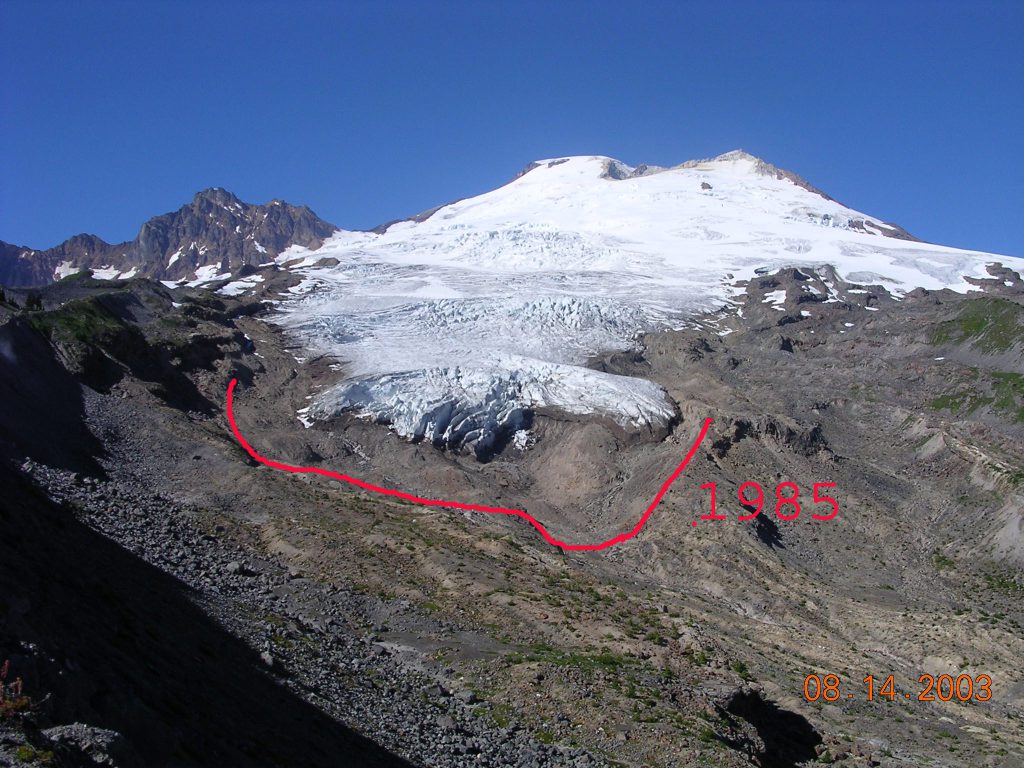
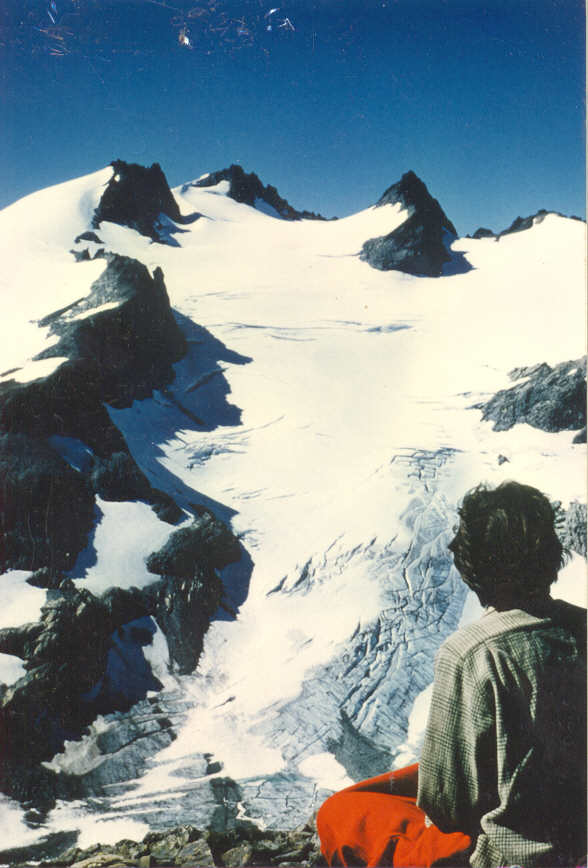
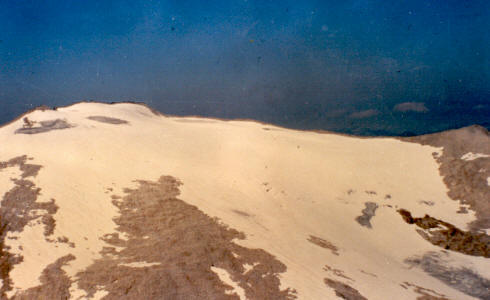
Type 1 glacier with lots of crevassing, indicating higher velocity, and
a substantial elevation range leading to high accumulation rates.
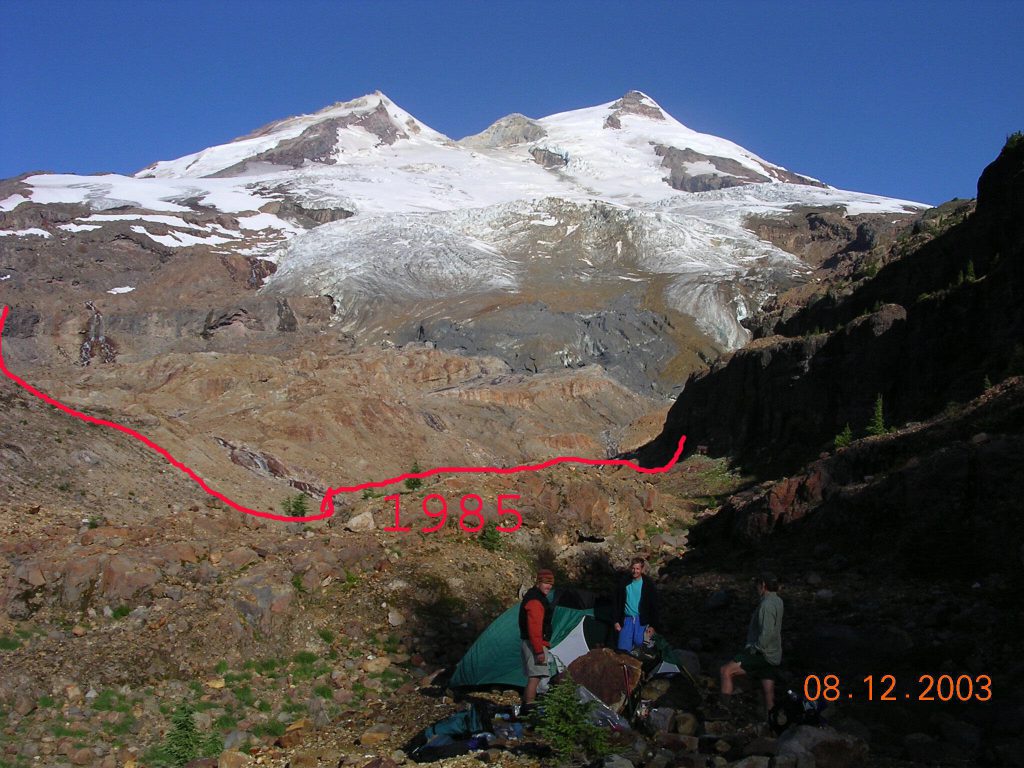
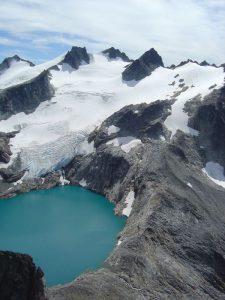
Sholes Glacier which has a moderate slope and modest accumulation rates
is a Type 2 glacier. |
ABSTRACT
Why have
North Cascade glacier
termini
behaved differently this century? On Snowfield Peak there are three
glaciers Colonial, Neve and Ladder Creek which each have behaved
differently. Colonial retreated throughout the century.
Ladder Creek advanced from 1950-1975 and Neve stopped retreating
from 1955-1980. Thus, it is not simply recent climate driven since they share the
same climate setting. We observed
the terminus
behavior of 38 North Cascade glaciers during the last century to
illustrate three different types of glacier response to climate change: The initial response times (Ts) of North Cascade glaciers to both a positive and negative mass balance changes resulting from climate change have been observed on 21 glaciers to be 4-16 years. Thus, when the weather got cooler and wetter beginning in 1946 glacier advances began on Coleman Glacier in 1949 and on all Type 1 glaciers by 1960. Similarly when the climate turned warmer and drier in 1977, glacier retreat commenced by 1987 on all Mount Baker glaciers, and by 1989 on all North Cascade glaciers. The
time required to reach a new steady state (Tm) for the post Little Ice Age
warming was approximately
20-50 years on Type 1;40-60
years
on
Type
2 glaciers, and at least 100
years on Type 3 glaciers. Tm on
North Cascade glaciers is
Full Report Follows
Mauri S. Pelto, Department of Environmental
Science Nichols College, Dudley, MA 01571: Cliff
Hedlund, Oregon State University |
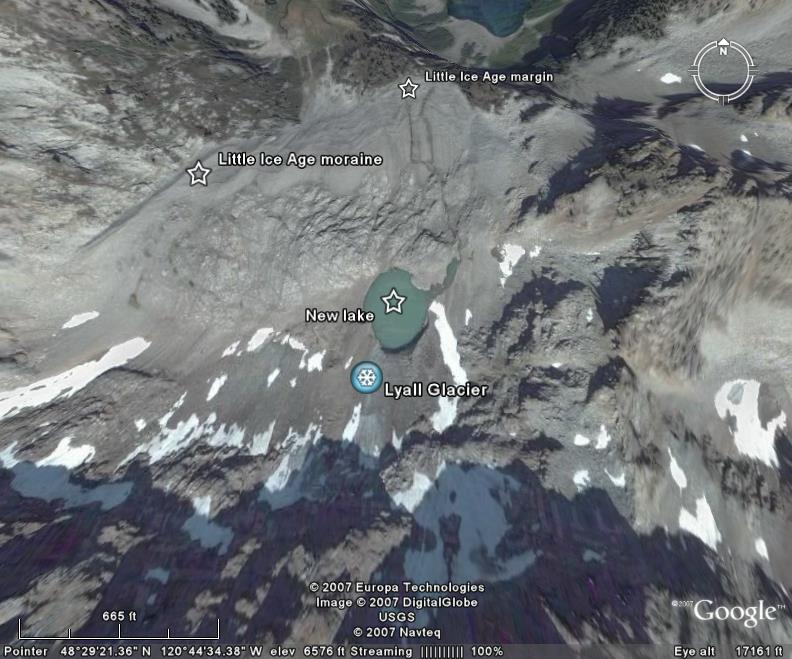
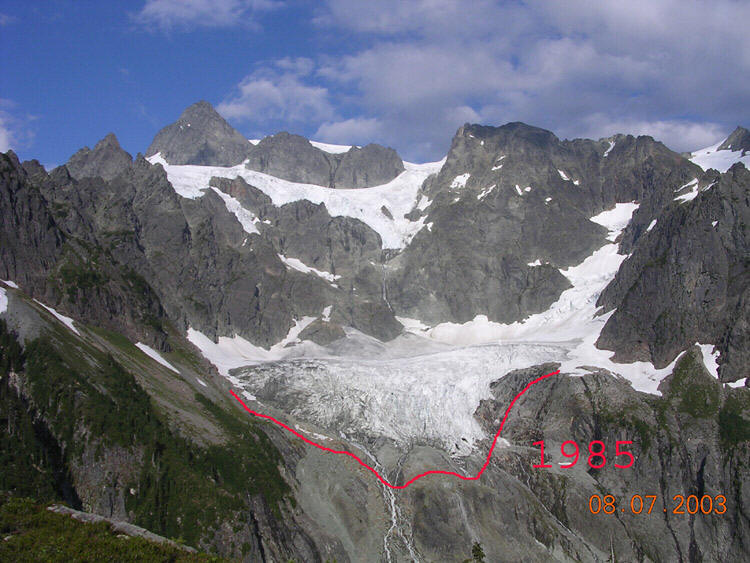
![]() Foss Glacier Type 3 |
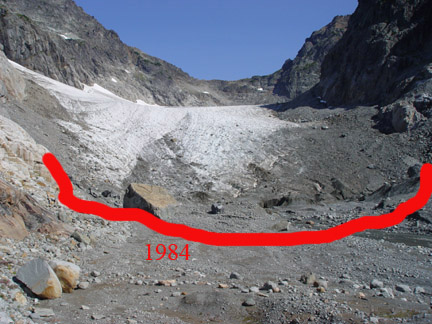
![]() Challenger Glacier Type 1 |
![]() |
![]() |
|
INTRODUCTION Observation of the differing terminus
behavior of North Cascade glaciers in response to the same climate changes
during the last century (Tangborn and others, 1990), has prompted the evaluation
of the terminus behavior of 38 glaciers in the North Cascades for the
1890-1990’s period. The objective
is to determine the characteristics that lead to differential terminus behavior
among North Cascade glaciers. To complete this task requires examination of the response time of glaciers to climate change. For any glacier there is a lag time (Ts) between a significant climate change and the initial observed terminus response (Paterson, 1994), this is also referred to as the reaction time of the glacier. It should be noted that Ts cannot be considered a physical property of a glacier and is expected to depend on the mass balance history and physical characteristics of the glacier. In this paper Ts is simply defined as the time lag from an observed climate shift to the initial observed change from an advancing to a retreating termini or from a retreating to an advancing termini. In addition, for each glacier there is
a response time to approach a new steady state for a given climate driven mass
balance change (Tm), referred to as length of memory by Johannesson and
others (1989). Johannesson and others (1989) defined Tm as the time-scale
for exponential asymptotic approach to a final steady state (approximately 63%
of a full response), resulting from a sudden change in climate to a new constant
climate. The magnitudes of Ts
and Tm are crucial to interpreting past and current glacier fluctuations
and predicting future changes (Paterson, 1994; Johannesson and others, 1989). In nature a step change in climate
causing an evolution from an initial to a final steady state never happens (Schwitter
and Raymond, 1993). The
variability of climate forcing and the continuous changes in the glacier
superimpose new disturbances on the response of the glaciers to previous
climate. This leads to the
conclusion that Tm cannot be defined directly from observations in
nature. However, Tm cannot
be accurately defined from models alone either.
In this study we recognize that the
response of the terminus is influenced by ongoing changes in forcing,
limiting the accuracy of determination of Tm from terminus observations.
We use terminus observations to establish limits on the range of Tm,
rather than attempting direct calculation of Tm from observations.
We use terminus observations to establish time limits on the range of Tm.
Our estimates of Tm are based on the understanding that, during a
period of relatively constant climate, the glacier should advance to about 2/3
of its final adjustment in its terminus positions and the rate of
advance/retreat of the terminus should be reduced to approximately 1/3 over a
time period of length Tm. The difficulty of examining terminus response
to a specific step change is minimized with respect to the post Little Ice Age
warming , because the climate change and associated terminus response is large
compared to climate changes and resulting terminus changes that have occurred in
the last half-century (Schwitter
and Raymond, 1993; Burbank, 1981; Porter, 1986).
In the North Cascades the disparate
terminus behavior of glaciers has been noted by Hubley (1956), Post and others
(1971), Tangborn and others (1990) and Pelto (1993). The primary goal of this
paper is to examine the observed terminus behavior and glacier geographic
characteristics of 38 North Cascade glaciers to determine why the terminus
behavior history varies. The
secondary goal is to identify the ranges of Ts and Tm for the
response of North Cascade glaciers to climate changes.
DATA
USED The North Cascade Glacier Climate
Project (NCGCP) has been observing terminus behavior on 47 North Cascade
glaciers and measuring annual balance on 9 glaciers since 1984 (Pelto, 1993;
1996). The primary objective
of this glacier research has been to identify the magnitude and timing of
glacier response to a climate change. This
NCGCP data set is extensive in its breadth, but not in its length of record,
extensive USGS aerial photographic collections and the ongoing research by the
USGS on South Cascade Glacier have been indispensable to this research in
providing long-term records. Terminus
Observations The magnitude of terminus changes from
the Little Ice Age Maximum (LIAM) has been measured on 38 glaciers by utilizing
720 USGS vertical aerial photographs, taken by Austin Post between 1962 and
1979, 150 aerial photographs taken by Richard Hubley at the University of
Washington from 1950 to 1955, and 120 photographs taken by J.B. Richardson and
William Long of the US Forest Service from 1940 to 1960 (all of these
photographs have been donated to NCGCP by William Long, Austin Post, and the
USGS).
Schwitter and Raymond (1993) noted the
ease of identification and utility of the well-preserved Little Ice Age moraines
for reconstructing former glacier profiles in the North Cascades and elsewhere.
The distance from the typically well preserved, fresh LIA moraines and
trimlines to the current glacier front has been measured in each case using a
laser ranging device (+1m). Additionally
on each of the 38 glaciers field measurements from the same LIA moraines to the
current glacier front was completed on at least two occasions between 1984 and
1998. The goal being to verify both
the LIAM and the actual terminus position changes from 1984-1998. In cases where the field measurements and
photographic measurements differed by more than 20 m the glacier is not used in
this analysis. This was the case on
two glaciers. Terminus
change from 1850-1950 is the distance from the aforementioned LIAM and the
position of the glacier terminus as in 1950 noted by Hubley (1956).
Terminus change from 1950-1979 is the change between the position noted
by Hubley (1956) and the USGS aerial observations in 1979.
Neither, 1950 or 1979 perfectly match the timing of climate changes noted
in the following section; however, they are closest to the climate shifts,
beginning in 1944 and 1976 respectively, for which adequate aerial photographic
observations were made. Terminus
change from 1979 to the present is based on comparison of the USGS aerial
observations and repeated field measurements of the North Cascade Glacier
Climate Project from 1984-1998 (Pelto, 1993; 1996). To determine Ts a group of 21
North Cascade was observed to switch from retreat to advance shortly after 1944,
and from advance to retreat shortly after 1976. Observations of the initial post-1944 glacier advances were
made by Long (1955 and 1956) and Hubley (1956).
Observations of the onset of retreat after 1976 are from Heikinnen
(1984), NCGCP field observations (Pelto, 1993) and USGS aerial photographs from
1979. Glacier
Characteristics On seventeen of the aforementioned 38
glaciers more detailed observations are used to calculate theoretical estimates
of Tm for comparison with observations of terminus behavior.
Each of these 17 glaciers had at least five terminus observations during
the 1850 to 1998 period (Table 1)(Hubley, 1956; Long, 1955; Meier and Post,
1962; Pelto, 1993; Post and others, 1971).
To be able to calculate Tm terminus velocity u(t), mass balance
near the terminus b(t), ice thickness (h) and glacier length (l)
have to be determined. Nine of the 17 glaciers have had annual balance measurements
over a span of more than 10 years (Table 1)(Pelto, 1996; Krimmel, 1996).
Krimmel (1999) has observed b(t) and u(t) on South Cascade
Glacier. On the other 16 glaciers b(t)
and u(t) have been directly observed for at
least two hydrologic years using stakes drilled into the glacier terminus
area by NCGCP (Pelto, 1996; Krimmel, 1999). Measurement of u(t) relied on
at least three points, in the lower 25% of the glacier’s length, which is
within 200 m of the terminus in each case.
The longer term annual balance measured on nine of these glaciers
indicates that the period of record for terminus mass balance measurement
(1994-1996) was close to the 1984-1997 mean. In 1998, Krimmel (1999) observed the length of the South Cascade Glacier. Glacier length on the other 16 glaciers length has been taken from the most recent USGS maps compiled from aerial photographs between 1982 and 1984, and adjusted for the observed retreat up 1998. Glacier thickness (h) has been
measured on three North Cascade glaciers South Cascade Glacier (Krimmel, 1970),
Easton Glacier (Harper, 1993) and Lewis Glacier. The first two are both comparatively large glaciers for
the area. Each had a maximum mean
profile depth of 60-80 m. These
measurements along with those of Driedger and Kennard (1986) on Cascade
volcanoes, which yielded a mean thickness of 50 m on Mt. Rainier, and 35 m on
Mt. Hood, illustrate that these glaciers are comparatively thin.
On Lewis Glacier the thickness was measured in a moulin that reached the
base of the glacier in 1985, 1986 and 1987.
The thickness of each of the other 14 glaciers where direct measurement
has not been made is assumed to be 50 m on thin concave or slope glaciers and
100 m on thicker convex or valley glaciers.
In both cases the resulting h is a maximum value, thus the Tm
would be a maximum value too (Post and others, 1971). Climate
Data A good single climate indicator for
North Cascade glaciers behavior is the Pacific Northwest Index (PNI), developed
by Ebbesmeyer and others (1991). Figure
1 is a graph of the PNI during this century.
The index is based on March 15 snowpack depth at Paradise on Mt. Rainier,
WA, mean annual temperature at Olga, WA., and total annual precipitation at
Cedar Lake, WA. Positive values
reflect negative glacier mass balances. TERMINUS
OBSERVATIONS Since the maximum advance of the
Little Ice Age (LIA) there have been three climate changes in the North Cascades
sufficient to substantially alter glacier terminus behavior.
During the LIA mean annual temperatures were 1.0-1.5oC cooler
than at present (Burbank, 1981: Porter, 1986).
The lower temperatures in the North Cascades led to a snowline lowering
of 100 to 150 m during the LIA (Porter, 1986; Burbank, 1981).
Depending on the glacier, the maximum advance occurred in the 16th, 18th,
or 19th century (Miller, 1971; Long, 1956). North Cascade glaciers maintained advanced terminal
positions from 1650-1890, emplacing one or several Little Ice Age terminal
moraines. Retreat from the LIAM was modest prior
to a still stand in the 1880’s (Burbank, 1981, Long, 1956).
Miller (1971) mapped the age of terminal moraines in front of Chickamin
and South Cascade Glacier and found in each case that a late-19th
century moraine was emplaced within 100 m of the LIAM.
On Mt. Rainier, just south of the study area, mapping of terminus changes
by (Burbank, 1981) indicate that rapid and continuous retreat of Mt. Rainier
glaciers from their LIAM began after the 1880-1885 still stand.
Long (1953) noted that retreat on Lyman Glacier and Easton Glacier became
substantial only after 1890. Long
(1955) noted that the Lyman Glacier has been retreating steadily since the
1890’s. Climate warming and
retreat began about 1850, but because of the modest retreat and subsequent
stillstand or advance of North Cascade glaciers around 1880, 1890 is used as the
approximate time for the climate change that initiated a continuous substantial
retreat from the LIA advanced positions in the North Cascades.
This first substantial climate change
was a progressive temperature rise from the 1880’s to the 1940’s.
The warming led to ubiquitous rapid retreat of North Cascade Range alpine
glaciers from 1890 to 1944 (Rusk, 1924; Burbank, 1981; Long, 1955; Hubley,
1956). Each North Cascade glacier retreated significantly from its LIAM.
It must be emphasized that the entire retreat noted from the LIAM to 1944
did not occur in the 1890-1944 interval, observations do not exist on most
glaciers to distinguish the exact timing of the initial post LIAM retreat,
though retreat was minor before 1890 on glacier where observations exist.
Average retreat of glaciers on Mt. Baker was 1440 m from LIAM to 1950 (Pelto,
1993). Average retreat of the 38
North Cascade glaciers in this study was 1215 m.
The PNI from 1895-1923 is rising, but
has a comparatively low mean (-0.34), that is still capable of generating
retreat on North Cascade glaciers, that are all still in advanced positions from
the LIA. The PNI average during the
1924 –1944 was the high at 0.44. This
warm dry period has been noted around the world and in the North Cascades as a
period of rapid glacier retreat (Burbank, 1981; Long, 1955; Hubley, 1956).
The second substantial change in climate began in 1944 when conditions
became cooler and precipitation increased (Hubley 1956; Tangborn, 1980).
The climate change in 1944 is evident in the PNI record (Figure 1). The
mean PNI from 1945-1976 was -0.37. This drop in the PNI average of 0.76 from the
previous interval marks the climate change that initiated the advance of some
North Cascade glaciers and the more positive mass balance for that period (Tangborn,
1980; Hubley, 1956). Hubley (1956) and Long (1956) noted
that North Cascade glaciers began to advance in the early 1950s, after 30 years
of rapid retreat. This
change was reflected in the mass balance of North Cascade glaciers.
A Runoff-Precipitation model constructed for South Cascade Glacier (Tangborn,
1980) yielded a mean annual balance of –1.15 m/a from 1924-1944, compared to
–0.15 m/a from 1945-1976. Approximately half the North Cascade
glaciers advanced during the 1950-1979 period (Hubley, 1956; Meier and Post,
1962). Advances of Mount Baker
glaciers ranged from 120 m to 750 m, ana
verage of 480 m, and ended in 1978
(Heikkinnen, 1984; Harper, 1993; Pelto, 1993).
All 11 Glacier Peak glaciers that advanced during the 1950-1979 period
emplaced an identifiable maximum advance terminal moraine, the mean advance was
295 m. Of the 47 glaciers that
NCGCP has observed during the 1984-1998 period, 15 advanced during the 1950-1978
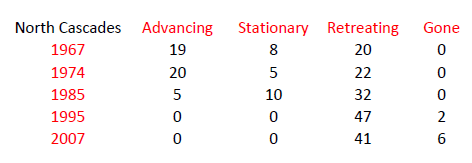
period. The final climate change was a step change in 1977 to a drier-warmer climate in the Pacific Northwest (Ebbesmeyer and others, 1991). The mean PNI from 1977-1998 was 0.53, even higher than the 1924-1944 period, indicating a warmer drier period that reestablished the ubiquitous retreat of North Cascade glaciers (Pelto, 1993). This change impacted glacier mass balance, alpine streamflow, and alpine snowpack (Ebbesmeyer and others, 1991). The impact on North Cascade glacier mass balance is evident from the USGS long-term record of South Cascade Glacier (1958-1998), where mean annual balance was –0.15 m/a from 1958-1976, in contrast to –1.00 m/a from 1977-1998 (Krimmel, 1999). The retreat and negative mass balances of the 1977-1998 period have been noted by Harper (1993), Krimmel (1994 and 1999), and Pelto (1993 and 1996). By 1984, all the Mount Baker glaciers, which were advancing in 1975, were again retreating (Pelto, 1993). In 1997-98, NCGCP measured the retreat of eight Mount Baker glaciers from their recent maximum position (late 1970’s-early 1980’s). The average retreat had been -197 m. All of the Mt. Baker termini are still in advance of their 1940 position as observed in photographs from J.B. Richardson, and observations by Austin Post (pers. comm.). However, the glacier region between the current terminus and 1940 terminus is nearly stagnant on each of the glaciers. Between 1979 and 1984, 35 of the 47 North Cascade glaciers observed annually by NCGCP had begun retreating. By 1992 all 47 glaciers termini observed by NCGCP were retreating (Pelto, 1993), and two had disappeared, Lewis Glacier and Milk Lake Glacier. INITIAL
TERMINUS RESPONSE The time between the onset of a mass balance change and the onset of a significant change in terminus behavior is called the initial terminus response time or reaction time (Ts). As indicate previously Ts is a descriptive quantity that quantifies the time lag between climate forcing and terminus response for a particular climate event, rather than a physical property of a glacier Ts in this study is based solely on the first observed terminus change from retreat to advance after 1944, and from advance to retreat after 1976. Ts has been identified from the response of North Cascade glaciers to the relative cooler and wetter weather beginning in 1944 (Hubley, 1956; Long 1955 and 1956; Tangborn, 1980), and to the subsequent warmer and drier conditions beginning in 1977 (Ebbesmeyer and others, 1991; Pelto, 1988; Pelto, 1993; Krimmel, 1994; Harper, 1993). Focusing on 21 North Cascade glaciers
that responded to these two climate shifTs, all having an area under 10 km2,
the initial terminus response invariably is less than 16 years (Pelto, 1993;
Hubley, 1956; Harper, 1993). Table
2 is a list of 21 North Cascade glaciers where Ts has been noted for both
advance and retreat for the post-1944 period by Hubley (1956), or Long (1955 and
1956). In each case the glaciers
were observed to be in retreat during the 1940’s, and subsequently each
advanced within 16 years of the climate change.
Table 2 also notes the response of the same glaciers from a period of
advance by each glacier in the early 1970’s to retreat by 1988, 12 years after
the climate change (Pelto, 1988 and 1993; Harper, 1993).
The observed Ts is not significantly different on individual
glaciers for initiation of advance, versus initiation of retreat.
Many North Cascade glaciers did not
respond to these two climatic changes. This
may be the result of a longer Ts, or as more likely is either due to an
ongoing retreat caused by continuing negative mass balances, or that climate
change was insufficient to substantially alter mass balance on these glaciers. ANALYSIS
AND CLASSIFICATION OF THE RESPONSE OF THE GLACIERS The 38 North Cascade glaciers, where the terminus history has been determined for the 1890-1998 period exhibit three distinct patterns (Table 3): 1) Retreat from 1890 to 1950 then a period of advance from 1950-1976, followed by retreat since 1976. 2) Rapid retreat from 1890 to approximately 1950, slow retreat or equilibrium from 1950-1976 and moderate to rapid retreat since 1976. 3) Continuous retreat from the 1890 to the present. Distinction of a glacier’s Type is based solely on iTs terminus behavior in this analysis. TYPE
1 GLACIERS
From 1890-1946 a retreat of at least 1000 m occurred on each of the
significant glaciers (over 1.0km2) on Mt. Baker and Glacier Peak.
Each of these glaciers is a Type 1 glacier: Mazama, Rainbow, Easton,
Squak, Talum and Boulder Glacier on Mt. Baker and, Ermine, Dusty, N. Guardian,
Kennedy, Scimitar, Ptarmigan and Vista Glacier on Glacier Peak are used in this
study. The two strato-volcanoes,
Glacier Peak and Mt. Baker are the highest peaks in the North Cascades.
The ability to advance was not limited to the high elevation glaciers of
the two large volcanoes, as this advance was also noted on other North Cascade
glaciers Ladder Creek, Challenger, Quien Sabe, Lower Curtis, Sulphide and N.
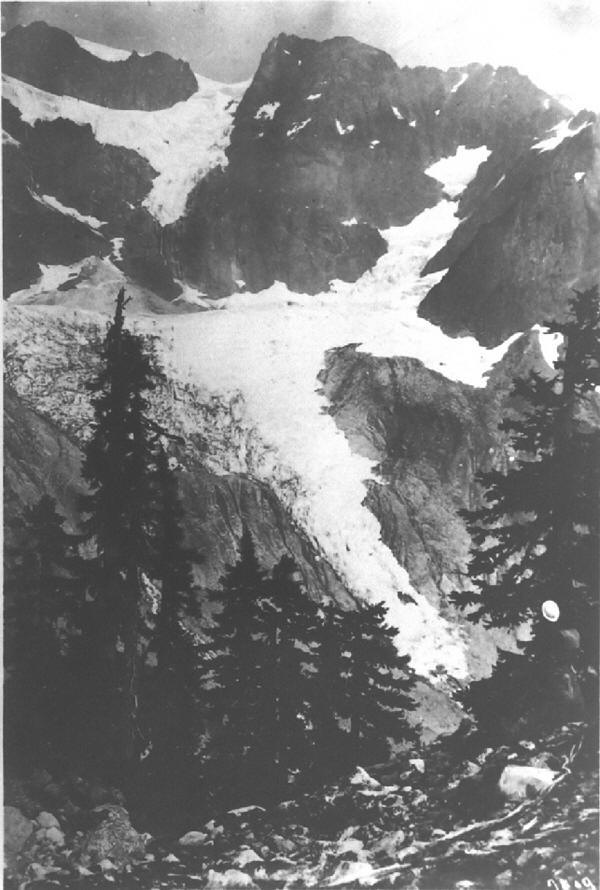
Klawatti Glacier (Hubley, 1956). Even in 1940 at the height of retreat
Type 1 glaciers were extensively crevassed and quite active in the photographs
taken by William Long and J.B. Richardson of the National Forest Service (Figure
2). Today despite moderate to
rapid retreat rates of 10-30m/a, all Type 1 glaciers remain extensively
crevassed.
Each Type 1 glacier was still retreating appreciably in 1940 but had
approached close enough to equilibrium that the climate shift beginning in 1944,
indicated by a decrease of the mean PNI of approximately 1, brought about a
rapid change from retreating to advancing conditions (Hubley, 1956).
The 50 years of continuous retreat reflects Type 1 glacier response to
the initial climate shift in approximately 1890, the progressive warming during
the 1895-1923 period, and the warmth of the 1924-1944 period (Long, 1955 and
Burbank, 1981). None of the glaciers had achieved a full adjustment by 1940,
but certainly seemed to be approaching it, suggesting that Tm is in the
20-30 year range for Type 1 glaciers. Similarly by 1976 advance had brought
these glaciers close enough to equilibrium, as evidenced by the slow rate of
terminus change (Harper, 1993), that the modest (10%) recent decline in winter
precipitation and rise in summer temperature (1.1oC) resulted in
glacier retreat (Pelto, 1993 and 1996; Harper, 1993). This again indicates that Tm is in the range of 20-30
years. It must be acknowledged that
these glaciers became smaller since the post Little Ice Age warming, and Tm
should therefore be shorter. TYPE
2 GLACIERS
Each of these glaciers retreated substantially from 1890-1950, followed
by nearly stable terminus positions between 1955 and 1979, and an increasing
retreat rate since 1984. Type 2
glaciers in this study are Columbia, Watson, Cache Col, Yawning, Sahale, Neve,
Ice Worm and Suiattle Glacier. The
maximum retreat or advance of this group was less than 30 m from 1955-1984.
Since 1984 the retreat rate has been increasing for this group of
glaciers, average retreat for the 1992-1998 period was 8 m/a.
In 1998 the retreat rate remains modest as the glaciers still seem to be
adjusting slowly to climate change. An increase in crevassing was noted on
the Neve, Yawning and Suiattle Glacier in 1955, but little or no advance
occurred, though the retreat did end in the early 1970’s on these three
glaciers. This suggests that that
the climate change was insufficient to generate an advance, but did manage to
halt the ongoing retreat. After continuously retreating from
1890-1950 the Type 2 glaciers had not approached close enough to equilibrium for
the 1944 climate shift to stop retreat initially. This suggests that Tm for Type 2 glaciers is on the
order of 40-60 years, since each glacier termini was close to equilibrium after
the 1944 climate change, but had not yet attained equilibrium due to the 1890
climate change. Exponential
filtering of the PNI index also indicates that a response time in this range is
required to approximately halt the retreat in the period 1944-1976 (Johannesson,
personal communication). TYPE
3 GLACIERS
This group includes South Cascade, Honeycomb, Foss, Hinman, Milk Lake,
Lyman, Whitechuck, White River, Lewis, Sholes and Colonial Glacier.
Each of these glaciers has retreated continuously throughout this
century. The most rapid retreat
period has varied; however, each glacier retreated more than 100 m between 1950
and 1979 and thinned aprreciably, when many North Cascade glaciers were
advancing or in equilibrium (Hubley, 1956; Meier and Post, 1962).
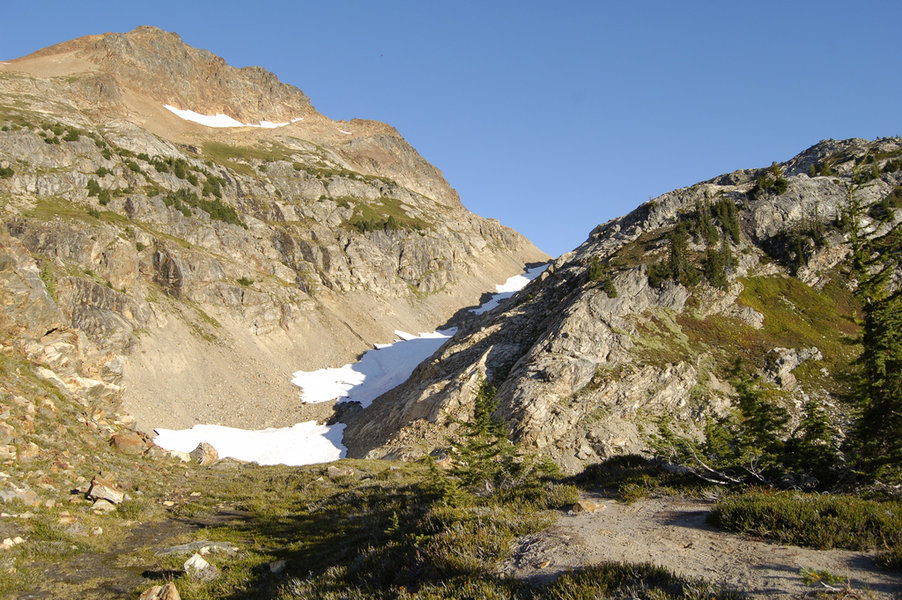
Type 3 glaciers all have a low slope,
limited crevassing and in general low velocities for their respective size.
South Cascade Glacier is a typical Type 3 glacier.
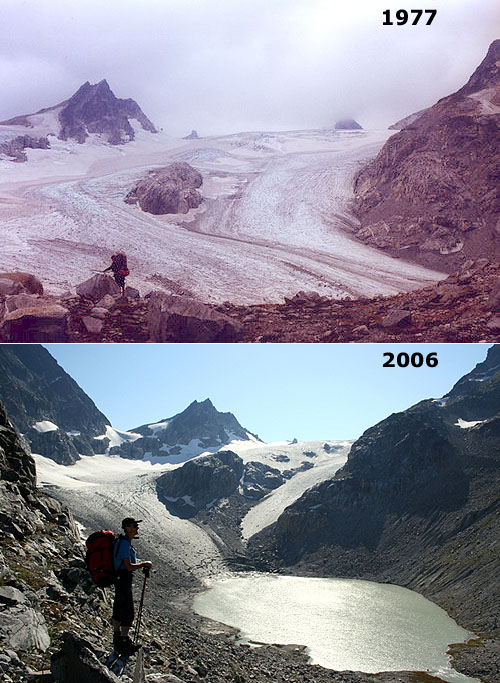
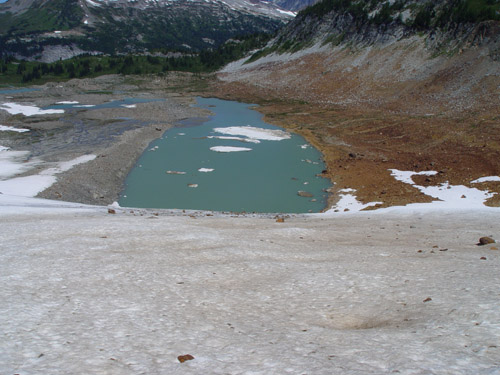
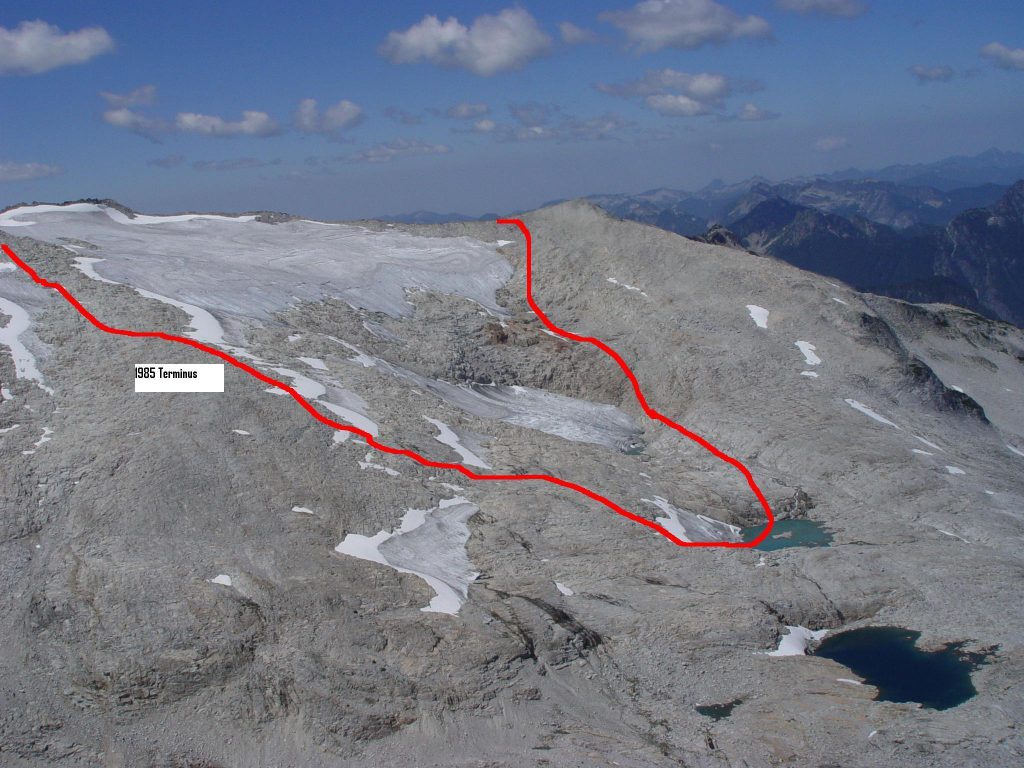
Lyman, Hinman, Foss and Colonial Glacier have each lost more than 50% of
their area in the last 50 years (Figure 4).
Of these four only Lyman Glacier is still moving at a detectable rate.
The others three had continuously negative mass balances and will
disappear with our current climate. None of the Type 3 glaciers has neared a
post LIA equilibrium. The disappearance of two glaciers in
this group, Lewis Glacier in 1989 and Milk Lake Glacier in 1993, illustrates
that after nearly 150 years of adjustment these glaciers still had failed and
did fail to achieve a new equilibrium. That
none of the glaciers had achieved equilibrium by 1975, after 85 years of
retreat, indicates a Tm of at least 60-100 years for Type 3 glaciers.
The complete melting away of Hinman and Foss Glacier may take another 50
years despite their small size.
South Cascade Glacier is the most studied glacier in the North Cascades.
The USGS has monitored the mass balance since 1952.
The mass balance trend through time indicates that from 1958-1976 mean
annual balance was –0.15 m/a (Krimmel, 1999).
The 1945-1975 period of more positive mass balance that generated advance
for many North Cascade glaciers, resulted only in smaller negative balances, but
a significant ongoing retreat (Krimmel,
1996). From 1977-1998 mean annual
balance on South Cascade Glacier was –1.0 m/a (Krimmel, 1999), and retreat has
been rapid. During the
1940-1998 period for which terminus observations exist, South Cascade Glacier
has not approached equilibrium.
None of the Type 3 glaciers has approached a steady state since the end
of the LIA regardless of the fluctuations in mass balance and the low values of
the proxy forcing function PNI from 1945-1976.
Type 3 glaciers are still adjusting in part to the post Little Ice Age
climate change, which has been reinforced by recent warming. It therefore, seems
likely that Type 3 glaciers and South Cascade Glacier are still adjusting to the
post LIA warming after a century of retreat and that Tm is at least 75 years. CHARACTERISTICS
OF GLACIER TYPES Each of the three glacier types was
established based solely on terminus behavior history; however, it is apparent
that each type has specific characteristics (Figure 2-5).
Figure 6 illustrates the different terminus behavior history
of North Cascade glaciers. The
slower initial response to climate change of Type 3 glaciers is evident.
The long-term result of the slow start is a more persistent retreat.
Table 3, lists the mean slope, mean
altitude and area of each glacier of the 38 glaciers.
Mass balance measurements in the accumulation zone exist for 12 of the
glaciers in this study. Type
1 glaciers have the highest mean elevations (2200 m), largest mean slope (0.42, +0.07),
highest measured mean accumulation (Pelto, 1988; 1996), most extensive
crevassing and highest measured terminus region velocity (20 m/a, + 3 m/a
). Type 3 glaciers have the lowest
slopes (0.23, +0.06), least crevassing, and lowest mean terminus velocity
(5 m/a, + 3 m/a) of any of the glacier types.
Type 2 glaciers have on average, a lower slope (0.35, +0.08), a
lower terminus region velocity (7 m/a, +4 m/a), less crevassing, and a
lower mean accumulation rate than Type 1 glaciers (Figure 3).
There is no significant relation
between aspect and glacier type. A
larger mean slope, higher accumulation rates, more extensive and higher velocity
either reflect or lead to increased glaciers velocities and longitudinal strain
rates. The greater the
longitudinal strain rate the faster the glacier can adjust to changing climate
conditions (Paterson, 1994). The
terminus region velocities on large alpine glaciers may be quite independent of
glacier velocity as a whole. On the
smaller North Cascade glaciers the terminus region velocity is, on the other
hand, a good indicator of mean glacier velocity.
The three glacier types illustrate that persistent differences in glacier
behavior are explainable based on the basic characteristics of the glacier which
in turn determine response time, and not unique to specific glaciers.
This is reinforced by the exceptionally high degree of correlation in
annual balance between North Cascade glaciers (Pelto, 1997).
The lowest cross correlation value for annual balance, between any pair
of nine glaciers observed by the USGS and NCGCP, is 0.79.
The different behavior of adjacent glacier termini based on differing topographic characteristics in the North Cascades was observed on S. Klawatti and N. Klawatti Glacier (Tangborn and others, 1990). From 1947-1961 N. Klawatti Glacier lost a volume equivalent to a mean thickness of 8.3m, continuing its ongoing retreat. S. Klawatti Glacier gained a thickness equivalent to a mean thickening of 5.8 m (Tangborn and others, 1990). This is not an unusual case in the North Cascades. Based on the classification of glacier type in this study S. Klawatti is a Type 1 glacier and N. Klawatti a Type 3 glacier. The difference in the degree of crevassing alone indicates a notable difference in flow. The adjacent glaciers differing responses fit the overall pattern for glaciers of their respective types in the North Cascades, and are not an anomalous case. We identified no important microclimatic effects that created differing mass balance conditions on glaciers across the North Cascades (Pelto, 1996 and 1997). An even more poignant example is that of the Neve and Ladder Creek Glacier, which share the same accumulation zone and have termini that both end at approximately 1680 m. The shared accumulation zone between 2000 m and 2400 m flows into a pass at 2000 m where the glacier turns both east and west. The Ladder Creek Glacier flows northwest and is a Type 1 glacier and has a steep, shorter terminus, 1200 m to terminus from the pass, comparatively rapid velocity, and was noted to advance by Hubley (1956). Neve Glacier is a Type 2 glacier, it is slightly larger than the Ladder Creek Glacier and has a longer terminus region, 1920 m from the pass. This results in a gentler slope and consequently slower velocity. This glacier did not advance, though crevassing did increase within 500 m of the terminus slowing the retreat to a standstill. Observation of different responses of glacier types to a climate change is not unique to the North Cascades. In Switzerland a sample of 38 glaciers with 150 year long terminus records was classified into, four different classes, with different types of terminus responses for each glacier class (Herren and others, 1999): 1) Large valley glacier such as the Gornergletscher which has retreated rapidly and continuously. 2) Small mountain glaciers such as the Saleina, which has advanced twice during this century, though retreat has been more pronounced. 3) Large mountain glaciers, such as the Tschierva, which follow the same pattern as Saleina except with more significant retreat. 4) Small cirque glaciers, such as the Gran Plan Neve, which has retreated slowly throughout the century. THEORETICAL
ESTIMATES OF RESPONSE TIME A primary difficulty in the identification of Tm is that after a climate change climate conditions do not reach a new steady state for periods comparable to the Tm of glaciers. Each glacier is then adjusting to the continually changing climate conditions and never achieves a steady state, due to the non-steady state climate (Schwitter and Raymond, 1993). Schwitter and Raymond (1993) noted that these difficulties are minimized with regard to changes from the LIAM to the present, since the basic climate change since the late 1800’s has been from a LIA climate favorable to glaciers and a post LIA climate unfavorable for glaciers. Changes in North Cascade terminus behavior and glacier thickness from the LIAM to the present are large compared to changes in response to more recent climate changes (Schwittter and Raymond, 1993). The
observed terminus record of North Cascade glaciers indicates a range of Tm
from 20 to 30 years on Type 1 glaciers, approximately 40-60 years on Type 2
glaciers, and a minimum of 60-100 years on Type 3 glaciers.
How do these values compare to those
calculated from the equations of Johannesson and others (1989).
Johannesson and others (1989),
compared two means of calculating Tm: Tm=f L /u(t)
(1)
and
Tm=h/-b(t)
(2) Tm
in these equations is potentially dependent on four variables: L the
glacier length, u(t) velocity of the glacier at the terminus, h
the thickness of the glacier, and b(t) the net annual balance at the
terminus. The former equation,
which was proposed by Nye (1960), produces longer full response times of 100 to
1000 years, the latter full response times of 10 to 100 years (Johannesson and
others, 1989). The variable f
is a shape factor that is the ratio between the changes in thickness at the
terminus to the changes in the thickness at the glacier head (Schwitter and
Raymond, 1993). Similar changes in
ice thickness will yield a value of f= 1, f=0.5 corresponds to a
linear decrease of thickness change from a maximum at the terminus to zero at
the head. The mean value of f has been determined as 0.3 (Schwitter and
Raymond, 1993), and this value of f
is applied. This equation is
quite sensitive to terminus velocity, which is often spatially inconsistent.
Table 4 displays the variables used in
determining Tm for 17 North Cascade glaciers, the calculated Tm
from equation 1, and Tm from equation 2. Each variable, except h, has been observed on each
glacier by the USGS (South Cascade
Glacier) or NCGCP.
It is evident that equation 2 yields values that are lower than the
estimates of Tm for North
Cascade glaciers of Types 2 and 3 glaciers, but the difference is smaller for
Type 1 glaciers. Equation 1
overestimates Tm and because of the wide spatial variability of u(t),
it is not expected to yield a consistently accurate result on alpine glaciers.
South Cascade Glacier, like
all Type 3 glaciers, is still adjusting to post LIA warming and the
discontinuous but progressive warming of this century.
This is not unique to the North Cascades, many alpine glaciers have not
yet fully adjusted to post LIA warming. The
Ptarmigan and Lemon Creek Glacier, Alaska; Gornergletsher and Rhonegletscher in
Switzerland; Athabasca Glacier, Canada, and in the Darwin Cordillera, Chile
several glaciers have retreated continuously during this century (Marcus and
others, 1995; Herren and others, 1999; Holmund and Fuenzalida, 1995). CONCLUSIONS
North Cascade glaciers had a varied terminal response to the 1944 climate
change, with only Type 1 glaciers advancing.
Based on this study, the failure of Type 2 and Type 3 glaciers to advance
is a function of their incomplete adjustment to the post LIA progressive
warming. Thus, they were still
significantly out of equilibrium in 1944, after approximately a half-century of
retreat (Burbank, 1981), and the modest positive mass balances did not trigger a
glacier advance. Pelto (1996) noted
the high cross correlation in observed annual balance on North Cascade glaciers
(Figure 7). This similarity
is true regardless of glacier type. This
is evidence that microclimates are not the key to differences in behavior.
Instead it is the physical characteristics slope, terminus velocity,
thickness, and accumulation rate of the glacier that determines its recent
terminus behavior and response time. An example is the adjacent N, Klawatti and S. Klawatti
Glaciers. S. Klawatti advanced in
the 1950-1975 interval and N. Klawatti continued to retreat.
The glaciers have different area-altitude distributions, to which
Tangborn and others (1990) attributed the differential terminus response.
However, the different area-altitude distribution is both a result of
slower response and a reflection of the differing topographic setting. Porter (1986) noted that many alpine
glaciers experienced nearly synchronous reversals in terminus behavior around
1950. This change in glacier
terminus behavior prompted Johannesson and others (1989) to suggest that, alpine
glacier behavior is dominated by short-term climate effects. In the North Cascades, this synchronous reversal to
advance and later to retreat of only Type 1 glaciers indicates that in the North
Cascades only glaciers close to equilibrium had a reversal in terminus behavior
due to the short-term climate effects. Glacier
termini such as the Honeycomb, Lyman, Columbia, Milk Lake, and South Cascade
Glacier were only modestly affected by the recent short-term climate changes in
the North Cascades. North Cascade glaciers occupy an
exceptionally temperate maritime climate for glaciers.
Ts on North Cascade glaciers are short (Hubley, 1956), ranging
from 4-16 years in response to both positive negative mass balance changes. Tm
varies considerably even between similarly sized glaciers in this region.
The key variables that decrease Tm are factors that increase mean
glacier velocity, accumulation rates and glacier slopes in particular.
The response times of 30-100 years for most of these small glaciers
indicates that with a substantial climate change the initial response may be
rapid, but full adjustment is not rapid in the North Cascade Range.
ACKNOWLEDGEMENTS
The comments of Roger LeB Hooke, M. Hoelzle, W. Haeberli, T. Johannesson,
M. Sturm and J.G. Cogley have been most helpful.
The USGS maps and photographs provided by Austin Post and David Hirst
were essential to this project. The
fine ongoing research initiated by Mark Meier and currently guided by Robert
Krimmel of the USGS on South Cascade Glacier provided essential long-term data.
|
Table 3 OBSERVATIONS OF COMPLETE RESPONSE TIME
| 1850-1950 | 1950-1979 | 1980-1998 | |||
| Mazama | 0.44 | -2350 | 450 | -117 | 2200 |
| Rainbow | 0.37 | -1370 | 512 | -148 | 1850 |
| Easton | 0.35 | -2420 | 608 | -97 | 2250 |
| Squak | 0.45 | -2500 | 305 | -160 | 2350 |
| Talum | 0.55 | -1975 | 275 | -161 | 2400 |
| Boulder | 0.5 | -2560 | 743 | -143 | 2350 |
| Ermine | 0.46 | -1800 | 170 | -108 | 2400 |
| Dusty | 0.42 | -1800 | 280 | -218 | 2350 |
| N. Guardian | 0.43 | -1550 | 160 | -120 | 2400 |
| Kennedy | 0.48 | -1700 | 330 | -151 | 2100 |
| Scimitar | 0.46 | -1600 | 350 | -98 | 2100 |
| Ptarmigan | 0.5 | -1050 | 75 | -39 | 2250 |
| Vista | 0.28 | -1900 | 105 | -105 | 2150 |
| Quien Sabe | 0.4 | -1250 | 55 | -89 | 2350 |
| Lower Curtis | 0.36 | -645 | 225 | -82 | 1650 |
| Ladder Creek | 0.31 | -1230 | 105 | -52 | 2100 |
| Sulphide | 0.38 | -1775 | 210 | -101 | 2100 |
| TYPE 2 | |||||
| Cache Col | 0.46 | -360 | -25 | -46 | 1950 |
| Columbia | 0.18 | -560 | -15 | -70 | 1600 |
| Watson | 0.4 | -320 | -21 | -55 | 1650 |
| Neve | 0.24 | -720 | -25 | -48 | 2150 |
| Sahale | 0.5 | -260 | -12 | -53 | 2400 |
| Sholes | 0.3 | -1170 | -57 | -50 | 1850 |
| Yawning | 0.39 | -310 | 35 | -31 | 1850 |
| Lynch | 0.36 | -160 | -390 | -88 | 2150 |
| Ice Worm | 0.33 | -925 | 0 | -55 | 2150 |
| Daniels | 0.5 | -960 | -20 | -121 | 2200 |
| White River | 0.2 | -780 | -140 | -98 | 2200 |
| Suiattle | 0.3 | -2400 | 15 | -23 | 2100 |
| TYPE 3 | |||||
| Lewis | 0.25 | -65 | -80 | -182 * | 2100 |
| Colonial | 0.27 | -230 | -81 | -52 | 2000 |
| Lyman | 0.23 | -1020 | -408 | -113 | 2000 |
| Foss | 0.36 | -975 | -86 | -112 | 2050 |
| Hinman | 0.21 | -410 | -300 | -711 | 1950 |
| S. Cascade | 0.17 | -1800 | -350 | -295 | 1900 |
| White Chuck | 0.22 | -1300 | -330 | -170 | 2150 |
| Honeycomb | 0.17 | -1750 | -290 | -338 | 2250 |
| Milk Lake | 0.17 | -400 | -190 | -210* | 1900
|
Advance Retreat
Glacier
Observed Observed
Coleman
1949
1979
Easton
1960
1989
Deming
1955
1986
Boulder
1954
1985
Squak
1955
1985
Rainbow
1955
1985
Kennedy
1955
1986
Chocolate
1950
1986
N. Guardian
1955
1986
Dusty
1955
1986
Ptarmigan
1960
1988
Vista
1960
1988
Ermine
1955
1986
Ladder Creek
1955
1987
Eldorado
1955
1984
Quien Sabe
1955
1984
Yawning
1955
1986
Lower Curtis
1955
1987
Challenger
1955
1985
Price
1954
1987
Chimney Rock 1955
1987
Table 2. Date of first
observed advance following the 1944
climate change. Date of the
first observed retreat following
the climate change
in 1976-77.
Table 4. The Termius Response time Calculations for North Cascade
Glaciers
| Glacier | l | u(l) | h | b(l) | ^l | Tm1a | Tm1b | Tm2 | Tmo |
| Colonial | 1.5 | 0.003 | 50 | -4.5 | -0.31 | 167 | 250 | 11 | 150+ |
| Columbia | 1.6 | 0.004 | 100 | -4.5 | -0.61 | 133 | 200 | 22 | 150+ |
| Daniels | 0.8 | 0.009 | 50 | -4 | -0.96 | 30 | 45 | 12 | 100 |
| Easton | 4 | 0.024 | 75 | -6.5 | -2.42 | 55 | 83 | 12 | 100 |
| Foss | 1 | 0.004 | 50 | -4.5 | -1.06 | 83 | 125 | 11 | 150 |
| Honeycomb | 4.4 | 0.006 | 100 | -6 | 2.36 | 244 | 366 | 16 | 150+ |
| Ice Worm | 0.5 | 0.002 | 50 | -4 | -0.93 | 83 | 125 | 12 | 100 |
| Kennedy | 2.4 | 0.02 | 100 | -6 | -1.6 | 40 | 60 | 16 | 100 |
| Ladder Creek | 2.6 | 0.025 | 100 | -5 | -1.23 | 35 | 52 | 20 | 100 |
| Lewis | 0.3 | 0.001 | 25 | -2 | -0.28 | 100 | 150 | 12 | 150 |
| Lower Curtis | 1.8 | 0.02 | 100 | -5.5 | -0.54 | 30 | 45 | 18 | 100 |
| Lyman | 0.6 | 0.005 | 50 | -5 | -1.43 | 40 | 60 | 10 | 150+ |
| Lynch | 1.2 | 0.012 | 100 | -4 | -0.45 | 33 | 50 | 25 | 150+ |
| Neve | 3.5 | 0.008 | 100 | -4.5 | -0.8 | 146 | 220 | 22 | 100 |
| Rainbow | 2.7 | 0.015 | 100 | -5 | -1.37 | 60 | 90 | 20 | 100 |
| South Cascade | 3.1 | 0.008 | 80 | -6 | 1.5 | 129 | 193 | 13 | 150+ |
| Yawning | 0.8 | 0.005 | 50 | -4 | -0.31 | 53 | 80 | 12 | 100 |
|
REFERENCES Aellen, M. 1986. Les
variation recentes des glaciers des Alpes Suisses.
Geografia Dinamica Quaternaire 8, 73-82. Armstrong, R.A. 1989. Mass
balance history of the Blue Glacier, Washington. In, Oerlemans, J. Glacier Fluctuations and Climate Change.
Kluwer Academic, London, 193-203. Burbank, D.W. 1981. A
chronology of late holocene glacier fluctuations on Mt. Rainier. Arctic and Alpine Res., 13, 369-386. Davis, P.T. 1988. Holocene
glacier fluctuations in the American Cordillera. Quaternary Science Reviews, 7, 129-157. Dreidger, C.L., and P.M. Kennard. 1986.
Ice volumes on Cascade Volcanoes. USGS
Prof. Paper, 1365. Ebbesmeyer, C.C., D.R. Cayan, D.R. McLain, F.H. Nichols, D.H. Peterson,
and K.T. Redmond. 1991. 1976 step
in the Pacific Climate: Forty environmental changes between 1968-1975 and
1976-1984. In Betancourt, J.L. and
Tharp, V.L., Proc. On the 7th Annual Pacific Climate Workshop, 129-141. Harper, J.T. 1993. Glacier
terminus fluctuations on Mt. Baker, Washington, USA, 1940-1980, and climate
variations. Arctic and Alpine Res,
. Harrsion, A.E. 1960.
Exploring Glaciers- with a camera. Sierra
Club, San Francisco. Heikkinen, A. 1984. Dendrochronological
evidence of variation of Coleman Glacier, Mt. Baker, Washington.
Arctic and Alpine Res., 16, 53-54. Heusser, C.J. and M.G. Marcus. 1964.
Surface movement, hydrological change and equilibrium flow of Lemon Creek
Glacier, Alaska. J. Glaciol.,
5(37), 61-75. Holmund, P. and H. Fuenzelida., 1995.
Anomalous glacier responses and 20th century climatic changes in Darwin
Cordillera, southern Chile. J.
Glaciol., 41(139), 465-473. Hubley, R.C. 1957. Glaciers of Washington's Cascades and Olympic
Mountains: Their present activity and its relation to local climatic trends.
J. Glaciol., 2(19), 669-674. Johannesson, T., C. Raymond, and E. Waddington. 1989.
Time-scale for adjustment of glacier to changes in mass balance.
J. Glaciol., 35(121), 355-369. Krimmel, R.M. 1996. “Water, ice and meteorological measurements at South
Cascade Glacier, WA 1995 balance year. USGS
OFR-96-4174. Long, W.A. 1955. What’s
happening to our glaciers. The
Scientific Monthly, 81, 57-64. Long, W.A. 1956. Present
growth and advance of Boulder Glacier, Mt. Baker.
The Scientific Monthly, 83, 1-2. Meier, M.F. and Post, A. 1962. Recent
variations in mass net budgets of glaciers in western North America.
IAHS 58, 63-77. Meier, M.F. and W.V. Tangborn 1965. Net
budget and flow of South Cascade Glacier, Washington.
J. Glaciol., 5(41)., 547-566. Paterson, W.S.B., 1981. Physics
of Glaciers, second edition. Pergamon Press, Oxford, UK. Pelto, M.S. 1988. The annual balance of North Cascade, Washington Glaciers
measured and predicted using an activity index method.
J. Glaciol., 34, 194-200. Pelto, M.S. 1993. Current behavior of glaciers in the North Cascades and
its effect on regional water supply. Washington
Geology, 21(2), 3-10. Pelto, M.S. 1996. Annual
balance of North Cascade glaciers 1984-1994.
J. Glaciol., 41, 3-9. Porter, S.C. 1986.
Pattern and forcing of Northern Hemisphere glacier variations during the
last millennium. Quaternary Res.,
26, 27-48. Post, A., D.Richardson, W.V. Tangborn, and F.L. Rosselot. 1971. Inventory
of glaciers in the North Cascades,Washington. US Geological Survey Prof. Paper,
705-A Rusk, C.E. 1924.
Tales of a Western Mountaineer. Houghton
Mifflin Co., New York. Schwitter, M.P., and C.Raymond. 1993.
Changes in the longitudinal profile of glaciers during advance and
retreat. J. Glaciol, 39(133),
582-590. Tangborn, W. V., 1980. Two models for estimating climate-glacier
relationships in the North Cascades, Washington, USA. J.Glaciol., 25, 3-21. Tangborn, W.V., A.G. Fountain and W.G. Sikonia, 1990.
Effect of area distribution with altitude on glacier mass balance- a comparison of the North and South Klawatti glaciers, Washington State, USA. Ann. Glaciol. 14, 278-282.
|